Environment: milieu / climate zone / depth range / distribution range
Ecology
Marine; reef-associated; depth range 5 - 40 m (Ref. 90102). Tropical
Indo-West Pacific: Madagascar to Indonesia and Australia (Ref. 2334, 3131).
Size / Weight / Age
Maturity: Lm ? range ? - ? cm
Max length : 65.0 cm SL male/unsexed; (Ref. 48637)
Dorsal
spines
(total): 6 - 7;
Dorsal
soft rays
(total): 28-31;
Anal
spines: 3;
Anal
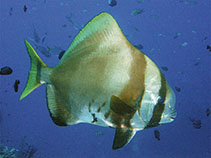
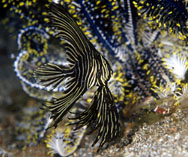
soft rays: 19 - 23. Adults (above 40 cm) silvery, with dark bar through eye and another (faint) bar just behind head. Fins dusky. Small juveniles black, vertical white lines on body and fins. Subadults brown, with black bar from nape, over eye to chest and another black bar from dorsal-fin origin, over pectoral fins to pelvic fins, pectoral and pelvic fins dark brown or black. Body orbicular and strongly compressed, its depth more than twice length of head and 1.1 to 1.9 times in SL. Snout profile of large adults (above 40 cm) concave, with prominent bony swelling between eyes. Jaws with bands of slender, flattened, tricuspid teeth, the middle cusp 3 to 4 times longer than lateral cusps. Vomer with a band of strong teeth, no teeth on palatines. Five pores on each side of lower jaw. Preopercle smooth. Opercle without spines (Ref 43039).
Inhabits continental reefs (Ref. 9710). Adults usually moderately deep on open substrates with sparse reef or coral heads. A solitary species, but occasionally in pairs or small groups. Small juveniles also in deep water and the zebra-pattern serves well as camouflage when sheltering with crinoids (Ref. 48637). Juveniles in shore waters; adults in deeper water.
Life cycle and mating behavior
Maturity | Reproduction | Spawning | Eggs | Fecundity | Larvae
Sainsbury, K.J., P.J. Kailola and G.G. Leyland, 1985. Continental shelf fishes of the northern and north-western Australia. An illustrated guide. CSIRO Division of Fisheries Research; Clouston & Hall and Peter Pownall Fisheries Information Service, Canberra, Australia. 375 p. (Ref. 3131)
IUCN Red List Status (Ref. 130435)
Threat to humans
Harmless
Human uses
Aquarium: commercial
More information
Common namesSynonymsMetabolismPredatorsEcotoxicologyReproductionMaturitySpawningSpawning aggregationFecundityEggsEgg development
ReferencesAquacultureAquaculture profileStrainsGeneticsElectrophoresesHeritabilityDiseasesProcessingNutrientsMass conversion
Tools
Special reports
Download XML
Internet sources
Estimates based on models
Preferred temperature (Ref.
123201): 25.1 - 29, mean 27.9 °C (based on 558 cells).
Phylogenetic diversity index (Ref.
82804): PD
50 = 0.5313 [Uniqueness, from 0.5 = low to 2.0 = high].
Bayesian length-weight: a=0.02692 (0.01137 - 0.06373), b=2.94 (2.74 - 3.14), in cm total length, based on LWR estimates for this (Sub)family-body shape (Ref.
93245).
Trophic level (Ref.
69278): 3.5 ±0.37 se; based on food items.
Resilience (Ref.
120179): Low, minimum population doubling time 4.5 - 14 years (Preliminary K or Fecundity.).
Fishing Vulnerability (Ref.
59153): Moderate to high vulnerability (52 of 100).
Nutrients (Ref.
124155): Calcium = 31.7 [16.8, 52.8] mg/100g; Iron = 0.472 [0.288, 0.735] mg/100g; Protein = 18.8 [17.6, 19.9] %; Omega3 = 0.0935 [, ] g/100g; Selenium = 36.6 [20.8, 64.8] μg/100g; VitaminA = 45.6 [13.6, 147.6] μg/100g; Zinc = 0.924 [0.657, 1.303] mg/100g (wet weight);