Teleostei (teleosts) >
Centrarchiformes (Basses) >
Kyphosidae (Sea chubs)
Etymology: Kyphosus: Greek, kyphos = bent (Ref. 45335); sectatrix: Named for its distributional range, restricted to Atlantic Ocean..
More on author: Linnaeus.
Issue
Regarded as nomina dubia by Sakai & Nakabo, 2014 (Ref. 95333). See explanation of the correct name choice to Kyphosus sectatrix (Linnaeus, 1758) versus saltatrix in Eschmeyer (CofF ver. Oct. 2012: Ref. 92135).
Environment: milieu / climate zone / depth range / distribution range
Ecology
Marine; reef-associated; depth range 1 - 30 m (Ref. 9626), usually 1 - 10 m (Ref. 40849). Subtropical; 46°N - 29°S, 98°W - 16°E
Circumglobal.
Size / Weight / Age
Maturity: Lm ? range ? - ? cm
Max length : 76.0 cm TL male/unsexed; (Ref. 5288); common length : 50.0 cm TL male/unsexed; (Ref. 3397); max. published weight: 6.0 kg (Ref. 40637)
Dorsal
spines
(total): 11;
Dorsal
soft rays
(total): 11-12;
Anal
spines: 3;
Anal
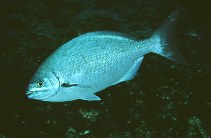
soft rays: 11. Gray overall, with faint yellow lines on side and yellow line from corner of mouth to preopercle (Ref. 26938). Upper part pf opercular membrane blackish. The young may display pale spots nearly as large as eye on the head, body and fins (Ref. 13442). Each jaw with a regular row of close-set, strong, incisor-like, round-tipped teeth of a peculiar hockey stick-shape, their bases set horizontally, resembling a radially striated bony plate inside mouth (Ref 52729).
Inhabits shallow waters, over turtle grass, sand or rocky bottom and around coral reefs (Ref. 3725). Young commonly found among floating Sargassum seaweeds (Ref. 3725). Feeds on plants, mainly on benthic algae, as well as on small crabs and mollusks (Ref. 6547, 44187). Also feeds on spinner dolphins’ feces and vomits at Fernando de Noronha Archipelago, southeast Atlantic. The offal feeding may be regarded as a simple behavioral shift from plankton feeding to drifting offal picking (Ref. 48727). Marketed fresh (Ref. 3725).
Life cycle and mating behavior
Maturity | Reproduction | Spawning | Eggs | Fecundity | Larvae
Knudsen, S.W. and K.D. Clements, 2013. Revision of the fish family Kyphosidae (Teleostei: Perciformes). Zootaxa 3751(1):001-101. (Ref. 95491)
IUCN Red List Status (Ref. 130435)
Threat to humans
Harmless
Human uses
Fisheries: minor commercial; gamefish: yes; aquarium: public aquariums
More information
ReferencesAquacultureAquaculture profileStrainsGeneticsElectrophoresesHeritabilityDiseasesProcessingNutrientsMass conversion
Tools
Special reports
Download XML
Internet sources
Estimates based on models
Preferred temperature (Ref.
123201): 20.1 - 28, mean 27 °C (based on 1240 cells).
Phylogenetic diversity index (Ref.
82804): PD
50 = 0.5000 [Uniqueness, from 0.5 = low to 2.0 = high].
Bayesian length-weight: a=0.01445 (0.00624 - 0.03346), b=3.01 (2.81 - 3.21), in cm total length, based on LWR estimates for this (Sub)family-body shape (Ref.
93245).
Trophic level (Ref.
69278): 2.0 ±0.0 se; based on diet studies.
Resilience (Ref.
120179): Low, minimum population doubling time 4.5 - 14 years (Preliminary K or Fecundity.).
Fishing Vulnerability (Ref.
59153): Moderate to high vulnerability (50 of 100).
Climate Vulnerability (Ref.
125649): High to very high vulnerability (70 of 100).
Nutrients (Ref.
124155): Calcium = 24.6 [9.4, 39.5] mg/100g; Iron = 0.545 [0.304, 0.913] mg/100g; Protein = 19.3 [18.1, 20.5] %; Omega3 = 0.146 [0.081, 0.262] g/100g; Selenium = 17.6 [8.3, 38.5] μg/100g; VitaminA = 29.2 [7.6, 106.5] μg/100g; Zinc = 0.968 [0.639, 1.461] mg/100g (wet weight);