Teleostei (teleosts) >
Stomiiformes (Lightfishes and dragonfishes) >
Sternoptychidae (Marine hatchetfishes) > Sternoptychinae
Etymology: Argyropelecus: Greek, argyros = silvered, silver + Greek, pelekys = axe (Ref. 45335).
More on author: Garman.
Environment: milieu / climate zone / depth range / distribution range
Ecology
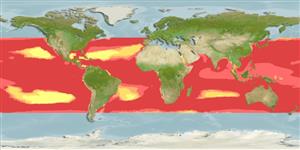
Marine; bathypelagic; oceanodromous (Ref. 51243); depth range 1 - 3872 m (Ref. 13608), usually 1 - 600 m (Ref. 35838). Deep-water; 45°N - 45°S, 180°W - 180°E
Eastern Atlantic: occasionally between Azores and Madeira (Ref. 4739), also from Senegal to Gulf of Guinea. Western Atlantic: 30°N-30°S, including the Gulf of Mexico (Ref. 27768). Northwest Atlantic: Canada (Ref. 5951). Indian Ocean: 20°N-20°S. Eastern Pacific: 35°N-35°S. Western Pacific: 30°N-10°S. South China Sea (Ref.74511).
Size / Weight / Age
Maturity: Lm ? range ? - ? cm
Max length : 8.4 cm SL male/unsexed; (Ref. 4462)
Dorsal
spines
(total): 0;
Dorsal
soft rays
(total): 8-9;
Anal
spines: 0;
Anal
soft rays: 12 - 14;
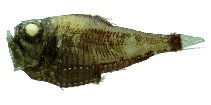
Vertebrae: 38 - 41. Scales deciduous; swim bladder well developed, gas-filled, euphysoclistous; branchiostegal rays 10, 3 on epihyal; post-abdominal spines (iliac) short, equal in length; abdominal keels shallow (Ref. 4739).
An oceanic and mesopelagic species (Ref. 4739, 58302), mainly at 300-650 m (Ref. 4054), 170-500 m at night and 350-600 m during day (Ref. 58302), commonly 1-600m (Ref. 035838). May make short diel migrations (Ref. 4739). Smaller individuals feed on copepods and ostracods; larger ones feed on euphausiids, salps and chaetognaths (Ref. 4739). Adult complement of photophores acquired at about 14 mm SL (Ref. 4739). Oviparous, with planktonic eggs and larvae (Ref. 35838).
Life cycle and mating behavior
Maturity | Reproduction | Spawning | Eggs | Fecundity | Larvae
Quéro, J.-C., J.C. Njock and M.M. de la Hoz, 1990. Sternoptychidae. p. 275-282. In J.C. Quero, J.C. Hureau, C. Karrer, A. Post and L. Saldanha (eds.) Check-list of the fishes of the eastern tropical Atlantic (CLOFETA). JNICT, Lisbon; SEI, Paris; and UNESCO, Paris. Vol. 1. (Ref. 4462)
IUCN Red List Status (Ref. 130435)
Threat to humans
Harmless
Human uses
Fisheries: of no interest
Tools
Special reports
Download XML
Internet sources
Estimates based on models
Preferred temperature (Ref.
123201): 9.2 - 28.9, mean 24.6 °C (based on 11134 cells).
Phylogenetic diversity index (Ref.
82804): PD
50 = 0.5078 [Uniqueness, from 0.5 = low to 2.0 = high].
Bayesian length-weight: a=0.01622 (0.00961 - 0.02738), b=2.97 (2.82 - 3.12), in cm total length, based on LWR estimates for this species & Genus-body shape (Ref.
93245).
Trophic level (Ref.
69278): 3.1 ±0.19 se; based on food items.
Generation time: 1.6 ( na - na) years. Estimated as median ln(3)/K based on 1
growth studies.
Resilience (Ref.
120179): High, minimum population doubling time less than 15 months (K=0.67).
Fishing Vulnerability (Ref.
59153): Low vulnerability (21 of 100).