Teleostei (teleosts) >
Syngnathiformes (Pipefishes and seahorses) >
Syngnathidae (Pipefishes and seahorses) > Syngnathinae
Etymology: Hippocampus: Greek, ippos = horse + Greek,kampe = curvature (Ref. 45335); denise: Named after Denise Tackett; noun in apposition..
More on authors: Lourie & Randall.
Environment: milieu / climate zone / depth range / distribution range
Ecology
Marine; reef-associated; non-migratory; depth range 7 - 100 m (Ref. 128812). Tropical
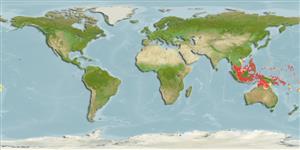
Indo-West Pacific: Indonesia to Vanuatu; north to the Philippines, south to northeast Australia.
Length at first maturity / Size / Weight / Age
Maturity: Lm 1.1 range ? - ? cm
Max length : 2.2 cm SL male/unsexed; (Ref. 47053); 2.4 cm SL (female)
Short description
Morphology | Morphometrics
Dorsal
soft rays
(total): 14. Color in life plain orange with slightly darker rings around tail; when preserved, pale orange with tiny dark brown flecks on the nape of the neck and all over in some specimens. Diminutive in size. Anal fin small or absent. Rings on trunk 12; on tail 28-29. Body fleshy with inferior and ventral trunk ridges reduced to separated cross-shaped spicules embedded in the skin. Nuchal plate rounded without a raised coronet. Snout length ca. 30% in HL. Head depth ca. 50% in HL. No spines above the eye. Trunk depth (between the 9th and 10th trunk rings) ca. 7% in SL (female) and 10-15% in SL (male). The angles of certain body ridges sometimes developed into rounded tubercles (distinctly fewer and less developed compared with H. bargibanti) (Ref. 47053).
Lives in association with gorgonian seafans (Annella reticulata, Muricella sp., and Echinogorgia sp.). Master of camouflage, with their coloration and body ornamentation in the form of tubercles, can match the stems and polyps of their gorgonian hosts (Ref. 47053). Ovoviviparous (Ref. 205). The male carries the eggs in a brood pouch which is found under the tail (Ref. 205).
Life cycle and mating behavior
Maturity | Reproduction | Spawning | Eggs | Fecundity | Larvae
Male carries the eggs in a brood pouch (Ref. 205).
Lourie, S.A., R.A. Pollom and S.J. Foster, 2016. A global revision of the seahorses Hippocampus Rafinesque 1810 (Actinopterygii: Syngnathiformes): taxonomy and biogeography with recommendations for further research. Zootaxa 4146(1):1-66. (Ref. 115213)
IUCN Red List Status (Ref. 130435)
Threat to humans
Harmless
Human uses
More information
Age/SizeGrowthLength-weightLength-lengthLength-frequenciesMorphometricsMorphologyLarvaeLarval dynamicsRecruitmentAbundanceBRUVS
ReferencesAquacultureAquaculture profileStrainsGeneticsElectrophoresesHeritabilityDiseasesProcessingNutrientsMass conversion
Tools
Special reports
Download XML
Internet sources
Estimates based on models
Preferred temperature (Ref.
123201): 26.2 - 28.5, mean 27.4 °C (based on 157 cells).
Phylogenetic diversity index (Ref.
82804): PD
50 = 0.5000 [Uniqueness, from 0.5 = low to 2.0 = high].
Bayesian length-weight: a=0.00447 (0.00177 - 0.01127), b=3.00 (2.78 - 3.22), in cm total length, based on LWR estimates for this (Sub)family-body shape (Ref.
93245).
Trophic level (Ref.
69278): 3.1 ±0.5 se; based on size and trophs of closest relatives
Resilience (Ref.
120179): High, minimum population doubling time less than 15 months (Preliminary K or Fecundity.).
Fishing Vulnerability (Ref.
59153): Low vulnerability (10 of 100).
Nutrients (Ref.
124155): Calcium = 708 [204, 5,752] mg/100g; Iron = 4.3 [1.0, 13.3] mg/100g; Protein = 17.2 [14.7, 19.6] %; Omega3 = 0.136 [0.018, 1.115] g/100g; Selenium = 154 [15, 1,179] μg/100g; VitaminA = 23.6 [1.4, 351.3] μg/100g; Zinc = 9.45 [3.10, 22.63] mg/100g (wet weight);