Teleostei (teleosts) >
Ovalentaria/misc (Various families in series Ovalentaria) >
Pomacentridae (Damselfishes) > Pomacentrinae
Etymology: Acanthochromis: Greek, akantha = thorn + Greek, chromis = a marine fish without identification, dealing with perch; cited by Plinius (Ref. 45335).
More on author: Bleeker.
Environment: milieu / climate zone / depth range / distribution range
Ecology
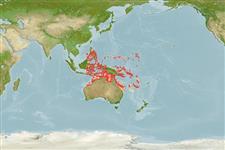
Marine; reef-associated; non-migratory; depth range 1 - 65 m (Ref. 9710), usually 4 - 20 m (Ref. 90102). Tropical; 15°N - 26°S, 116°E - 169°E (Ref. 56301)
Western Pacific: Indonesia and the Philippines to northeastern Australia and Melanesia.
Size / Weight / Age
Maturity: Lm ? range ? - ? cm
Max length : 16.0 cm TL male/unsexed; (Ref. 129178)
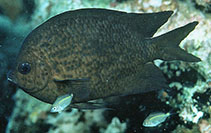
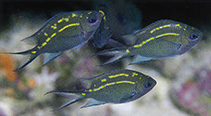
Adults inhabit inshore and offshore coral reefs (Ref. 9710). Also found in harbors, lagoons and outer reef slopes. The only pomacentrid species that lacks a pelagic larval stage. One of the very few marine fishes where fry are guarded by the parents (Ref. 9710, 48636). School as they grow and sub-adults are usually seen in small groups. Adults form pairs and are territorial when breeding (Ref. 48636). Monogamous (Ref. 52884). Oviparous (Ref. 205). Eggs are demersal and adhere to the substrate (Ref. 205). Males guard and aerate the eggs (Ref. 205).
Life cycle and mating behavior
Maturity | Reproduction | Spawning | Eggs | Fecundity | Larvae
Oviparous, distinct pairing during breeding (Ref. 205). Monogamous mating is observed as both obligate and genetic (Ref. 52884). Eggs are demersal and adhere to the substrate (Ref. 205). Males guard and aerate the eggs (Ref. 205). Does not have a juvenile bisexual phase and all males have the typical testicular morphology of gonochores (Ref. 103751).
Allen, G.R., 1991. Damselfishes of the world. Mergus Publishers, Melle, Germany. 271 p. (Ref. 7247)
IUCN Red List Status (Ref. 130435)
Threat to humans
Harmless
Human uses
More information
ReferencesAquacultureAquaculture profileStrainsGeneticsElectrophoresesHeritabilityDiseasesProcessingNutrientsMass conversion
Tools
Special reports
Download XML
Internet sources
Estimates based on models
Preferred temperature (Ref.
123201): 25.1 - 28.9, mean 27.8 °C (based on 458 cells).
Phylogenetic diversity index (Ref.
82804): PD
50 = 1.0000 [Uniqueness, from 0.5 = low to 2.0 = high].
Bayesian length-weight: a=0.03236 (0.01926 - 0.05438), b=3.05 (2.90 - 3.20), in cm total length, based on LWR estimates for this species & (Sub)family-body (Ref.
93245).
Trophic level (Ref.
69278): 2.7 ±0.30 se; based on food items.
Resilience (Ref.
120179): High, minimum population doubling time less than 15 months (Preliminary K or Fecundity.).
Fishing Vulnerability (Ref.
59153): Low vulnerability (13 of 100).
Nutrients (Ref.
124155): Calcium = 112 [57, 167] mg/100g; Iron = 0.861 [0.520, 1.422] mg/100g; Protein = 18.3 [17.1, 19.4] %; Omega3 = 0.121 [0.074, 0.195] g/100g; Selenium = 36.9 [20.2, 68.6] μg/100g; VitaminA = 50.9 [13.7, 180.6] μg/100g; Zinc = 1.67 [1.14, 2.38] mg/100g (wet weight);