Environment: milieu / climate zone / depth range / distribution range
Ecology
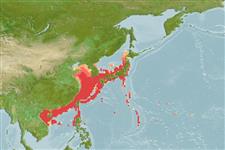
Marine; freshwater; brackish; demersal; catadromous (Ref. 51243); depth range 1 - 400 m (Ref. 6898). Subtropical; 4°C - 27°C (Ref. 12468); 46°N - 15°N, 105°E - 170°E
Asia: Japan to the East China Sea, Taiwan, Korea, China and northern Philippines. Spawning grounds of this species are presumed to be in the western Mariana Islands, at a salinity front near 15°N and 140°E (Ref. 54488). Most expensive food fish in Japan. Introduced elsewhere.
Size / Weight / Age
Maturity: Lm ? range ? - ? cm
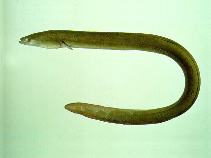
Max length : 150 cm TL male/unsexed; (Ref. 9828); common length : 40.0 cm SL male/unsexed; (Ref. 35840); max. published weight: 1.9 kg (Ref. 82795)
Spawning occurs in the sea; small eels ascend the rivers in schools; develop and grow in freshwater. The species may crawl over land at night from one place to another (Ref. 5258, 11230). Adults feed on crustaceans, insects and fish (Ref. 5258). Maximum weight given (1889 g) has a maximum length of 100.8 cm TL in Ref. 82795. Utilized fresh, smoked, canned and frozen; eaten steamed, broiled and baked (Ref. 9988). Used in Chinese medicine (Ref. 12166).
Life cycle and mating behavior
Maturity | Reproduction | Spawning | Eggs | Fecundity | Larvae
Assuming reproductive mode to be the same as that of Anguilla anguilla.
Masuda, H., K. Amaoka, C. Araga, T. Uyeno and T. Yoshino, 1984. The fishes of the Japanese Archipelago. Vol. 1. Tokai University Press, Tokyo, Japan. 437 p. (text). (Ref. 559)
IUCN Red List Status (Ref. 130435)
Threat to humans
Harmless
Human uses
Fisheries: highly commercial; aquaculture: commercial
Tools
Special reports
Download XML
Internet sources
Estimates based on models
Preferred temperature (Ref.
123201): 2.5 - 23.3, mean 17 °C (based on 432 cells).
Phylogenetic diversity index (Ref.
82804): PD
50 = 0.5000 [Uniqueness, from 0.5 = low to 2.0 = high].
Bayesian length-weight: a=0.00062 (0.00039 - 0.00099), b=3.18 (3.05 - 3.31), in cm total length, based on LWR estimates for this species & Genus-body shape (Ref.
93245).
Trophic level (Ref.
69278): 3.6 ±0.51 se; based on food items.
Generation time: 15.7 ( na - na) years. Estimated as median ln(3)/K based on 1
growth studies.
Resilience (Ref.
120179): Low, minimum population doubling time 4.5 - 14 years (K=0.07).
Fishing Vulnerability (Ref.
59153): High to very high vulnerability (71 of 100).
Nutrients (Ref.
124155): Calcium = 32.7 [19.9, 65.7] mg/100g; Iron = 0.741 [0.434, 1.157] mg/100g; Protein = 19.5 [17.7, 21.4] %; Omega3 = 0.35 [0.19, 0.67] g/100g; Selenium = 55.1 [28.6, 103.5] μg/100g; VitaminA = 8.74 [1.85, 42.36] μg/100g; Zinc = 0.685 [0.498, 0.991] mg/100g (wet weight); based on
nutrient studies.