Common names from other countries
Environment: milieu / climate zone / depth range / distribution range
Ecology
Freshwater; brackish; pelagic-neritic; amphidromous (Ref. 51243). Tropical; 25°C - 30°C (Ref. 1672)
Asia and Oceania: India eastward to the Philippines, and south to Indonesia, Vanuatu, Solomon Islands, Papua New Guinea, and northern Australia.
Size / Weight / Age
Maturity: Lm ? range ? - ? cm
Max length : 30.0 cm TL male/unsexed; (Ref. 4833); common length : 20.0 cm TL male/unsexed; (Ref. 4833)
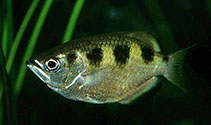
Occurs primarily in brackish mangrove estuaries, but also penetrates rivers and small streams (Ref. 4833, 44894). Reported to occur near overhanging vegetation on reefs (Ref. 9710, 48636). Usually in small aggregations (Ref. 48635). Feeds at the surface during daytime on floating debris which includes insects and vegetable matter. It is renowned for its ability to 'shoot down' insect prey by expelling beads of water from its mouth with considerable force and for its remarkable ability to compensate for visual refraction when aiming its shoots; shooting range is about 150 cm (Ref. 2847, 55339). Sold fresh in markets.
Life cycle and mating behavior
Maturity | Reproduction | Spawning | Eggs | Fecundity | Larvae
Allen, G.R., 1991. Field guide to the freshwater fishes of New Guinea. Publication, no. 9. 268 p. Christensen Research Institute, Madang, Papua New Guinea. (Ref. 2847)
IUCN Red List Status (Ref. 130435)
CITES (Ref. 128078)
Not Evaluated
Threat to humans
Harmless
Human uses
Fisheries: minor commercial; aquarium: commercial
More information
ReferencesAquacultureAquaculture profileStrainsGeneticsElectrophoresesHeritabilityDiseasesProcessingMass conversion
Tools
Special reports
Download XML
Internet sources
Estimates based on models
Phylogenetic diversity index (Ref.
82804): PD
50 = 0.5156 [Uniqueness, from 0.5 = low to 2.0 = high].
Bayesian length-weight: a=0.01660 (0.00635 - 0.04340), b=3.00 (2.78 - 3.22), in cm Total Length, based on LWR estimates for this (Sub)family-body shape (Ref.
93245).
Trophic level (Ref.
69278): 2.6 ±0.27 se; based on food items.
Resilience (Ref.
120179): Medium, minimum population doubling time 1.4 - 4.4 years (Preliminary K or Fecundity.).
Fishing Vulnerability (Ref.
59153): Low vulnerability (20 of 100).