Teleostei (teleosts) >
Acanthuriformes (Surgeonfishes) >
Acanthuridae (Surgeonfishes, tangs, unicornfishes) > Acanthurinae
Etymology: Acanthurus: Greek, akantha = thorn + Greek, oura = tail (Ref. 45335).
More on author: Bloch.
Environment: milieu / climate zone / depth range / distribution range
Ecology
Marine; reef-associated; depth range 2 - 25 m (Ref. 7345), usually 2 - 15 m (Ref. 27115). Subtropical; 22°C - 25°C (Ref. 27115); 43°N - 30°S, 98°W - 14°W (Ref. 55164)
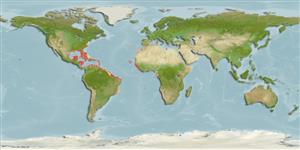
Western Atlantic: Massachusetts (USA), Bermuda, and the northern Gulf of Mexico to São Paulo, Brazil. Eastern Atlantic: Senegal.
Length at first maturity / Size / Weight / Age
Maturity: Lm ?, range 17 - ? cm
Max length : 39.0 cm TL male/unsexed; (Ref. 47377); common length : 35.0 cm TL male/unsexed; (Ref. 5217); max. published weight: 5.1 kg (Ref. 40637)
Inhabits shallow reefs or rocky areas. Found in loose aggregations (Ref. 9710). Mainly diurnal. Ingests sand when feeding on algae (Ref. 13442). The spine on both sides of the caudal peduncle may inflict painful wounds (Ref. 5217). Minimum depth reported from Ref. 27115. Larvae are planktonic (Ref. 47377). At Fernando de Noronha Archipelago in southwestern Atlantic, juveniles hold cleaning stations together with the blue tang (Acanthurus coeruleus) and sergeant major (Abudefduf saxatilis) and graze algae as well as pick molted skin and parasites from green turtles (Chelonia mydas). This behavior is preceded by a characteristic inspection usually followed by feeding nips on the turtles’ skin (head, limbs, and tail), as well as on the carapace. The most inspected and cleaned body parts are the flippers (Ref. 51385).
Life cycle and mating behavior
Maturity | Reproduction | Spawning | Eggs | Fecundity | Larvae
Robins, C.R. and G.C. Ray, 1986. A field guide to Atlantic coast fishes of North America. Houghton Mifflin Company, Boston, U.S.A. 354 p. (Ref. 7251)
IUCN Red List Status (Ref. 130435)
Threat to humans
Traumatogenic (Ref. 5217)
Human uses
Fisheries: minor commercial; aquarium: commercial
More information
ReferencesAquacultureAquaculture profileStrainsGeneticsElectrophoresesHeritabilityDiseasesProcessingNutrientsMass conversion
Tools
Special reports
Download XML
Internet sources
Estimates based on models
Preferred temperature (Ref.
123201): 26.1 - 28, mean 27.4 °C (based on 769 cells).
Phylogenetic diversity index (Ref.
82804): PD
50 = 0.5000 [Uniqueness, from 0.5 = low to 2.0 = high].
Bayesian length-weight: a=0.02188 (0.01789 - 0.02676), b=2.95 (2.91 - 2.99), in cm total length, based on LWR estimates for this species (Ref.
93245).
Trophic level (Ref.
69278): 2.1 ±0.1 se; based on diet studies.
Resilience (Ref.
120179): Medium, minimum population doubling time 1.4 - 4.4 years (K=0.25-0.50).
Fishing Vulnerability (Ref.
59153): Low vulnerability (23 of 100).
Nutrients (Ref.
124155): Calcium = 39.8 [15.6, 133.0] mg/100g; Iron = 0.822 [0.286, 2.182] mg/100g; Protein = 19.1 [17.8, 20.4] %; Omega3 = 0.146 [0.063, 0.347] g/100g; Selenium = 8.83 [2.71, 27.87] μg/100g; VitaminA = 17.5 [3.7, 82.5] μg/100g; Zinc = 1.78 [0.55, 3.61] mg/100g (wet weight);