Environment: milieu / climate zone / depth range / distribution range
Ecology
Marine; brackish; reef-associated; amphidromous (Ref. 51243); depth range 0 - 84 m (Ref. 13608), usually 1 - 15 m (Ref. 9268). Subtropical; 26°N - 7°N, 97°W - 58°W (Ref. 118624)
Worldwide in warm seas. Hawaiian species have been verified by electrophoretic analysis (Ref. 5577), hence, Albula vulpes might be further split. Eastern Pacific: California, USA to Peru (Ref. 2850). Western Atlantic: North Carolina, USA to Florida, Bahamas, Gulf of Mexico, Antilles and Caribbean to Brazil (Ref. 26938). Northwest Atlantic: Canada (Ref. 5951). The West African form is Albula goreensis, Valenciennes, 1846.
Length at first maturity / Size / Weight / Age
Maturity: Lm 37.5, range 21 - 36 cm
Max length : 104 cm TL male/unsexed; (Ref. 7251); max. published weight: 10.0 kg (Ref. 37955)
Dorsal
spines
(total): 0;
Dorsal
soft rays
(total): 15-19;
Anal
spines: 0;
Anal
soft rays: 7 - 9;
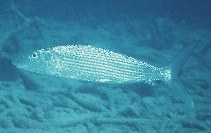
Vertebrae: 69 - 74. Branchiostegal rays 12-14 (Ref. 4639). Silvery with dusky fins; base of pectorals yellow (Ref. 3970). Body elongate and fusiform (Ref. 4832). Last ray of dorsal and anal fins not prolonged; head region naked; spot and band absent on head; margin of nasal pore not black (Ref. 13608). Bluntly conical snout extends beyond inferior mouth (Ref. 26938). Pectoral and pelvic axillary scales present; a single long scale on each side of membrane between each ray of dorsal and anal fins (Ref. 4832).
Inhabits shallow coastal waters, estuaries and bays, over sand and mud bottoms (Ref. 3237). Often in schools, except large individuals which are solitary (Ref. 7251). Dorsal fin may show above surface (Ref. 42064). More or less pelagic but feeds on benthic worms, crustaceans, and mollusks (Ref. 2850); that are picked from mud and sand bottoms (Ref. 27549). Tolerates oxygen poor water by inhaling air into a lung-like airbladder (Ref. 9710). Flesh is bony and not esteemed (Ref. 9268). One of the most important game fishes worldwide (Ref. 26938).
Spawning occurs in open waters. Eggs are pelagic (Ref. 205).
Whitehead, P.J.P., 1990. Albulidae. p. 122-124. In J.C. Quero, J.C. Hureau, C. Karrer, A. Post and L. Saldanha (eds.) Check-list of the fishes of the eastern tropical Atlantic (CLOFETA). JNICT, Lisbon; SEI, Paris; and UNESCO, Paris, Vol. 1. (Ref. 4447)
IUCN Red List Status (Ref. 130435)
Threat to humans
Reports of ciguatera poisoning (Ref. 4690)
Human uses
Fisheries: minor commercial; gamefish: yes; bait: usually
More information
ReferencesAquacultureAquaculture profileStrainsGeneticsElectrophoresesHeritabilityDiseasesProcessingNutrientsMass conversion
Tools
Special reports
Download XML
Internet sources
Estimates based on models
Preferred temperature (Ref.
123201): 20.4 - 28.4, mean 27 °C (based on 1501 cells).
Phylogenetic diversity index (Ref.
82804): PD
50 = 0.5007 [Uniqueness, from 0.5 = low to 2.0 = high].
Bayesian length-weight: a=0.01288 (0.00909 - 0.01825), b=3.00 (2.91 - 3.09), in cm total length, based on LWR estimates for this species (Ref.
93245).
Trophic level (Ref.
69278): 3.7 ±0.3 se; based on diet studies.
Resilience (Ref.
120179): Low, minimum population doubling time 4.5 - 14 years (K=0.3; tm=2; tmax=20).
Fishing Vulnerability (Ref.
59153): Moderate vulnerability (40 of 100).
Climate Vulnerability (Ref.
125649): High to very high vulnerability (66 of 100).
Nutrients (Ref.
124155): Calcium = 16.1 [8.5, 47.7] mg/100g; Iron = 0.503 [0.283, 0.890] mg/100g; Protein = 19.8 [18.7, 20.9] %; Omega3 = 0.258 [0.146, 0.453] g/100g; Selenium = 21 [11, 40] μg/100g; VitaminA = 23.8 [7.7, 79.0] μg/100g; Zinc = 0.641 [0.446, 0.942] mg/100g (wet weight);