Elasmobranchii (sharks and rays) >
Carcharhiniformes (Ground sharks) >
Carcharhinidae (Requiem sharks)
Etymology: Carcharhinus: karcharos (Gr.), sharp or jagged; rhinus, an ancient name for sharks, from rhine (Gr.), rasp, both words alluding to a shark's jagged, rasp-like skin. (See ETYFish); melanopterus: melanos (Gr.), black; pterus, from pteron (Gr.), fin, referring to its black-tipped fins. (See ETYFish).
More on authors: Quoy & Gaimard.
Environment: milieu / climate zone / depth range / distribution range
Ecology
Marine; brackish; reef-associated; amphidromous (Ref. 51243); depth range 0 - 75 m (Ref. 37816). Subtropical; 35°N - 25°S, 7°E - 134°W
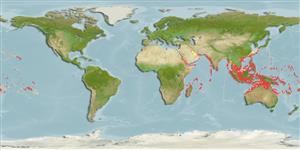
Indo-Pacific: Persian Gulf (Ref. 68964), Red Sea and East Africa to the Hawaiian Islands and the Tuamoto Archipelago. North to Japan and south to Australia. Apparently rare or absent in the more easterly groups. Also eastern Mediterranean (through the Suez Canal).
Length at first maturity / Size / Weight / Age
Maturity: Lm 102.0, range 91 - 120 cm
Max length : 200 cm TL male/unsexed; (Ref. 5578)
Dorsal
spines
(total): 0;
Dorsal
soft rays
(total): 0;
Anal
spines: 0;
Anal
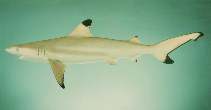
soft rays: 0. A small shark with a short, bluntly rounded snout, oval eyes, and narrow-cusped teeth; 2nd dorsal fin large; no interdorsal ridge (Ref. 5578). Yellow-brown above, white below; all fins conspicuous with black or dark brown tips also anterior and posterior dark edging on pectoral fins and upper lobe of caudal fin; a prominent black tip of first dorsal fin set off abruptly by a light band below it; a conspicuous dark band on flanks, extending rearward to pelvic fins (Ref. 9997).
Inhabits shallow water close inshore on coral reefs and in the intertidal zone (reef flats), near reef drop-offs and close offshore (Ref. 244, 58302). Also found in mangrove areas, moving in and out with the tide (Ref. 6871) and even in fresh water, but not in tropical lakes and rivers far from the sea (Ref. 9997). Occurs singly or in small groups (Ref. 244, 54301). Prefers fishes but also feeds on crustaceans, cephalopods and other mollusks (Ref. 6871). Viviparous (Ref. 50449). May become aggressive to spear fishers and has been reported to bite people wading in shallow water (Ref. 6871). Reported to cause poisoning (Ref. 4690). 2 to 4 young of 46 to 52 cm are born per litter (Ref. 1602). Generally marketed fresh (as fillet), may be dried, salted, smoked (Ref. 5284) or frozen (Ref. 9987). Fins are valued for shark-fin soup (Ref. 9987); liver as source of oil (Ref. 9997). This species is commonly seen in public aquaria (Ref. 54301). Maximum reported weight from IGFA was 13.550 kg (Ref. 40637). Minimum depth reported taken from Ref. 128797.
Viviparous, placental (Ref. 50449). Litter size 2-4 pups (Ref. 244) after an 8-9 months gestation period (up to 16 months in some localities) (Ref.58048). Size at birth ranges from 33-52 cm (Ref. 244); 48-50 cm TL (Ref.58048). Distinct pairing with embrace (Ref. 205). Precopulatory and courtship involve the male closely following near the female's vent which could possibly be guided by their sense of smell (Ref. 49562, 47987).
Compagno, L.J.V., 1984. FAO Species Catalogue. Vol. 4. Sharks of the world. An annotated and illustrated catalogue of shark species known to date. Part 2 - Carcharhiniformes. FAO Fish. Synop. 125(4/2):251-655. Rome: FAO. (Ref. 244)
IUCN Red List Status (Ref. 130435)
Threat to humans
Traumatogenic (Ref. 4690)
Human uses
Fisheries: commercial; aquarium: public aquariums
More information
ReferencesAquacultureAquaculture profileStrainsGeneticsElectrophoresesHeritabilityDiseasesProcessingNutrientsMass conversion
Tools
Special reports
Download XML
Internet sources
Estimates based on models
Preferred temperature (Ref.
123201): 23.8 - 28.4, mean 27.4 °C (based on 397 cells).
Phylogenetic diversity index (Ref.
82804): PD
50 = 0.5000 [Uniqueness, from 0.5 = low to 2.0 = high].
Bayesian length-weight: a=0.00457 (0.00244 - 0.00856), b=3.04 (2.89 - 3.19), in cm total length, based on LWR estimates for this species & Genus-body shape (Ref.
93245).
Trophic level (Ref.
69278): 3.9 ±0.4 se; based on diet studies.
Generation time: 4.4 ( na - na) years. Estimated as median ln(3)/K based on 1
growth studies.
Resilience (Ref.
120179): Low, minimum population doubling time 4.5 - 14 years (Fec=2).
Prior r = 0.26, 95% CL = 0.14 - 0.48, Based on 3 stock assessments.
Fishing Vulnerability (Ref.
59153): High vulnerability (57 of 100).
Nutrients (Ref.
124155): Calcium = 4.73 [0.83, 25.13] mg/100g; Iron = 0.387 [0.096, 1.146] mg/100g; Protein = 23 [20, 25] %; Omega3 = 0.162 [0.059, 0.403] g/100g; Selenium = 13.5 [4.1, 39.5] μg/100g; VitaminA = 28.8 [9.3, 88.9] μg/100g; Zinc = 0.468 [0.221, 0.937] mg/100g (wet weight);