: DOMDocument::load(): Extra content at the end of the document in http://fishbase.se/webservice/AquaMaps/getAMap.php?genus=Centropyge&species=bispinosa, line: 2 in
Environment: milieu / climate zone / depth range / distribution range
Ecology
Marine; reef-associated; non-migratory; depth range 0 - 60 m (Ref. 89972). Tropical; 35°N - 32°S
Indo-Pacific: East Africa to the Tuamoto Islands, north to the Izu Island, south to Lord Howe Island. Not found in the Red Sea, Hawaii, and the southern Pacific Ocean (Ref. 48391).
Size / Weight / Age
Maturity: Lm ? range ? - ? cm
Max length : 11.5 cm TL male/unsexed; (Ref. 26587)
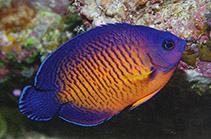
Secretive species found in lagoon and seaward reef slopes in areas with rich coral growth. Found singly or in aggregations (Ref. 1602); forms harems of 3-7 individuals. Feeds on algae. Frequently exported through the aquarium trade (Ref. 48391). Minimum depth reported taken from Ref. 128797.
Life cycle and mating behavior
Maturity | Reproduction | Spawning | Eggs | Fecundity | Larvae
Myers, R.F., 1991. Micronesian reef fishes. Second Ed. Coral Graphics, Barrigada, Guam. 298 p. (Ref. 1602)
IUCN Red List Status (Ref. 130435)
Threat to humans
Harmless
Human uses
Fisheries: subsistence fisheries; aquarium: commercial
More information
Common namesSynonymsMetabolismPredatorsEcotoxicologyReproductionMaturitySpawningSpawning aggregationFecundityEggsEgg development
ReferencesAquacultureAquaculture profileStrainsGeneticsElectrophoresesHeritabilityDiseasesProcessingNutrientsMass conversion
Tools
Special reports
Download XML
Internet sources
Estimates based on models
Preferred temperature (Ref.
123201): 24.6 - 28.8, mean 27.5 °C (based on 598 cells).
Phylogenetic diversity index (Ref.
82804): PD
50 = 0.5000 [Uniqueness, from 0.5 = low to 2.0 = high].
Bayesian length-weight: a=0.04467 (0.02396 - 0.08327), b=2.75 (2.59 - 2.91), in cm total length, based on LWR estimates for this species & (Sub)family-body (Ref.
93245).
Trophic level (Ref.
69278): 2.8 ±0.29 se; based on food items.
Resilience (Ref.
120179): Medium, minimum population doubling time 1.4 - 4.4 years (Preliminary K or Fecundity.).
Fishing Vulnerability (Ref.
59153): Low vulnerability (10 of 100).
Nutrients (Ref.
124155): Calcium = 106 [51, 161] mg/100g; Iron = 0.719 [0.442, 1.188] mg/100g; Protein = 18.1 [16.9, 19.3] %; Omega3 = 0.125 [0.075, 0.203] g/100g; Selenium = 26.2 [14.3, 48.6] μg/100g; VitaminA = 103 [28, 361] μg/100g; Zinc = 1.73 [1.18, 2.49] mg/100g (wet weight);