Teleostei (teleosts) >
Acanthuriformes (Surgeonfishes) >
Pomacanthidae (Angelfishes)
Etymology: Pomacanthus: Greek, poma, -atos = cover, operculum + Greek, akantha = thorn (Ref. 45335).
More on author: Cuvier.
Environment: milieu / climate zone / depth range / distribution range
Ecology
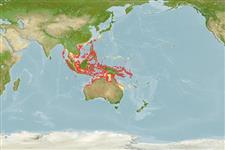
Marine; reef-associated; non-migratory; depth range 3 - 40 m (Ref. 9710). Tropical; 32°N - 25°S, 92°E - 162°E
Indo-Pacific: Indonesia to Papua New Guinea, north to the Philippines, south to Rowley Shoals and the southern Great Barrier Reef; including Palau and Yap in Micronesia.
Size / Weight / Age
Maturity: Lm ? range ? - ? cm
Max length : 28.0 cm TL male/unsexed; (Ref. 9710); max. reported age: 15 years (Ref. 72479)
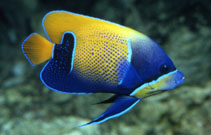
Occurs in coral rich areas of clear lagoons, channels, and protected outer reef slopes. Changes to adult pattern is dramatic, and intermediate stage are rarely seen (Ref. 48636). Often solitary. Feeds on sponges and tunicates. Uncommon (Ref. 9710). Highly prized aquarium export (Ref. 37816).
Life cycle and mating behavior
Maturity | Reproduction | Spawning | Eggs | Fecundity | Larvae
Myers, R.F., 1991. Micronesian reef fishes. Second Ed. Coral Graphics, Barrigada, Guam. 298 p. (Ref. 1602)
IUCN Red List Status (Ref. 130435)
Threat to humans
Harmless
Human uses
Fisheries: subsistence fisheries; aquarium: commercial
More information
Common namesSynonymsMetabolismPredatorsEcotoxicologyReproductionMaturitySpawningSpawning aggregationFecundityEggsEgg development
ReferencesAquacultureAquaculture profileStrainsGeneticsElectrophoresesHeritabilityDiseasesProcessingNutrientsMass conversion
Tools
Special reports
Download XML
Internet sources
Estimates based on models
Preferred temperature (Ref.
123201): 26.1 - 28.9, mean 27.9 °C (based on 368 cells).
Phylogenetic diversity index (Ref.
82804): PD
50 = 0.5001 [Uniqueness, from 0.5 = low to 2.0 = high].
Bayesian length-weight: a=0.03236 (0.01300 - 0.08052), b=2.89 (2.71 - 3.07), in cm total length, based on LWR estimates for this Genus-body shape (Ref.
93245).
Trophic level (Ref.
69278): 2.7 ±0.00 se; based on food items.
Resilience (Ref.
120179): Low, minimum population doubling time 4.5 - 14 years (Preliminary K or Fecundity.).
Fishing Vulnerability (Ref.
59153): Low vulnerability (18 of 100).
Nutrients (Ref.
124155): Calcium = 52.8 [27.0, 86.9] mg/100g; Iron = 0.557 [0.344, 0.909] mg/100g; Protein = 18.2 [17.0, 19.4] %; Omega3 = 0.097 [0.062, 0.153] g/100g; Selenium = 30 [17, 55] μg/100g; VitaminA = 69.3 [18.4, 250.1] μg/100g; Zinc = 1.4 [1.0, 2.0] mg/100g (wet weight);