Environment: milieu / climate zone / depth range / distribution range
Ecology
Marine; demersal; depth range 0 - 366 m (Ref. 2850). Subtropical; 58°N - 28°N, 136°W - 112°W
Eastern Pacific: Sitka, Alaska to Magdalena Bay, southern Baja California, Mexico. Records from areas south of Baja California and in the Gulf of California are in error. Two populations exist, one from Oregon northward and the other from San Francisco southward (Ref. 2850).
Size / Weight / Age
Maturity: Lm ? range ? - ? cm
Max length : 38.0 cm TL male/unsexed; (Ref. 2850)
Short description
Morphology | Morphometrics
Dorsal
spines
(total): 2;
Dorsal
soft rays
(total): 33-37;
Anal
spines: 0;
Anal
soft rays: 30 - 35;
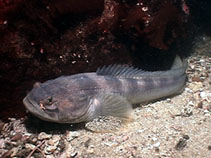
Vertebrae: 42 - 46. Caudal fin rounded and narrow; pectorals broad (Ref. 6885). Olive brown to bronze or dark iridescent purple on dorsal surface, paler on sides with a golden yellow on ventral surface; white space under eye with a black crescent below; white on posterior edge of maxillary; young with a weak dark dorsal saddle (Ref. 6885). Branchiostegal rays: 6 (Ref. 36489).
Ranges from intertidal areas (where they may remain out of water under rocks or seaweeds, Ref. 31184) to deeper water over sand and mud bottoms (Ref. 4925). Adults make vertical migrations at night (Ref. 6885). Feed on crustaceans and fishes (Ref. 6885). Oviparous with eggs and larvae attached to nest wall (Ref. 36489). Nest is guarded by male (Ref. 36489). Important prey item for seals and sea lions (Ref. 2850). Adults breathe air when out of water (Ref. 31184). Possess photophores which are arranged on the underside of the head in a 'U' fashion.
Nests are cavities that are formed under rocks and eggs are deposited on the roof of the cavity. As few as 19 or as much as 789 eggs have been found attached in a nest. Eggs are guarded by the fasting male. Probably polygamous (Ref. 6885).
Eschmeyer, W.N., E.S. Herald and H. Hammann, 1983. A field guide to Pacific coast fishes of North America. Boston (MA, USA): Houghton Mifflin Company. xii+336 p. (Ref. 2850)
IUCN Red List Status (Ref. 130435)
Threat to humans
Harmless
Human uses
Fisheries: of potential interest
More information
ReferencesAquacultureAquaculture profileStrainsGeneticsElectrophoresesHeritabilityDiseasesProcessingNutrientsMass conversion
Tools
Special reports
Download XML
Internet sources
Estimates based on models
Preferred temperature (Ref.
123201): 6.9 - 16.8, mean 8.3 °C (based on 78 cells).
Phylogenetic diversity index (Ref.
82804): PD
50 = 0.5001 [Uniqueness, from 0.5 = low to 2.0 = high].
Bayesian length-weight: a=0.00562 (0.00323 - 0.00980), b=3.16 (3.01 - 3.31), in cm total length, based on LWR estimates for this species & Genus-body shape (Ref.
93245).
Trophic level (Ref.
69278): 4.0 ±0.67 se; based on food items.
Resilience (Ref.
120179): Medium, minimum population doubling time 1.4 - 4.4 years (tm=3.5; tmax=7).
Fishing Vulnerability (Ref.
59153): Low to moderate vulnerability (28 of 100).
Nutrients (Ref.
124155): Calcium = 81.9 [43.9, 161.7] mg/100g; Iron = 1.11 [0.65, 1.89] mg/100g; Protein = 17.8 [16.8, 18.8] %; Omega3 = 0.322 [0.190, 0.553] g/100g; Selenium = 36.1 [18.1, 78.3] μg/100g; VitaminA = 24 [8, 72] μg/100g; Zinc = 0.668 [0.466, 0.959] mg/100g (wet weight);