Teleostei (teleosts) >
Eupercaria/misc (Various families in series Eupercaria) >
Labridae (Wrasses)
Etymology: Diproctacanthus: Greek, di = two + Greek, proktos = anus + Greek, akantha = thorn (Ref. 45335).
More on author: Bleeker.
Environment: milieu / climate zone / depth range / distribution range
Ecology
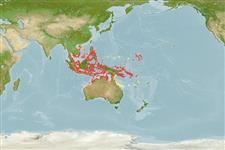
Marine; reef-associated; depth range 2 - 25 m (Ref. 90102), usually 2 - 20 m (Ref. 27115). Tropical; 24°C - 28°C (Ref. 27115); 19°N - 25°S, 99°E - 172°E
Western Central Pacific: Philippines, Palau, Indonesia, New Guinea, and Great Barrier Reef.
Size / Weight / Age
Maturity: Lm ? range ? - ? cm
Max length : 10.0 cm TL male/unsexed; (Ref. 6023)
Dorsal
spines
(total): 9;
Dorsal
soft rays
(total): 9-10;
Anal
spines: 2;
Anal
soft rays: 9 - 11;
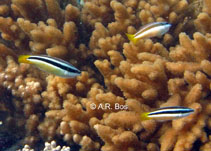
Vertebrae: 25. Juveniles with 3 broad black stripes from head to caudal fin where the stripes merge; with growth, lower stripe disappears, upper stripe is less distinct; black caudal fin becomes entirely yellow in adults. Head scales small. Lips thick and fleshy, forming a short tube when mouth is closed. Caudal fin rounded to truncate; pelvic fins rounded.
A solitary species (Ref. 90102) occurring in coral rich areas of shallow lagoons and sheltered seaward reefs. Adults feed mainly on coral polyps while juveniles remove ectoparasites from small territorial fishes (Ref. 2334, 9710). Adults swim in small groups. Usually, only small juveniles clean other fishes (Ref. 48636).
Life cycle and mating behavior
Maturity | Reproduction | Spawning | Eggs | Fecundity | Larvae
Oviparous, distinct pairing during breeding (Ref. 205).
Randall, J.E., G.R. Allen and R.C. Steene, 1990. Fishes of the Great Barrier Reef and Coral Sea. University of Hawaii Press, Honolulu, Hawaii. 506 p. (Ref. 2334)
IUCN Red List Status (Ref. 130435)
Threat to humans
Harmless
Human uses
Aquarium: commercial
More information
ReferencesAquacultureAquaculture profileStrainsGeneticsElectrophoresesHeritabilityDiseasesProcessingNutrientsMass conversion
Tools
Special reports
Download XML
Internet sources
Estimates based on models
Preferred temperature (Ref.
123201): 26.8 - 29, mean 28.2 °C (based on 610 cells).
Phylogenetic diversity index (Ref.
82804): PD
50 = 1.0000 [Uniqueness, from 0.5 = low to 2.0 = high].
Bayesian length-weight: a=0.00912 (0.00466 - 0.01787), b=3.06 (2.89 - 3.23), in cm total length, based on LWR estimates for this species & (Sub)family-body (Ref.
93245).
Trophic level (Ref.
69278): 3.3 ±0.61 se; based on food items.
Resilience (Ref.
120179): High, minimum population doubling time less than 15 months (Preliminary K or Fecundity.).
Fishing Vulnerability (Ref.
59153): Low vulnerability (10 of 100).
Nutrients (Ref.
124155): Calcium = 121 [70, 214] mg/100g; Iron = 0.854 [0.488, 1.603] mg/100g; Protein = 18.3 [15.5, 20.6] %; Omega3 = 0.162 [0.099, 0.263] g/100g; Selenium = 22.3 [12.7, 40.8] μg/100g; VitaminA = 154 [47, 580] μg/100g; Zinc = 2.07 [1.39, 3.30] mg/100g (wet weight);