Teleostei (teleosts) >
Acanthuriformes (Surgeonfishes) >
Pomacanthidae (Angelfishes)
Etymology: Apolemichthys: Greek, apolemos, -os,-on = quiet, peaceful + Greek, ichthys = fish (Ref. 45335).
More on author: Cuvier.
Environment: milieu / climate zone / depth range / distribution range
Ecology
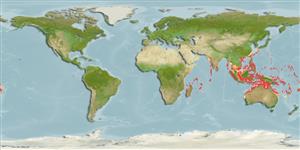
Marine; reef-associated; non-migratory; depth range 3 - 60 m (Ref. 47838). Tropical; 32°N - 28°S, 34°E - 168°W (Ref. 47838)
Indo-West Pacific: East Africa south to 28°S (Ref. 33390) and east to Samoa, north to southern Japan, south to Australia.
Size / Weight / Age
Maturity: Lm ? range ? - ? cm
Max length : 26.0 cm TL male/unsexed; (Ref. 48636)
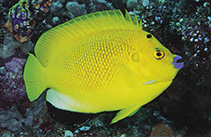
Inhabits lagoon and seaward reefs (Ref. 9710); found near coral (Ref. 5953). Feeds mainly on sponges and tunicates (Ref. 1602). Juveniles secretive and occur below 25 m (Ref. 37816). Adults in small but loose groups at moderate depths (Ref. 48636). Frequently exported through the aquarium trade (Ref. 48391).
Life cycle and mating behavior
Maturity | Reproduction | Spawning | Eggs | Fecundity | Larvae
Pyle, R., 2001. Pomacanthidae: Angelfishes. p. 3266-3286. In K.E. Carpenter and V.H. Niem (eds.) FAO species identification guide for fishery purposes. The living marine resources of the Western Central Pacific. Volume 5. Bony fishes part 3 (Menidae to Pomacentridae). Rome, FAO. (Ref. 48391)
IUCN Red List Status (Ref. 130435)
Threat to humans
Harmless
Human uses
Fisheries: minor commercial; aquarium: commercial
More information
Common namesSynonymsMetabolismPredatorsEcotoxicologyReproductionMaturitySpawningSpawning aggregationFecundityEggsEgg development
ReferencesAquacultureAquaculture profileStrainsGeneticsElectrophoresesHeritabilityDiseasesProcessingNutrientsMass conversion
Tools
Special reports
Download XML
Internet sources
Estimates based on models
Preferred temperature (Ref.
123201): 25 - 29, mean 28.1 °C (based on 892 cells).
Phylogenetic diversity index (Ref.
82804): PD
50 = 0.5020 [Uniqueness, from 0.5 = low to 2.0 = high].
Bayesian length-weight: a=0.03090 (0.01359 - 0.07026), b=2.89 (2.70 - 3.08), in cm total length, based on LWR estimates for this (Sub)family-body shape (Ref.
93245).
Trophic level (Ref.
69278): 2.6 ±0.00 se; based on food items.
Resilience (Ref.
120179): Low, minimum population doubling time 4.5 - 14 years (Preliminary K or Fecundity.).
Fishing Vulnerability (Ref.
59153): Low vulnerability (16 of 100).
Nutrients (Ref.
124155): Calcium = 55 [28, 89] mg/100g; Iron = 0.565 [0.347, 0.930] mg/100g; Protein = 18.1 [16.9, 19.3] %; Omega3 = 0.101 [0.064, 0.160] g/100g; Selenium = 32.3 [17.7, 60.2] μg/100g; VitaminA = 70.2 [18.0, 261.4] μg/100g; Zinc = 1.44 [1.00, 2.04] mg/100g (wet weight);