
|
Apterichtus caecus (Linnaeus, 1758) European finless eel |
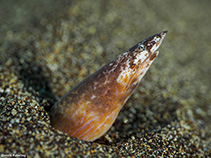
|
|
photo by
Rabeling, D. |
| Family: | Ophichthidae (Snake eels), subfamily: Ophichthinae | |||
| Max. size: | 60 cm TL (male/unsexed) | |||
| Environment: | demersal; marine; depth range 0 - 85 m | |||
| Distribution: | Eastern Atlantic: Western and eastern Mediterranean, eastern Atlantic south to Azores, Madeira, and the Canary islands. | |||
| Diagnosis: | Vertebrae: 132-139. This species is distinguished by the following characters: tail 1.6-1.7, head 12-15, and body depth 56-83 in total length; preopercular pores 4 and there are 5 pores in supratemporal canal; teeth conical and uniserial on jaws, becoming biserial on vomer of large specimens, vomerine teeth 8-14; when fresh body ochre in color with numerous small dark brown spots, those spots forming a continuous mid-dorsal band, yellowish on ventral surface; the head with dark brown spots over a pale background, a prominent horizontal white patch beneath and behind the orbit; MVF 52-134, total vertebrae 132-139 (n=6) (Ref. 101270). | |||
| Biology: | Burrows in sand or mud on the continental shelf (Ref. 4455); usually in fine sand (Ref. 101270). | |||
| IUCN Red List Status: | Least Concern (LC); Date assessed: 20 October 2011 Ref. (130435) | |||
| Threat to humans: | harmless | |||