| Family: |
Epinephelidae (Groupers) |
| Max. size: |
40 cm TL (male/unsexed) |
| Environment: |
reef-associated; brackish; marine; depth range 20 - 60 m, non-migratory |
| Distribution: |
Indo-West Pacific: East Africa to the Ryukyu Islands, Marshall Islands, Fiji, New Caledonia, and northern Australia. Recently recorded from Tonga (Ref. 53797). Reported from Somalia and India by Heemstra & Randall in 1984 but valid records and specimens have not been found (Ref. 4787). Closely related to Epinephelus summana known only from the Red Sea. |
| Diagnosis: |
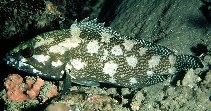
Dorsal spines (total): 11-11; Dorsal soft rays (total): 14-16; Anal spines: 3-3; Anal soft rays: 8-8. This species is distinguished by the following characters: body depth 2.7-3.2 in SL; head length 2.3-2.5 in SL; head pointed, flat interorbital area, dorsal head profile slightly convex; preopercle rounded, serrae small and mostly covered by skin; upper edge of operculum strongly convex, the rear edge almost vertical, the upper spine extending posterior to lower spine; rear nostril diameter about twice that of anterior nostril; small, embedded scales on maxilla; 2-4 rows of small teeth at midlateral part of lower jaw; canines at front of jaws small or absent; gill rakers of first gill arch 8-10 + 15-18 (including 6 to 8 rudiments on each limb); caudal fin rounded; pectoral fins large and fleshy, with 15-17 rays, the fin length 1.4-1.7 in HL; short pelvic fins, 1.9-2.4 in HL; lateral-line scales 48-53; lateral scale series 95-110. Colour of body brown, with numerous small white spots (in specimens >10 cm SL), horizontally elongate and tend to form wavy white lines in adults, several round or irregular pale blotches (eye-sized or larger) usually superimposed over small white spots, head brown, with numerous small white spots dorsally behind eyes; black maxillary streak usually hidden by maxilla, median fins with small white spots and streaks, the posterior margin blackish with a white edge, paired fins are greyish brown; juveniles of about 6 cm SL are brown, covered with small, dark-edged white spots which are round, except on front part of dorsal fin where they are elongated; white spots on paired fins become fewer and fainter with growth, and are absent in adults (Ref. 39231, 89707, 90102). |
| Biology: |
Adults inhabit inner coastal and lagoon reefs, also found in brackish waters in ledges and caves (Ref. 5213). Adults usually found deeper than 20 m (Ref. 48635). Solitary (Ref 90102). They feed on crustaceans and small fishes (Ref. 89707). Are cryptic species which are not very common, but of some interest to fisheries in Japan (and probably elsewhere). Caught with hook-and-line, spear, and traps (Ref. 39231). |
| IUCN Red List Status: |
Least Concern (LC); Date assessed: 22 November 2016 Ref. (130435)
|
| Threat to humans: |
harmless |
Source and more info: www.fishbase.org. For personal, classroom, and other internal use only. Not for publication.