| Family: |
Gobiidae (Gobies), subfamily: Gobiinae |
| Max. size: |
6.4 cm TL (male/unsexed) |
| Environment: |
reef-associated; freshwater; brackish; marine; depth range 0 - 78 m, amphidromous |
| Distribution: |
Indo-West Pacific: Red Sea and East Africa to the Tuamoto Islands, north to the Ryukyu Islands. |
| Diagnosis: |
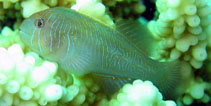
Dorsal spines (total): 7-7; Dorsal soft rays (total): 10-11; Anal spines: 1-1; Anal soft rays: 8-9. Characterized by red face with vertical blue lines; uniformly dark brown to light brown or bright green with a longitudinal thin red stripe; red stripe at the base of dorsal fins; absence of scales; complete pelvic fin frenum and basal membrane; depth of body at level of pelvic fins 2.6-3.0 in SL (Ref. 90102). |
| Biology: |
Marine species usually living on coral reefs but also recorded from pools, freshwater streams or lagoon mouths (Ref. 4343). They are found on tabletop Acropora corals (Ref. 1602); a coral-commensal species (Ref. 72446). Adults prey on copepods (Ref. 92840). Monogamous (Ref. 52884). The male takes care of eggs deposited on a coral branch (Ref. 32163). Has the ability to change sex in both directions to favor reproductive success (Ref. 32163). |
| IUCN Red List Status: |
Least Concern (LC); Date assessed: 28 June 2018 Ref. (130435)
|
| Threat to humans: |
harmless |
Source and more info: www.fishbase.org. For personal, classroom, and other internal use only. Not for publication.