This website uses cookies to enhance your browsing experience and ensure the functionality of our site. For more detailed information about the types of cookies we use and how we protect your privacy, please visit our Privacy Information page.
×
Cookie Settings
This website uses different types of cookies to enhance your experience. Please select your preferences below:
Arctic, Northwest to Northeast Pacific: drainages from Rae River (Coronation Gulf) and Great Bear Lake in Northwest Territories, Canada to Copper River in Alaska (Ref. 33312). Also rivers, estuaries and coastal waters of European and Siberian shores of Artic Ocean, from Kara drainage to Chukotka in eastern Siberia and to Korea and Hokkaido in Japan (Ref. 59043).
Length at first maturity / Size / Weight / Age
Maturity: Lm10.0 range ? - ? cm Max length : 20.0 cm TL male/unsexed; (Ref. 86798); common length : 11.3 cm TL male/unsexed; (Ref. 12193); max. published weight: 50.00 g (Ref. 56527); max. reported age: 10 years (Ref. 72499)
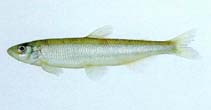
Dorsalspines (total): 0; Dorsalsoft rays (total): 8 - 11; Analspines: 0; Analsoft rays: 13 - 17; Vertebrae: 52 - 56. Vomer without posterior process; periphery of glossohyal bone with single row of conical teeth, another row of smaller teeth in center; pyloric caeca 2 (1-5); base of adipose fin more than 20% of head length; adipose eyelid absent. Body shape (shape guide): elongated.
Inhabits brackish water of estuaries, lagoons, coastal waters of open sea, freshwater of lowland and piedmont rivers and lakes (Ref. 59043). Found in the middle and surface waters of ponds, lakes, and streams over a variety of bottom types (Ref. 5723, 86798). The species is basically anadromous, ascending rivers to spawn in spring (Ref. 33312). The anadromous populations are pelagic at the sea, commonly at 4-5 m depth and spawn in rivers. Landlocked populations may spawn in lakes or undertake migration to their tributaries. Spawns along shallow river shores and in backwaters with little or no current, often in lakes, on sand or gravel bottom (Ref. 59043). Within a specific lake or pond, adults are generally found in inshore spawning areas in spring and early summer, later moving offshore (Ref. 27547). Feeds on zooplankton, insects and algae (Ref. 28680, 28681). Only a few survive beyond age 3 (Ref. 27547).
Saruwatari, T., J.A. López and T.W. Pietsch, 1997. A revision of the ormerid genus Hypomesus Gill (Teleostei: Salmoniformes), with a description of a new species from the southern Kuril Islands. Species Diversity 2:59-82. (Ref. 33312)
IUCN Red List Status (Ref. 130435: Version 2025-2)
Phylogenetic diversity index (Ref. 82804): PD50 = 0.5313 [Uniqueness, from 0.5 = low to 2.0 = high].
Bayesian length-weight: a=0.00398 (0.00246 - 0.00645), b=3.20 (3.06 - 3.34), in cm total length, based on LWR estimates for this species & (Sub)family-body (Ref. 93245).
Trophic level (Ref. 69278): 3.2 ±0.3 se; based on diet studies.
Resilience (Ref. 120179): Medium, minimum population doubling time 1.4 - 4.4 years (tm=2; tmax=5).
Fishing Vulnerability (Ref. 59153): Low vulnerability (10 of 100). 🛈