Common names from other countries
Milieu: milieu / Klimaatzone / Diepte / verspreidingsgebied
Ecologie
; zoet water; brak water pelagisch; potamodroom (Ref. 126106); diepte 2 - 30 m (Ref. 30578), usually 2 - 3 m (Ref. 27368). Temperate; 6°C - 22°C (Ref. 2059); 67°N - 36°N, 1°W - 75°E
Europe and Asia: Caspian, Baltic, Black and Aral Sea basins; Elbe (North Sea basin) and Maritza (Aegean basin) drainages. North to about 65° N in Finland. Introduced widely (Ref. 59043). Several countries report adverse ecological impact after introduction (Ref. 1739).
Lengte bij maturiteit / Grootte / Gewicht / Leeftijd
Maturiteit: Lm 37.2, range 28 - 46 cm
Max length : 100.0 cm SL mannelijk / geslacht onbekend; (Ref. 59043); common length : 50.0 cm TL mannelijk / geslacht onbekend; (Ref. 556); max. gepubliceerd gewicht: 20.0 kg (Ref. 40476); max. gerapporteerde leeftijd: 17 Jaren (Ref. 59043)
Dorsale stekels (totaal) : 13 - 20; Dorsale zachte stralen (totaal) : 18 - 24; Anale stekels: 2 - 3; Anale zachte stralen: 10 - 14; Wervels: 45 - 47. Distinguished from congeners in Europe by the following combination of characters: 1-2 enlarged canine teeth in anterior part of each jaw; second dorsal fin with 18-22½ branched rays; and 80-97 scales on lateral line (Ref. 59043).
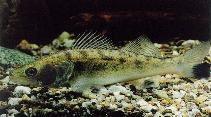
Body shape (shape guide): fusiform / normal.
Adults inhabit large, turbid rivers and eutrophic lakes, brackish coastal lakes and estuaries. They feed mainly on gregarious, pelagic fishes. They attain first sexual maturity at 3-10 years of age, usually at 4. Undertake short spawning migrations. Individuals foraging in brackish water move to freshwater habitats. Migrations up to 250 km have been recorded. Homing is well developed, even nearby populations may be relatively isolated. Spawn in pairs at dawn or night. Spawning occurs in April-May, exceptional from late February until July, depending on latitude and altitude when temperatures reach 10-14° C on spawning grounds (Ref. 59043). Popularly fished by sport fishers. Its flesh is succulent (Ref. 30578). Utilized fresh or frozen and eaten steamed, broiled and microwaved (Ref. 9988). An individual weighing 19 kg was reportedly caught in 1959 in Starnberger, Bavaria, Germany (Peter Admicka, pers. Comm. E-mail: peter.adamicka@oeaw.ac.at).
The spawning places are over gravel in moving water (Ref. 205). "Males are territorial and excavate shallow depressions about 50 cm in diameter and 5-10 cm deep in sand or gravel, or among exposed plant roots on which eggs are deposited, usually in turbid water and at 1-3 m depth. Spawn in pairs, at dawn or night. The female remains over the nest while the male circles rapidly around, at about 1 meter from the nest. Then male takes a vertical orientation and both swim around swiftly, and eggs and sperm are released, The female leaves the nest after all eggs are released. The male defends the nest and fans the eggs with his pectorals. Females spawn once a year, laying all the eggs at one time (Ref. 88075). Feeding larvae are positively phototactic and feed on pelagic organisms after they leave the nest for open water" (Ref. 59043).
Kottelat, M. and J. Freyhof, 2007. Handbook of European freshwater fishes. Publications Kottelat, Cornol and Freyhof, Berlin. 646 pp. (Ref. 59043)
Status op de Rode Lijst van het IUCN (Ref. 130435: Version 2025-2 (Global))
Gevaar voor de mens
Potential pest (Ref. 57271)
Gebruik door de mens
Visserij: commercieel; Aquacultuur: commercieel; sportvis: ja; Aquarium: Publieke aquaria
Tools
Speciale rapporten
Download XML
Internetbronnen
Schattingen op basis van modellen
Fylogenetische diversiteitsindex (Ref.
82804): PD
50 = 0.5312 [Uniqueness, from 0.5 = low to 2.0 = high].
Bayesian length-weight: a=0.00589 (0.00494 - 0.00702), b=3.12 (3.07 - 3.17), in cm total length, based on LWR estimates for this species (Ref.
93245).
Trofisch niveau (Ref.
69278): 4.0 ±0.78 se; based on food items.
Generation time: 8.2 (5.8 - 12.2) years. Estimated as median ln(3)/K based on 19
growth studies.
Weerstandsvermogen (Ref.
120179): laag, minimale populatieverdubbelingstijd 4,5-14 jaar (K=0.10-0.24; tmax=16; Fecundity=10,000).
Kwetsbaarheid van de visserij (Ref.
59153): High vulnerability (62 of 100).
🛈
Voedingsstoffen (Ref.
124155): Calcium = 50.9 [29.3, 80.5] mg/100g; Iron = 0.262 [0.132, 0.524] mg/100g; Protein = 18.8 [17.9, 19.6] %; Omega3 = 0.496 [0.193, 0.969] g/100g; Selenium = 2.25 [0.74, 7.60] μg/100g; VitaminA = 17 [6, 52] μg/100g; Zinc = 0.729 [0.551, 0.986] mg/100g (wet weight); based on
nutrient studies.