Reinhardtius hippoglossoides, Greenland halibut : fisheries, gamefish

You can sponsor this page

Reinhardtius hippoglossoides (Walbaum, 1792)

Greenland halibut
Beobachtung melden im Fish Watcher
Native range | All suitable habitat | Point map | Year 2050
This map was computer-generated and has not yet been reviewed.
Reinhardtius hippoglossoides   AquaMaps   Data sources: GBIF OBIS
Hochladen Photos und videos
Bilder | Google Bild
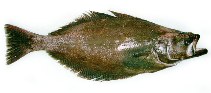
Image of Reinhardtius hippoglossoides (Greenland halibut)
Reinhardtius hippoglossoides
Photo von Dolgov, A.


Greenland territory information

Common names: Kaleralik, Netarnârak, Qaleralik
Occurrence: native
Salinity: marine
Abundance: | Ref:
Importance: commercial | Ref: Robins, C.R. and G.C. Ray, 1986
Aquaculture: | Ref:
Regulations: | Ref:
Uses: no uses
Comments: Occurs along the west coast including the fjords. On the east coast as far north as Scoresbysund (Ref. 9926). Also Ref. 9925, 9988.
National Checklist:
Territory Information: https://www.cia.gov/library/publications/resources/the-world-factbook/geos/gl.html
National Fisheries Authority:
Occurrences: Occurrences Point map
Main Ref: Nielsen, J.G., 1986
National Database:

Common names from other countries

Klassifizierung / Names Namen | Synonyme | Catalog of Fishes(Gattung, Arten) | ITIS | CoL | WoRMS | Cloffa

> Pleuronectiformes (Flatfishes) > Pleuronectidae (Righteye flounders) > Hippoglossinae
Etymology: Reinhardtius: Because of Johannes Christopher H. Reinhardt, Danish zoologist, studied under Vahl and Cuvier, professor in Kobanhavn in 1813 (1776-1845) (Ref. 45335).
Eponymy: Dr Johannes Christopher Hagemann Reinhardt (1778–1845) was a Norwegian zoologist who became Professor of Zoology (1814) at the University of Copenhagen. [...] (Ref. 128868), visit book page.
More on author: Walbaum.

Umwelt: Milieu / Klimazone / Tiefenbereich / Verbreitungsgebiet Ökologie

seewasser benthopelagisch; ozeanodrom (Ref. 51243); tiefenbereich 1 - 2200 m (Ref. 108960), usually 500 - 1000 m (Ref. 6263). Boreal; -1°C - 4°C (Ref. 43586); 79°N - 33°N, 180°W - 180°E (Ref. 54862)

Verbreitung Territorien | FAO Gebiete | Ökosysteme | Vorkommen | Punkt Karte | Einführungen | Faunafri

Circumglobal: In arctic and temperate waters; northern hemisphere. Sea of Japan off Honshu north to Shishmaref, Alaska in the Chukchi Sea, throughout the Aleutian Islands, and southeast to northern Baja California, Mexico. North Atlantic: New Jersey, USA to Spitsbergen (Svalbard Islands) and the Barents Sea south to Ireland. Northwest Atlantic: Canada (Ref. 5951).

Länge bei der ersten Reifung / Größe / Gewicht / Alter

Geschlechtsreife: Lm 63.5, range 65 - 80 cm
Max length : 110 cm TL Männchen/unbestimmt; (Ref. 80637); 130.0 cm TL (female); common length : 56.0 cm FL Männchen/unbestimmt; (Ref. 55110); max. veröff. Gewicht: 7.0 kg (Ref. 173); max. veröff. Gewicht: 7.0 kg; max. veröff. Alter: 36 Jahre (Ref. 117245)

Kurzbeschreibung Bestimmungsschlüssel | Morphologie | Morphometrie

Rückenflossenstacheln (insgesamt) : 0; Rückenflossenweichstrahlen (insgesamt) : 83 - 108; Afterflossenstacheln: 0; Afterflossenweichstrahlen: 62 - 79; Wirbelzahl: 60 - 64. Dorsal origin behind posterior edge of upper eye. Caudal slightly forked to truncate. Pectorals small.
Body shape (shape guide): fusiform / normal.

Biologie     Fachlexikon (Englisch) (z.B. epibenthic)

Often caught pelagically (Ref. 4705). Adults prefer bottom temperatures of -0.5°C to 6.0°C (Ref. 5951). Epibenthic (Ref. 58426). Feed on crustaceans, fishes (Ref. 4705, 6885), eelpouts, capelin, redfishes, deep sea prawns and other bottom invertebrates (Ref. 35388). Batch spawner (Ref. 51846). Utilized dried or salted and frozen; can be steamed and fried (Ref. 9988). Size of the Greenland halibut collected from 400-599 m deep in eastern Bering Sea, ranged from 9 to 99 cm FL with a mean of 56 cm (Ref. 55110).

Lebenszyklus und Paarungsverhalten Geschlechtsreife | Fortpflanzung | Ablaichen | Eier | Fruchtbarkeit | Larven

Fertilized eggs develop in approximately 50 days. Larvae are pelagic with a maximum size of 8 cm and will drift for about 4 months before settling at about 7 cm on clay-silt subtrates at depths of 300-450 m, after which they metamorphose (Ref. 117245).

Hauptreferenz Laden Sie Ihre Referenzen hoch | Referenzen | Koordinator : Amaoka, Kunio | Partner

Vinnikov, K.A., R.C. Thomson and T.A. Munroe, 2018. Revised classification of the righteye flounders (Teleostei: Pleuronectidae) based on multilocus phylogeny with complete taxon sampling. Molecular phylogenetics and evolution, 125:147-162. (Ref. 122998)

IUCN Rote Liste Status (Ref. 130435: Version 2025-2 (Global))

  Gefährdung zunehmend (NT) (A4bcd); Date assessed: 24 February 2021

CITES

Not Evaluated

CMS (Ref. 116361)

Not Evaluated

Bedrohung für Menschen

  Harmless


Nutzung durch Menschen

Fischereien: hoch kommerziell; Sportfisch: ja
FAO - Fischereien: landungen, Artbeschreibung; Publication: search | FIRMS - Stock assessments | FishSource | Das Meer um uns herum

Mehr Information

Trophische Ökologie
Lebensmittel (Beutetiere)
Nahrungszusammensetzung
Nahrungsaufnahme
Lebensmittelrationen
Räuber
Ökologie
Ökologie
Home ranges
Populationsdynamik
Wachstumsparameter
Max. Alter/Größen
Länge-Gewicht-Rel.
Länge-Länge-Verhältnis.
Längenhäufigkeiten
Massenkonvertierung
Rekrutierung
Dichte
Lebenszyklus
Fortpflanzung
Geschlechtsreife
Reifung/Kiemen rel.
Fruchtbarkeit
Ablaichen
Laichaggregationen
Eier
Eientwicklung
Larven
Larven Pop.Dyn.
Verbreitung
Territorien
FAO Gebiete
Ökosysteme
Vorkommen
Einführungen
BRUVS - Videos
Anatomie
Kiemenoberfläche
Gehirn
Otolith
Physiologie
Körperliche Zusammensetzung
Nährstoffe
Sauerstoffverbrauch
Schwimmart
Schwimmgeschwindigkeit
Visuelle Pigmente
Fischgeräusche
Krankheiten und Parasiten
Toxizität (LC50s)
Genetik
Genom
Genetik
Heterozygotie
Vererbbarkeit
Menschenbezogen
Aquakultur-Systeme
Aquakultur Profile
Zuchtlinien
Ciguatera-Fälle
Briefmarken, Münzen, Verschiedenes.
Aufsuchen
Partner
Referenzen
Referenzen

Tools

Zusatzinformationen

Download XML

Internet Quellen

AFORO (otoliths) | Aquatic Commons | BHL | Cloffa | Websites from users | FishWatcher Einträge suchen | CISTI | Catalog of Fishes: Gattung, Arten | DiscoverLife | ECOTOX | FAO - Fischereien: landungen, Artbeschreibung; Publication: search | Faunafri | Fishipedia | Fishtrace | GloBI | Google Books | Google Scholar | Google | IGFA World Record | Nationale Datenbanken | OceanAdapt | OneZoom | Open Tree of Life | Otolith Atlas of Taiwan Fishes | PubMed | Reef Life Survey | Socotra Atlas | TreeBase | Tree of Life | Wikipedia: Gehe zu, Suchen | World Records Freshwater Fishing | Zoologischer Rekord

Schätzungen auf der Grundlage von Modellen

Bevorzugte Temperatur (Ref. 123201): 0.5 - 4.2, mean 3 °C (based on 361 cells).
Phylogenetischer Diversitätsindex (Ref. 82804):  PD50 = 1.0000   [Uniqueness, from 0.5 = low to 2.0 = high].
Bayesian length-weight: a=0.00363 (0.00292 - 0.00451), b=3.19 (3.12 - 3.26), in cm total length, based on LWR estimates for this species (Ref. 93245).
Trophische Ebene (Ref. 69278):  4.4   ±0.1 se; based on diet studies.
Generation time: 12.2 (11.0 - 15.7) years. Estimated as median ln(3)/K based on 10 growth studies.
Widerstandsfähigkeit (Ref. 120179):  niedrig, Verdopplung der Population dauert 4,5 - 14 Jahre. (K=0.07-0.10; tm=7-12; tmax=30; Fec=6,800).
Prior r = 0.26, 95% CL = 0.17 - 0.39, Based on 13 full stock assessments.
Anfälligkeit der Fischerei (Ref. 59153):  High to very high vulnerability (71 of 100). 🛈
Klimaanfälligkeit (Ref. 125649):  Moderate vulnerability (39 of 100). 🛈
Preiskategorie (Ref. 80766):   Medium.
Nährstoffe (Ref. 124155):  Calcium = 6.69 [3.30, 13.54] mg/100g; Iron = 0.117 [0.062, 0.270] mg/100g; Protein = 15 [13, 17] %; Omega3 = 0.262 [0.104, 0.631] g/100g; Selenium = 44.6 [20.3, 101.4] μg/100g; VitaminA = 17.9 [3.9, 85.7] μg/100g; Zinc = 0.308 [0.204, 0.448] mg/100g (wet weight); based on nutrient studies.