Engraulis japonicus, Japanese anchovy : fisheries, aquaculture, bait

You can sponsor this page

Engraulis japonicus Temminck & Schlegel, 1846

Japanese anchovy
Thêm quan sát của bạn vào Fish Watcher
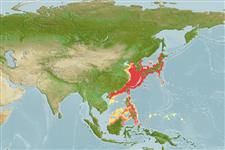
Native range | All suitable habitat | Point map | Year 2050
This map was computer-generated and has not yet been reviewed.
Engraulis japonicus   AquaMaps   Data sources: GBIF OBIS
Tải lên của bạn hình ảnh Và Video
Các tranh (Ảnh) | Google image
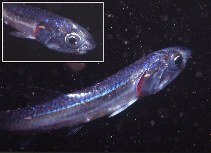
Image of Engraulis japonicus (Japanese anchovy)
Engraulis japonicus
Hình ảnh của Zsilavecz, G.


Japan territory information

Common names: Gisukeni, Katakuchi-iwashi, Niboshi
Occurrence: native
Salinity: marine
Abundance: common (usually seen) | Ref: Sokolovskaya, T.G., A.S. Sokolovskii and E.I. Sobolevskii, 1998
Importance: highly commercial | Ref: FAO, 1994
Aquaculture: | Ref:
Regulations: | Ref:
Uses: no uses
Comments: Adults occur eastwards to 160°E at high level of abundance; moves northwards in summer (Ref. 39882). Also Ref. 189.
National Checklist:
Territory Information: https://www.cia.gov/library/publications/resources/the-world-factbook/geos/ja.html
National Fisheries Authority: http://www.maff.go.jp/eindex.html
Occurrences: Occurrences Point map
Main Ref: Masuda, H., K. Amaoka, C. Araga, T. Uyeno and T. Yoshino, 1984
National Database:

Common names from other countries

Phân loại / Tên Tên thường gặp | Các synonym ( Các tên trùng) | Catalog of Fishes(Giống, Các loài) | ITIS | CoL | WoRMS | Cloffa

> Clupeiformes (Herrings) > Engraulidae (Anchovies) > Engraulinae
Etymology: Engraulis: Greek, eggraulis, -eos = anchovy (Ref. 45335).
More on authors: Temminck & Schlegel.

Môi trường: môi trường / vùng khí hậu / Mức độ sâu / phạm vi phân phối Sinh thái học

biển pelagic-neritic; Ở đại duơng, biển (Ref. 51243); mức độ sâu 0 - 400 m (Ref. 50550). Temperate; 8°C - 30°C (Ref. 56557); 49°N - 2°N, 105°E - 155°E (Ref. 54432)

Sự phân bố Lãnh thổ | Các khu vực của FAO | Các hệ sinh thái | Những lần xuất hiện | Bản đồ điểm | Những chỉ dẫn | Faunafri

Western Pacific: southern Sakhalin Islands, Sea of Japan and Pacific coasts of Japan, and south to almost Canton/Taiwan; rare records (seems to represent stray fishes) off the coasts of Luzon and Western Mindanao, Philippines and from Manado and Ujung Pandang, Sulawesi, Indonesia (Ref. 189).

Chiều dài lúc trưởng thành đầu tiên / Bộ gần gũi / Khối lượng (Trọng lượng) / Tuổi

Chín muồi sinh dục: Lm 10.5, range 10 - 11 cm
Max length : 18.0 cm TL con đực/không giới tính; (Ref. 56527); common length : 14.0 cm TL con đực/không giới tính; (Ref. 56527); Khối lượng cực đại được công bố: 45.00 g (Ref. 56527); Tuổi cực đại được báo cáo: 4 các năm (Ref. 56527)

Mô tả ngắn gọn Khóa để định loại | Hình thái học | Sinh trắc học

Các tia vây lưng cứng (tổng cộng) : 0; Các vây lưng mềm (tổng cộng) : 12 - 14; Tia cứng vây hậu môn: 0; Tia mềm vây hậu môn: 13 - 18. Differs very little from the European anchovy (see E. encrasicolus) and can be identified from that description. Of other anchovies found in the southern part of its distribution, only species of Encrasicholina and Stolephorus are of similar appearance, but all have small spine-like pre-pelvic scutes (usually 2 to 7 scutes). Thryssa have compressed bodies and a keel of scutes along belly.
Body shape (shape guide): elongated; Cross section: oval.

Sinh học     Tự điển (thí dụ epibenthic)

Occurs in large schools near the surface, mainly in coastal waters but as far out as over 1,000 km from the shore. Tends to move more northward and inshore in spring and summer. Juveniles associate with drifting seaweed (Ref. 12114, 12115). Feeds on copepods, but also on other small crustaceans, molluscan larvae, fish eggs and larvae and diatoms. Marketed fresh and salted, processed into fishmeal and oil (Ref. 12484).

Vòng đời và hành vi giao phối Chín muồi sinh dục | Sự tái sinh sản | Đẻ trứng | Các trứng | Sự sinh sản | Ấu trùng

Tài liệu tham khảo chính Tải lên tài liệu tham khảo của bạn | Các tài liệu tham khảo | Người điều phối | Người cộng tác

Whitehead, P.J.P., G.J. Nelson and T. Wongratana, 1988. FAO Species Catalogue. Vol. 7. Clupeoid fishes of the world (Suborder Clupeoidei). An annotated and illustrated catalogue of the herrings, sardines, pilchards, sprats, shads, anchovies and wolf-herrings. FAO Fish. Synop. 125(7/2):305-579. Rome: FAO. (Ref. 189)

Tình trạng Sách đỏ IUCN (Ref. 130435: Version 2025-2 (Global))

  Least Concern (LC) ; Date assessed: 16 May 2018

CITES

Not Evaluated

CMS (Ref. 116361)

Not Evaluated

Mối đe dọa đối với con người

  Reports of ciguatera poisoning (Ref. 4690)


Sử dụng của con người

Các nghề cá: tính thương mại cao; Nuôi trồng thủy sản: tính thương mại; mồi: usually
FAO - Các nghề cá: hạ cánh, hồ sơ loài; Publication: search | FishSource | Biển chung quanh ta

Thêm thông tin

Vòng đời
Sự tái sinh sản
Chín muồi sinh dục
Độ trưởng thành/Mang liên quan
Sự sinh sản
Đẻ trứng
Tập hợp sinh sản
Các trứng
Sự phát triển của trứng
Ấu trùng
Sự biến động ấu trùng
Sự phân bố
Lãnh thổ
Các khu vực của FAO
Các hệ sinh thái
Những lần xuất hiện
Những chỉ dẫn
BRUVS - Video
Giải phẫu
Vùng mang
Não
sỏi tai
Sinh lý học
Thành phần cơ thể
Chất dinh dưỡng
Thành phần ô-xy
Kiểu bơi
Tốc độ bơi
Sắc tố thị giác
Tiếng cá
Bệnh tật & Ký sinh trùng
Độc tính (LC50)
Liên quan đến con người
Hệ thống nuôi trồng thủy sản
Các tổng quan nuôi trồng thủy sản
Các giống
Các trường hợp ngộ độc Ciguatera
Tem, tiền xu, v.v.
Tiếp cận
Người cộng tác
Các tài liệu tham khảo

Các công cụ

Báo cáo đặc biệt

Tải xuống XML

Các nguồn internet

AFORO (otoliths) | Aquatic Commons | BHL | Cloffa | Websites from users | Check FishWatcher | CISTI | Catalog of Fishes: Giống, Các loài | DiscoverLife | ECOTOX | FAO - Các nghề cá: hạ cánh, hồ sơ loài; Publication: search | Faunafri | Fishipedia | Fishtrace | GloBI | Google Books | Google Scholar | Google | IGFA World Record | Các cơ sở dữ liệu quốc gia | OneZoom | Open Tree of Life | Otolith Atlas of Taiwan Fishes | PubMed | Reef Life Survey | Socotra Atlas | TreeBase | Cây Đời sống | Wikipedia: Go, tìm | World Records Freshwater Fishing | Zoobank | Tạp chí Zoological Record

Ước tính dựa trên mô hình

Nhiệt độ ưa thích (Tài liệu tham khảo 123201): 8.1 - 23.3, mean 18.4 °C (based on 139 cells).
Chỉ số đa dạng phát sinh loài (Tài liệu tham khảo 82804):  PD50 = 0.5020   [Uniqueness, from 0.5 = low to 2.0 = high].
Bayesian length-weight: a=0.00389 (0.00263 - 0.00576), b=3.10 (2.98 - 3.22), in cm total length, based on LWR estimates for this species & Genus-body shape (Ref. 93245).
Mức dinh dưỡng (Tài liệu tham khảo 69278):  3.1   ±0.1 se; based on diet studies.
Generation time: 1.1 (1.0 - 1.8) years. Estimated as median ln(3)/K based on 16 growth studies.
Thích nghi nhanh (Tài liệu tham khảo 120179):  Chiêù cao, thời gian nhân đôi của chủng quần tối thiểu là dưới 15 tháng (K=1.05; tm=1-2; tmax=3).
Prior r = 0.90, 95% CL = 0.60 - 1.36, Based on 3 full stock assessments.
Sự dễ bị tổn thương của nghề đánh cá (Ref. 59153):  Low vulnerability (23 of 100). 🛈
Loại giá (Ref. 80766):   Low.
Chất dinh dưỡng (Ref. 124155):  Calcium = 148 [56, 380] mg/100g; Iron = 0.698 [0.304, 1.783] mg/100g; Protein = 18.3 [16.8, 19.7] %; Omega3 = 1.57 [0.74, 3.39] g/100g; Selenium = 14.9 [5.6, 40.7] μg/100g; VitaminA = 7.51 [1.30, 42.67] μg/100g; Zinc = 0.939 [0.527, 1.630] mg/100g (wet weight);