This website uses cookies to enhance your browsing experience and ensure the functionality of our site. For more detailed information about the types of cookies we use and how we protect your privacy, please visit our Privacy Information page.
×
Cookie Settings
This website uses different types of cookies to enhance your experience. Please select your preferences below:
Teleostei (teleosts) > Eupercaria/misc (Various families in series Eupercaria) > Sciaenidae (Drums or croakers)
Etymology: Sciaena:Greek, skiaina, skion = a fish, red mullet (Ref. 45335). More on author: Linnaeus.
Environment: milieu / climate zone / depth range / distribution range Ecology
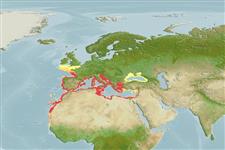
Marine; brackish; demersal; depth range 1 - 200 m (Ref. 9505). Subtropical; 51°N - 13°N, 19°W - 42°E
Eastern Atlantic: Southern Bay of Biscay to Mauritania, occasionally southwards to Senegal. Also throughout the Mediterranean and Black seas. Records from Ghana (Ref. 6810) and Gabon (Ref. 5516) are questionable. Two records in Belgium were actually for Micropogonias undulatus (Linnaeus, 1766) (Ref. 117298). The record off Wimereux is a misinterpretation during data entry mistake from the the Müller (2004, Ref. YYY) (Bailly, pers. comm., March 2018).
Length at first maturity / Size / Weight / Age
Maturity: Lm23.5 range ? - ? cm Max length : 70.0 cm TL male/unsexed; (Ref. 3397); common length : 28.0 cm TL male/unsexed; (Ref. 3397); max. reported age: 21 years (Ref. 9505)
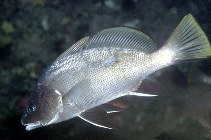
Occurs in shallow coastal waters mainly on rocky and sandy bottoms, often entering estuaries and more active at night. Also inhabits caves and reefs (Ref. 9987). Feeds on small fishes and crustaceans (Ref. 4780). SCUBA diving observations suggest this to be a very calm fish with remarkable buoyancy control and an ability to move without much apparent effort (Ref. 9505). Marketed fresh and frozen; in Turkey, otoliths are ground to a powder and used as remedy for urinary tract infections (Ref. 9987).
Chao, L.N. and E. Trewavas, 1990. Sciaenidae. p. 813-826. In J.C. Quero, J.C. Hureau, C. Karrer, A. Post and L. Saldanha (eds.) Check-list of the fishes the eastern tropical Atlantic (CLOFETA). JNICT, Lisbon; SEI, Paris; and UNESCO, Paris. Vol. 2. (Ref. 3593)
IUCN Red List Status (Ref. 130435: Version 2025-2)