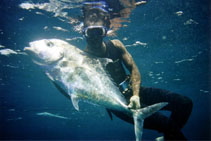
Common names from other countries
Klassifizierung / Names
Namen | Synonyme | Catalog of Fishes(Gattung, Arten) | ITIS | CoL | WoRMS | Cloffa
Umwelt: Milieu / Klimazone / Tiefenbereich / Verbreitungsgebiet
Ökologie
seewasser pelagic-neritic; tiefenbereich ? - 70 m (Ref. 2683). Subtropical; 42°N - 13°S, 19°W - 36°E
Eastern Atlantic: off Morocco to Angola (Ref. 4225, 57392), including southern parts of the Mediterranean (Ref. 4225).
Größe / Gewicht / Alter
Geschlechtsreife: Lm ? range ? - ? cm
Max length : 100.0 cm TL Männchen/unbestimmt; (Ref. 27584); common length : 60.0 cm TL Männchen/unbestimmt; (Ref. 3397); max. veröff. Gewicht: 3.2 kg (Ref. 40637)
Kurzbeschreibung
Bestimmungsschlüssel | Morphologie | Morphometrie
Rückenflossenstacheln (insgesamt) : 8; Rückenflossenweichstrahlen (insgesamt) : 20 - 22; Afterflossenstacheln: 3; Afterflossenweichstrahlen: 18 - 20. Diagnosis: body deep and strongly compressed, becoming elongate with growth (body depth comprised from 1.3 to 1.8 times in fork length); dorsal profile abrupt; mouth large, upper jaw ending below posterior half of eye; dorsal fin with 7 spines, becoming resorbed and indistinct at about 150 mm fork length, followed by 1 spine and 20-22 soft rays; anal fin with 2 spines, becoming resorbed and indistinct at very small sizes, followed by 1 spine and 18-20 soft rays; 1st dorsal- and anal-fin rays extremely long and filamentous in young individuals, becoming shorter in adults; pectoral fins falcate, longer than head; pelvic fins elongate in young individuals; scales very small and cycloid, hardly visible, absent on some parts of head and body; straight part of lateral line with 4-20 scutes; base of caudal fin with bilateral paired keels (Ref. 57392).
Coloration: silvery, with a faint metallic-blue tint on upper third of body and head; juveniles with 5 dark crossbars on sides (Ref. 57392).
Body shape (shape guide): short and / or deep.
Adults solitary in coastal water near the bottom to at least 50 m and strong swimmers (Ref. 7079, 57392). Juveniles usually pelagic and drifting, sometimes occurring in brackish water (Ref. 4225, 57392). Feed on squid and other fishes (Ref. 4233). Eggs are pelagic (Ref. 4233).
Lebenszyklus und Paarungsverhalten
Geschlechtsreife | Fortpflanzung | Ablaichen | Eier | Fruchtbarkeit | Larven
Smith-Vaniz, W.F., J.-C. Quéro and M. Desoutter, 1990. Carangidae. p. 729-755. In J.C. Quero, J.C. Hureau, C. Karrer, A. Post and L. Saldanha (eds.) Check-list of the fishes of the eastern tropical Atlantic (CLOFETA). JNICT, Lisbon; SEI, Paris; and UNESCO, Paris. Vol. 2. (Ref. 7097)
IUCN Rote Liste Status (Ref. 130435: Version 2025-2 (Global))
Bedrohung für Menschen
Harmless
Nutzung durch Menschen
Fischereien: weniger kommerziell; Sportfisch: ja
Tools
Zusatzinformationen
Download XML
Internet Quellen
Schätzungen auf der Grundlage von Modellen
Bevorzugte Temperatur (Ref.
123201): 18.6 - 27.9, mean 24.4 °C (based on 150 cells).
Phylogenetischer Diversitätsindex (Ref.
82804): PD
50 = 0.7500 [Uniqueness, from 0.5 = low to 2.0 = high].
Bayesian length-weight: a=0.02455 (0.01365 - 0.04414), b=2.83 (2.67 - 2.99), in cm total length, based on LWR estimates for this species & (Sub)family-body (Ref.
93245).
Trophische Ebene (Ref.
69278): 3.6 ±0.59 se; based on food items.
Widerstandsfähigkeit (Ref.
120179): mittel, Verdopplung der Population dauert 1,4 - 4,4 Jahre. (Assuming tm=3-4).
Anfälligkeit der Fischerei (Ref.
59153): High vulnerability (60 of 100).
🛈
Klimaanfälligkeit (Ref.
125649): High to very high vulnerability (69 of 100).
🛈
Nährstoffe (Ref.
124155): Calcium = 61.2 [24.9, 118.5] mg/100g; Iron = 1.32 [0.68, 2.80] mg/100g; Protein = 19.6 [18.3, 20.9] %; Omega3 = 0.269 [0.144, 0.501] g/100g; Selenium = 25.9 [12.2, 56.9] μg/100g; VitaminA = 5.16 [1.20, 19.90] μg/100g; Zinc = 0.558 [0.374, 0.860] mg/100g (wet weight);