Aphanopus carbo, Black scabbardfish : fisheries

You can sponsor this page

Aphanopus carbo Lowe, 1839

Black scabbardfish
Waarneming toevoegen in Fish Watcher
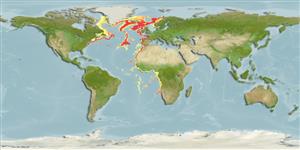
Native range | All suitable habitat | Point map | Year 2050
This map was computer-generated and has not yet been reviewed.
Aphanopus carbo   AquaMaps   Data sources: GBIF OBIS
Uploaden van uw Foto's en video's
Afbeeldingen | Google afbeelding
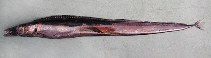
Image of Aphanopus carbo (Black scabbardfish)
Aphanopus carbo
Female Afbeelding van Cambraia Duarte, P.M.N. (c)ImagDOP

Common names from other countries

Classificatie / Namen Lokale namen | Synoniemen | Catalog of Fishes(Genus, Soort(en)) | ITIS | CoL | WoRMS | Cloffa

> Scombriformes (Mackerels) > Trichiuridae (Cutlassfishes) > Aphanopodinae
Etymology: Aphanopus: Greek, aphanes = hidden + Greek, pous = foot (Ref. 45335).
More on author: Lowe.

Milieu: milieu / Klimaatzone / Diepte / verspreidingsgebied Ecologie

marien bathypelagisch; oceanodroom (Ref. 108735); diepte 200 - 2300 m (Ref. 108733), usually 700 - 1300 m (Ref. 108735). Deep-water; 71°N - 23°S, 82°W - 17°E (Ref. 6181)

Verspreiding Gebieden | FAO regio's | Ecosystemen | Voorkomen | Verspreidingskaart | Introducties | Faunafri

North Atlantic: on both sides and at underwater rises from Denmark Strait to Cape Verde.

Lengte bij maturiteit / Grootte / Gewicht / Leeftijd

Maturiteit: Lm 111.6  range ? - 117.5 cm
Max length : 151 cm TL mannelijk / geslacht onbekend; (Ref. 108708); common length : 70.0 cm SL mannelijk / geslacht onbekend; (Ref. 3698); max. gepubliceerd gewicht: 0.00 g

Korte beschrijving Determinatiesleutels | Morfologie | Morfometrie

Dorsale stekels (totaal) : 34 - 41; Dorsale zachte stralen (totaal) : 52 - 56; Anale stekels: 2; Anale zachte stralen: 43 - 48; Wervels: 97 - 100. Body is extremely elongated, with body depth 10.8 to 13.4 times in SL. The snout is large with strong fang-like teeth. Pelvic fins represented by a single spine in juveniles but entirely absent in adults. Color is coppery black with iridescent tint. The inside of the mouth and gill cavities black.
Body shape (shape guide): eel-like; Cross section: compressed.

Biologie     Verklarende woordenlijst (bv. epibenthic)

Juveniles mesopelagic (Ref. 6181). Bathypelagic (Ref. 58426). Migrate to midwater at night and feed on crustaceans, cephalopods and fishes (mostly macrourids, morids and alepocephalids). Mature at 80 to 85 cm. Eggs and larvae are pelagic (Ref. 6768). Data from study reveal mature individuals undertake horizontal migration to spawning and nursery grounds located off the Madeira and Canary islands (Ref. 108708). Commercial catch up to 1000 t was caught off Madeira with a specialized commercial deep water longline (Ref. 6255). Appear as bycatch in the trawl fishery west of the British Isles, along the Middle-Atlantic Ridge and at Corner Rise. Important and fabled food fish in Madeira (Ref. 4537). Some specimens reach 145 cm (Nuno Marques, Nomad@netmadeira.com, 12/09).

Levenscyclus en paargedrag Maturiteit | Voortplanting | Paaien | Eieren | Fecunditeit | Larven

Displays determinate fecundity (Ref. 108695). Mature individuals undertake horizontal migration to spawning and nursery grounds (Ref. 108708). Suspended pre-spawning stages occurred in some areas of the Northeast Atlantic caused by atresia in ovaries (Ref. 108708).

Hoofdreferentie Upload uw referenties | Referenties | Coördinator : Parin, Nikolay V. | Medewerkers

Nakamura, I. and N.V. Parin, 1993. FAO Species Catalogue. Vol. 15. Snake mackerels and cutlassfishes of the world (families Gempylidae and Trichiuridae). An annotated and illustrated catalogue of the snake mackerels, snoeks, escolars, gemfishes, sackfishes, domine, oilfish, cutlassfishes,. scabbardfishes, hairtails, and frostfishes known to date. FAO Fish. Synop. 125(15):136 p. (Ref. 6181)

Status op de Rode Lijst van het IUCN (Ref. 130435: Version 2025-2 (Global))

  Niet bedreigd (LC) ; Date assessed: 12 October 2018

CITES

Not Evaluated

CMS (Ref. 116361)

Not Evaluated

Gevaar voor de mens

  Harmless


Gebruik door de mens

Visserij: van groot commercieel belang
FAO - visserij: aanvoer, soortsprofiel; Publication: search | FIRMS - Stock assessments | FishSource | Sea Around Us

Meer informatie

Trofische ecologie
Voedsel (prooien)
Dieetsamenstelling
Voedselconsumptie
Voedselrantsoenen
Predatoren
Ecologie
Ecologie
Home ranges
Populatiedynamica
Groeiparameters
Max. leeftijden / maten
Lengte-gewicht rel.
Lengte-lengte rel.
Lengtefrequenties
Massaconversie
Rekrutering
Abundantie
Levenscyclus
Voortplanting
Maturiteit
Rijpheid/kieuwen rel.
Fecunditeit
Paaien
Paaibestanden
Eieren
Ontwikkeling van de eieren
Larven
Larvale populatiedynamiek
Verspreiding
Gebieden
FAO regio's
Ecosystemen
Voorkomen
Introducties
BRUVS - Video's
Anatomie
Kieuwoppervlak
Hersenen
Otoliet
Fysiologie
Lichaamssamenstelling
Voedingsstoffen
Zuurstofverbruik
Type zwemmen
Zwemsnelheid
Visuele pigmenten
Vis geluid
Ziekten en parasieten
Toxiciteit (LC50)
Genetica
genoom
Genetica
Heterozygositeit
Erfelijkheid
Menselijk gerelateerd
Aquacultuursystemen
Aquacultuurprofielen
Kweeklijnen
Ciguatera gevallen
Postzegels, munten, diversen.
Outreach
Medewerkers
Referenties
Referenties

Tools

Speciale rapporten

Download XML

Internetbronnen

AFORO (otoliths) | Aquatic Commons | BHL | Cloffa | Websites from users | Bekijk FishWatcher | CISTI | Catalog of Fishes: Genus, Soort(en) | DiscoverLife | ECOTOX | FAO - visserij: aanvoer, soortsprofiel; Publication: search | Faunafri | Fishipedia | Fishtrace | GloBI | Google Books | Google Scholar | Google | IGFA World Record | Nationale databanken | OneZoom | Open Tree of Life | Otolith Atlas of Taiwan Fishes | PubMed | Reef Life Survey | Socotra Atlas | TreeBase | Tree of Life | Wikipedia: ga naar, zoek | World Records Freshwater Fishing | Zoobank | Zoological Record

Schattingen op basis van modellen

Gewenste temperatuur (Ref. 123201): 1.1 - 12.6, mean 7.1 °C (based on 244 cells).
Fylogenetische diversiteitsindex (Ref. 82804):  PD50 = 0.5078   [Uniqueness, from 0.5 = low to 2.0 = high].
Bayesian length-weight: a=0.00046 (0.00033 - 0.00063), b=3.15 (3.06 - 3.24), in cm total length, based on LWR estimates for this species (Ref. 93245).
Trofisch niveau (Ref. 69278):  4.5   ±0.77 se; based on food items.
Weerstandsvermogen (Ref. 120179):  Gemiddeld, minimale populatieverdubbelingstijd 1,4-4,4 jaar (K=0.11-0.25, tmax=14?; tm=3).
Prior r = 0.20, 95% CL = 0.13 - 0.30, Based on 3 full stock assessments.
Kwetsbaarheid van de visserij (Ref. 59153):  High vulnerability (64 of 100). 🛈
Kwetsbaarheid voor het klimaat (Ref. 125649):  Moderate vulnerability (44 of 100). 🛈
Prijsklasse (Ref. 80766):   Low.
Voedingsstoffen (Ref. 124155):  Calcium = 11.6 [6.0, 18.7] mg/100g; Iron = 0.192 [0.097, 0.400] mg/100g; Protein = 17.4 [16.1, 18.7] %; Omega3 = 0.161 [0.071, 0.370] g/100g; Selenium = 34.7 [15.7, 77.9] μg/100g; VitaminA = 15.8 [1.6, 130.4] μg/100g; Zinc = 0.391 [0.267, 0.539] mg/100g (wet weight); based on nutrient studies.