Lates calcarifer, Barramundi : fisheries, aquaculture, gamefish, aquarium

You can sponsor this page

Lates calcarifer (Bloch, 1790)

Barramundi
Добавить Ваши наблюдения в Fish Watcher
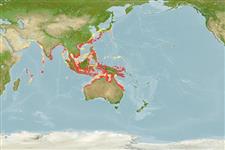
Native range | All suitable habitat | Point map | Year 2050
This map was computer-generated and has not yet been reviewed.
Lates calcarifer   AquaMaps   Data sources: GBIF OBIS
Загрузить свой Фото и Видео
изображения | Марки, монеты и прочее. | Изображение на Google
Image of Lates calcarifer (Barramundi)
Lates calcarifer
Изображение сделано Lai, N.-W.


Thailand territory information

Common names: Pla kapong keo, Pla kapong-khao
Occurrence: native
Salinity: brackish
Abundance: | Ref:
Importance: highly commercial | Ref:
Aquaculture: commercial | Ref: FAO Fishery Information, Data and Statistics Service, 1993
Regulations: | Ref:
Uses: live export: yes;
Comments: Known fom Nonthaburi, Songkhla, Krabi, Trat, Chanthaburi, Samut Prakan and Klong Wan (Prachuap Khiri Khan) (Ref. 37773). Also Ref. 778, 3281.
National Checklist:
Territory Information: https://www.cia.gov/library/publications/resources/the-world-factbook/geos/th.html
National Fisheries Authority:
Occurrences: Occurrences Point map
Main Ref: Monkolprasit, S., S. Sontirat, S. Vimollohakarn and T. Songsirikul, 1997
National Database:

Common names from other countries

Классификация / Имена народные названия | синонимы | Catalog of Fishes(род, виды) | ITIS | CoL | WoRMS | Cloffa

> Carangaria/misc (Various families in series Carangaria) > Latidae (Lates perches)
Etymology: Lates: Latin, lateo, latere = to be hidden.
More on author: Bloch.

Окружающая среда: среда / климатическая зона / пределы глубины / диапазон распространения экология

морской; пресноводный; солоноватоводный демерсальный; катадромный (Ref. 51243); пределы глубины 10 - 40 m (Ref. 7261). Tropical; 15°C - 28°C (Ref. 2060); 49°N - 26°S, 56°E - 155°E (Ref. 54239)

распространение Территории | регионы FAO | Экосистемы | места находок | карта точек | интродукции | Faunafri

Indo-West Pacific: eastern edge of the Persian Gulf to China, Taiwan and southern Japan, southward to southern Papua New Guinea and northern Australia.

Длина при первой зрелости / Размер / Вес / Возраст

половая зрелость: Lm 44.5, range 29 - 60 cm
Max length : 200 cm TL самец/пол неопределен; (Ref. 7050); common length : 150 cm NG самец/пол неопределен; (Ref. 9799); наибольший вес (опубликованные данные): 60.0 kg (Ref. 28138); наибольший возраст (опубликованны данные): 35 годы (Ref. 125591)

Краткое описание определительные ключи | морфология | морфометрия

колючие лучи спинного плавника (общее число) : 7 - 9; членистые (мягкие) лучи спинного плавника (общее число) : 10 - 11; колючие лучи анального плавника: 3; членистые (мягкие) лучи анального плавника: 7 - 8. Body elongate; mouth large, slightly oblique, upper jaw extending behind the eye. Lower edge of preopercle serrated, with strong spine at its angle; opercle with a small spine and with a serrated flap above the origin of the lateral line. Caudal fin rounded.
Body shape (shape guide): fusiform / normal; Cross section: compressed.

биология     глоссарий (например epibenthic)

Found in coastal waters, estuaries and lagoons, in clear to turbid water (Ref. 5259, 44894). A diadromous fish, inhabiting rivers before returning to the estuaries to spawn. A protandrous hermaphrodite (Ref. 32209). Larvae and young juveniles live in brackish temporary swamps associated with estuaries, and older juveniles inhabit the upper reaches of rivers (Ref. 6390, 44894). Have preference for cover on undercut banks, submerged logs and overhanging vegetation (Ref. 44894). Feed on fishes and crustaceans. They reach 1500-3000 g in one year in ponds under optimum conditions (Ref. 11046, 44894). Juveniles also eat insects (Ref. 44894). Sold fresh and frozen; consumed steamed, pan-fried, broiled and baked (Ref. 9987). A very popular and sought-after fish of very considerable economic importance (Ref. 9799). Presently used for aquaculture in Thailand, Indonesia and Australia (Ref. 9799). Australia's most important commercial fish and one of the most popular angling species (Ref. 44894).

Жизненный цикл и брачное поведение половая зрелость | размножение | нерест | икра | Плодовитость | личинки

Breed in estuaries throughout the Indo-Pacific. Maturing male barramundi migrate downstream from freshwater habitats at the start of the wet (monsoon) season to spawn with resident females in estuaries (Ref. 27132) and on tidal flats outside the mouths of rivers (Ref. 6390). Barramundi spawn on the full moon and new moon, primarily at the beginning of an incoming tide which carries the eggs into the estuary (Ref. 28135). Barramundi are broadcast spawners that aggregate to spawn (Ref. 6390). Spawning aggregations occur in or around the mouths of rivers (Ref. 28132). While adults and juveniles are capable of living in fresh water, brackish waters are required for embryonic development (Ref. 6136). Female barramundi are capable of producing large numbers of eggs, with estimates as high as 2.3 million eggs per kg of body weight (Ref. 28134). Barramundi are protandrous hermaphrodites, i.e., they undergo sex reversion during their life cycle. Females are generally absent in the smaller length classes, but dominate larger length classes. Most barramundi mature first as males and function as males for one or more spawning seasons before undergoing sex inversion. A few females will develop directly from immature fish (Ref. 28132). Similarly, some males may never undergo sex inversion (Ref. 28132). Also Ref. 103751.

Основная ссылка Загрузите свои рекомендации | ссылки | координатор | соавторы

Larson, H., 1999. Order Perciformes. Suborder Percoidei. Centropomidae. Sea perches. p. 2429-2432. In K.E. Carpenter and V.H. Niem (eds.) FAO species identification guide for fishery purposes. The living marine resources of the Western Central Pacific. Volume 4. Bony fishes part 2 (Mugilidae to Carangidae). FAO, Rome. (Ref. 9799)

Статус Красного Списка МСОП (Ref. 130435: Version 2025-2)

  Не вызывающий беспокойства (LC) ; Date assessed: 15 February 2019

CITES

Not Evaluated

CMS (Ref. 116361)

Not Evaluated

Угроза для людей

  Harmless


Использование человеком

рыболовство: важный объект промысла; аквакультура (рыбоводство): коммерческий; объект спортивного рыболовства: да; аквариум: общественные аквариумы
FAO - Системы аквакультуры: Производство, Видовой профиль; рыболовство: посадки, Видовой профиль; Publication: search | FishSource | Море вокруг нас

дополнительная информация

Трофическая экология
Пищевые предметы (добыча)
состав пищи
потребление пищи
Продовольственные пайки
хищники
экология
экология
Home ranges
Жизненный цикл
размножение
половая зрелость
Зрелость/Жиры относительно.
Плодовитость
нерест
Нерестовые скопления
икра
Развитие икры
личинки
динамика численности личинок
Анатомия
жаберная область
Мозг
Отолит
Физиология
Состав тела
Питательные вещества
Потребление кислорода
Тип плавания
Скорость плавания
Зрительные пигменты
Звук рыбы
Болезни и паразиты
Токсичность (LC50s)
генетика
Геном
генетика
Гетерозиготность
наследуемость
Связанные с человеком
Системы аквакультуры
особенности рыбоводства
степень растяжения
Случаи заболевания сигуатерой
Марки, монеты и прочее.
Информационно-просветительская работа
соавторы
ссылки
ссылки

инструменты

Специальные отчеты

Скачать в формате XML

ресурсы в Интернет

Оценки, основанные на моделях

Предпочтительная температура (ссылка 123201): 25 - 29.1, mean 28.3 °C (based on 710 cells).
Индекс филогенетического разнообразия (ссылка 82804):  PD50 = 0.5005   [Uniqueness, from 0.5 = low to 2.0 = high].
Bayesian length-weight: a=0.00977 (0.00619 - 0.01542), b=3.00 (2.87 - 3.13), in cm total length, based on LWR estimates for this species & Genus-body shape (Ref. 93245).
Трофический уровень (ссылка 69278):  3.8   ±0.60 se; based on food items.
устойчивость к внешним воздействиям (ссылка 120179):  средний (среднего размера), минимальное время удвоения популяции 1.4-4.4 года (K=0.09-0.13; tm=1-5; Fec = 15,300,000).
Prior r = 0.52, 95% CL = 0.34 - 0.77, Based on 3 full stock assessments.
Уязвимость рыбной ловли (Ref. 59153):  High to very high vulnerability (69 of 100). 🛈
Климатическая уязвимость (Ref. 125649):  High to very high vulnerability (72 of 100). 🛈
Категория цены (Ref. 80766):   Very high.
Питательные вещества (Ref. 124155):  Calcium = 115 [26, 284] mg/100g; Iron = 1 [0, 2] mg/100g; Protein = 19.6 [18.2, 21.1] %; Omega3 = 0.187 [0.117, 0.295] g/100g; Selenium = 144 [50, 373] μg/100g; VitaminA = 7.36 [2.09, 30.74] μg/100g; Zinc = 0.84 [0.34, 1.90] mg/100g (wet weight); based on nutrient studies.