Solea solea, Common sole : fisheries, aquaculture, gamefish, aquarium

You can sponsor this page

Solea solea (Linnaeus, 1758)

Common sole
Ajouter votre observation dans Fish Watcher
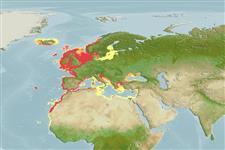
Native range | All suitable habitat | Point map | Year 2050
This map was computer-generated and has not yet been reviewed.
Solea solea   AquaMaps   Data sources: GBIF OBIS
Envoyez vos Photos et vidéos
Images | Timbres, pièces de monnaie, divers | Images Google
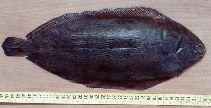
Image of Solea solea (Common sole)
Solea solea
Photo de Canosa, C. & B.F. Souto


Tunisia territory information

Common names: [No common name]
Occurrence: native
Salinity: marine
Abundance: | Ref:
Importance: minor commercial | Ref: FAO, 1994
Aquaculture: commercial | Ref: FAO, 1997
Regulations: | Ref:
Uses: no uses
Comments:
National Checklist:
Territory Information: https://www.cia.gov/library/publications/resources/the-world-factbook/geos/ts.html
National Fisheries Authority:
Occurrences: Occurrences Point map
Main Ref: Muus, B. and P. Dahlström, 1978
National Database:

Common names from other countries

Classification / Noms Noms communs | Synonymes | Catalog of Fishes(Genre, Espèce) | ITIS | CoL | WoRMS | Cloffa

> Pleuronectiformes (Flatfishes) > Soleidae (Soles)
Etymology: Solea: Latin, solea = sandal (shoe); refered to the flat shape of the fish (Ref. 45335).
More on author: Linnaeus.

Environnement : milieu / zone climatique / profondeur / gamme de distribution Écologie

marin; saumâtre démersal; océanodrome (Ref. 51243); profondeur 0 - 150 m (Ref. 35388), usually 10 - 60 m (Ref. 6302). Subtropical; 8°C - 24°C (Ref. 4944); 64°N - 14°N, 25°W - 38°E (Ref. 54889)

Distribution Territoires | Zones FAO | Écosystèmes | Occurrences | Carte par point | Introductions | Faunafri

Eastern Atlantic: southward from Trondheim Fjord (including North Sea and western Baltic) and Mediterranean Sea (including Sea of Marmara, Bosporus and southwestern Black Sea) (Ref. 4710). Elsewhere, southward to Senegal (Ref. 4710), including Cape Verde (Ref. 5304).

Longueur à la première maturité / Taille / Poids / Âge

Maturité: Lm 30.3  range ? - ? cm
Max length : 70.0 cm SL mâle / non sexé; (Ref. 4710); common length : 35.0 cm SL mâle / non sexé; (Ref. 5504); poids max. publié: 3.0 kg (Ref. 5504); âge max. reporté: 26 années (Ref. 32766)

Description synthétique Clés d'identification | Morphologie | Morphométrie

Épines dorsales (Total) : 0; Rayons mous dorsaux (Total) : 69 - 97; Épines anales: 0; Rayons mous anaux: 53 - 80; Vertèbres: 46 - 52. This species is distinguished by the following characters: body oval, flat and asymmetric; eyes located on right side of head, except in reversed individuals (Ref. 57416). Upper eye less than its own diameter from dorsal profile of head (Ref. 4710). Anterior nostril on blind side not enlarged (Ref. 4710, 57416), but surrounded by small rim (Ref. 57416). Its distance from front margin of head 1.5-1.9x in its distance from cleft of mouth; anterior nostril on eyed side with backward-pointing tube not or only barely reaching front border of lower eye (Ref. 4710). Preopercle covered by skin and opercle entirely scaled; mouth arched and inferior; dorsal and anal fins lacking spinous rays and united to caudal fin by well-developed membrane, but caudal peduncle distinct; dorsal fin originating on horizontal axis through upper eye; pectoral fin on eyed side asymmetrical, with 7-10 rays, and on blind side slightly shorter; straight part of lateral line visible, supratemporal part slightly arched above eyes; body covered with rectangular ctenoid scales (Ref. 57416).
Body shape (shape guide): short and / or deep; Cross section: flattened.

Biologie     Glossaire (ex. epibenthic)

Adults occur at a temperature range of 8.0-24.0°C (Ref. 4944). Usually solitary. They burrow into sandy and muddy bottoms. Retreat to deeper water during winter (Ref. 9988). Juveniles are found during the first 2 to 3 years in coastal nurseries (bays and nurseries) before migrating to deeper waters (Ref. 92286). Adults feed on worms, mollusks and small crustaceans at night. Waden sea is the most important nursery area. Batch spawner (Ref. 51846). Recruitment is very variable. Frequently found pelagically during spawning migrations (Ref. 35388). Marketed fresh and frozen; utilized steamed, fried, broiled, microwaved and baked (Ref. 9988).

Cycle de vie et comportement reproducteur Maturité | Reproduction | Frai | Œufs | Fécondité | Larves

Spawning takes place in shallow coastal waters at temperatures of 6 - 12°C. Reproduction starts after 3-5 years of age, when 25-30cm size is reached. Spawning happens mainly during the months of February-May (for example, off the coasts of Galicia), although in warmer areas (such as the Mediterranean), it can occur at the beginning of the winter. Incubation lasts about 5 days (at 1 2°) and larval phase 35 days (at 18°C).

Référence principale Téléchargez vos références | Références | Coordinateur | Collaborateurs

Desoutter, M., 1992. Soleidae. p. 860-865. In C. Levêque, D. Paugy, and G.G. Teugels (eds.) Faune des poissons d'eaux douces et saumâtres d'Afrique de l'Ouest Tome 2. Faune Tropicale n° 28. Musée Royal de l'Afrique Centrale, Tervuren, Belgique and O.R.S.T.O.M., Paris, France, 902. (Ref. 7395)

Statut dans la liste rouge de l'IUCN (Ref. 130435: Version 2025-2 (Global))

  Données manquantes (DD) ; Date assessed: 15 July 2014

CITES

Not Evaluated

CMS (Ref. 116361)

Not Evaluated

Menace pour l'homme

  Harmless


Utilisations par l'homme

Pêcheries: hautement commercial; Aquaculture: commercial; pêche sportive: oui; Aquarium: Aquariums publics
FAO - Systèmes d'aquaculture: production; pêcheries: débarquements, Résumé espèce; Publication: search | FIRMS - Stock assessments | FishSource | Sea Around Us

Plus d'informations

Anatomie
Surface branchiale
Cerveau
Otolithe
Génétique
génôme
Génétique
Hétérozygotie
Héritabilité
Liées à l'homme
Systèmes d'aquaculture
Profils d'aquaculture
Souches
Cas de ciguatera
Timbres, pièces de monnaie, divers
Sensibilisation
Collaborateurs
Références
Références

Outils

Articles particuliers

Télécharger en XML

Sources Internet

AFORO (otoliths) | Aquatic Commons | BHL | Cloffa | Websites from users | FishWatcher | CISTI | Catalog of Fishes: Genre, Espèce | DiscoverLife | DORIS | ECOTOX | FAO - Systèmes d'aquaculture: production; pêcheries: débarquements, Résumé espèce; Publication: search | Faunafri | Fishipedia | Fishtrace | GloBI | Google Books | Google Scholar | Google | IGFA World Record | Bases de données nationales | OneZoom | Open Tree of Life | Otolith Atlas of Taiwan Fishes | Aquariums publics | PubMed | Reef Life Survey | Socotra Atlas | TreeBase | Arbre de Vie | Wikipedia: aller à, chercher | World Records Freshwater Fishing | Zoological Record

Estimations basées sur des modèles

Température préférée (Réf. 123201): 9 - 20, mean 11.4 °C (based on 678 cells).
Indice de diversité phylogénétique (Réf. 82804):  PD50 = 0.5020   [Uniqueness, from 0.5 = low to 2.0 = high].
Bayesian length-weight: a=0.00661 (0.00575 - 0.00759), b=3.08 (3.04 - 3.12), in cm total length, based on LWR estimates for this species (Ref. 93245).
Niveau trophique (Réf. 69278):  3.2   ±0.1 se; based on diet studies.
Generation time: 3.9 (3.2 - 4.6) years. Estimated as median ln(3)/K based on 31 growth studies.
Résilience (Réf. 120179):  Milieu, temps minimum de doublement de population : 1,4 à 4,4 années (K=0.21-0.33; tm=3-5; tmax=26; Fec=100,000).
Prior r = 0.50, 95% CL = 0.33 - 0.75, Based on 40 full stock assessments.
Vulnérabilité de la pêche (Ref. 59153):  Low to moderate vulnerability (35 of 100). 🛈
Vulnérabilité climatique (Ref. 125649):  Moderate vulnerability (38 of 100). 🛈
Catégorie de prix (Ref. 80766):   Very high.
Nutriments (Ref. 124155):  Calcium = 79.8 [29.8, 184.5] mg/100g; Iron = 0.915 [0.416, 1.919] mg/100g; Protein = 18.3 [16.6, 20.1] %; Omega3 = 0.224 [0.141, 0.343] g/100g; Selenium = 17.2 [6.8, 47.5] μg/100g; VitaminA = 4.77 [1.36, 16.81] μg/100g; Zinc = 0.453 [0.263, 1.007] mg/100g (wet weight); based on nutrient studies.