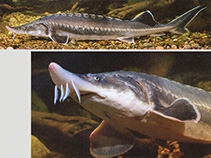
Acipenser huso, Beluga : fisheries, aquaculture

You can sponsor this page

Acipenser huso Linnaeus, 1758

Beluga
Upload your photos and videos
Pictures | Stamps, coins, misc. | Google image
Image of Acipenser huso (Beluga)
Acipenser huso
Picture by Hartl, A.


Ukraine territory information

Common names: Beluga, Білуга, Білуга звичайна
Occurrence: native
Salinity: freshwater
Abundance: | Ref:
Importance: | Ref:
Aquaculture: commercial | Ref: FAO, 1997
Regulations: | Ref:
Uses: no uses
Comments:
National Checklist:
Territory Information: https://www.cia.gov/library/publications/resources/the-world-factbook/geos/up.html
National Fisheries Authority:
Occurrences: Occurrences Point map
Main Ref: Svetovidov, A.N., 1964
National Database:

Common names from other countries

Classification / Names Common names | Synonyms | Catalog of Fishes(genus, species) | ITIS | CoL | WoRMS | Cloffa

Chondrostei (sturgeons) > Acipenseriformes (Sturgeons and paddlefishes) > Acipenseridae (Sturgeons)
Etymology: Acipenser: Latin, acipenser = sturgeon, 1853 (Ref. 45335).
More on author: Linnaeus.

Environment: milieu / climate zone / depth range / distribution range Ecology

Marine; freshwater; brackish; pelagic-neritic; anadromous (Ref. 138126); depth range 70 - 180 m. Temperate; 10°C - 20°C (Ref. 2059); 57°N - 35°N, 13°E - 60°E

Distribution Territories | FAO areas | Ecosystems | Occurrences | Point map | Introductions | Faunafri

Eurasia: Caspian, Black, Azov and Adriatic Sea basins.

Extirpated from Adriatic Sea.

Length at first maturity / Size / Weight / Age

Maturity: Lm ?, range 200 - ? cm
Max length : 800 cm TL male/unsexed; (Ref. 59043); common length : 215 cm TL male/unsexed; (Ref. 3397); max. published weight: 3.2 t (Ref. 59043); max. reported age: 118 years (Ref. 47437)

Short description Identification keys | Morphology | Morphometrics

Dorsal spines (total): 0; Dorsal soft rays (total): 62 - 73; Anal spines: 0; Anal soft rays: 28 - 41. Snout moderate and pointed, turning slightly upward. Lower lip not continuous, interrupted at center. Barbels oval or flat, leaf-like posteriorly, reaching almost to mouth. Five rows of scutes, dorsal 11-14 (first one smallest), lateral 41-52 on each side, ventral 9-11 on each side. Back ash-grey or greenish, flanks lighter, belly white.
Body shape (shape guide): elongated; Cross section: circular.

Biology     Glossary (e.g. epibenthic)

Pelagic at the sea, following its prey. Undertakes upriver migration to spawn. Juveniles occur in shallow riverine habitats during their first summer. Spawns in the main course of large and deep rivers with strong current and on stone or gravel bottom (Ref. 59043). Feeds mostly on sea fishes (Black Sea whiting, anchovies, flatfishes, gobies, fry of bottom-living fishes), also crustaceans, mollusks, mysids and amphipods. Fisheries are based almost entirely on the value of the caviar, but meat also is sold fresh, smoked and frozen; eaten broiled, boiled, fried and baked (Ref. 9988). Bester, a hybrid of female Huso huso and male sterlet Acipenser ruthenus, has been successfully cultivated for its high quality eggs (Ref. 9988). The largest sturgeon and largest European freshwater fish. In Guinness Book of Records as the most expensive fish (Ref. 6472). Threatened due to overfishing for meat at the sea and for caviar in estuaries. These threats will soon cause global extinction of the natural populations. Survival can only depend on stocking (Ref. 59043).

Life cycle and mating behavior Maturity | Reproduction | Spawning | Eggs | Fecundity | Larvae

Enters rivers from March, usually April and May (also in autumn). Survives largely by artificial propagation. About 360,000-7,700,000 eggs per female. Females carry eggs only once every five to seven years (Ref. 9988).

Main reference Upload your references | References | Coordinator | Collaborators

Kottelat, M. and J. Freyhof, 2007. Handbook of European freshwater fishes. Publications Kottelat, Cornol and Freyhof, Berlin. 646 pp. (Ref. 59043)

IUCN Red List Status (Ref. 130435: Version 2025-2 (Global))

  Critically Endangered (CR) (A2bcd); Date assessed: 14 September 2019

CITES


Threat to humans

  Harmless


Human uses

Fisheries: commercial; aquaculture: commercial
FAO - Aquaculture systems: production; Fisheries: landings, species profile; Publication: search | FishSource | Sea Around Us

More information

Trophic ecology
Food items (preys)
Diet composition
Food consumption
Food rations
Predators
Ecology
Ecology
Home ranges
Population dynamics
Growth parameters
Max. ages / sizes
Length-weight rel.
Length-length rel.
Length-frequencies
Mass conversion
Recruitment
Abundance
Life cycle
Reproduction
Maturity
Maturity/Gills rel.
Fecundity
Spawning
Spawning aggregations
Eggs
Egg development
Larvae
Larval dynamics
Anatomy
Gill area
Brain
Otolith
Physiology
Body composition
Nutrients
Oxygen consumption
Swimming type
Swimming speed
Visual pigments
Fish sound
Diseases & Parasites
Toxicity (LC50s)
Genetics
Genome
Genetics
Heterozygosity
Heritability
Human related
Aquaculture systems
Aquaculture profiles
Strains
Ciguatera cases
Stamps, coins, misc.
Outreach
Collaborators
References
References

Tools

Special reports

Download XML

Internet sources

AFORO (otoliths) | Alien/Invasive Species database | Aquatic Commons | BHL | Cloffa | Websites from users | Check FishWatcher | CISTI | Catalog of Fishes: genus, species | DiscoverLife | ECOTOX | FAO - Aquaculture systems: production; Fisheries: landings, species profile; Publication: search | Faunafri | Fishipedia | Fishtrace | GloBI | Google Books | Google Scholar | Google | IGFA World Record | National databases | OneZoom | Open Tree of Life | Otolith Atlas of Taiwan Fishes | PubMed | Reef Life Survey | Socotra Atlas | TreeBase | Tree of Life | Wikipedia: Go, Search | World Records Freshwater Fishing | Zoobank | Zoological Record

Estimates based on models

Preferred temperature (Ref. 123201): 7.7 - 15.6, mean 9.1 °C (based on 19 cells).
Phylogenetic diversity index (Ref. 82804):  PD50 = 0.5000   [Uniqueness, from 0.5 = low to 2.0 = high].
Bayesian length-weight: a=0.00427 (0.00261 - 0.00698), b=3.12 (2.99 - 3.25), in cm total length, based on LWR estimates for this species & Genus-body shape (Ref. 93245).
Trophic level (Ref. 69278):  4.4   ±0.3 se; based on diet studies.
Resilience (Ref. 120179):  Very Low, minimum population doubling time more than 14 years (K=0.1; tm=13-22; tmax=118; Fec=360,000).
Fishing Vulnerability (Ref. 59153):  Very high vulnerability (89 of 100). 🛈
Climate Vulnerability (Ref. 125649):  Very high vulnerability (79 of 100). 🛈
Price category (Ref. 80766):   Unknown.
Nutrients (Ref. 124155):  Calcium = 6 [3, 12] mg/100g; Iron = 0.234 [0.128, 0.408] mg/100g; Protein = 17.9 [15.5, 20.5] %; Omega3 = 0.34 [0.15, 0.73] g/100g; Selenium = 27.1 [11.7, 60.4] μg/100g; VitaminA = 5.85 [1.52, 24.89] μg/100g; Zinc = 0.331 [0.221, 0.505] mg/100g (wet weight); based on nutrient studies.