Molva molva, Ling : fisheries, gamefish

You can sponsor this page

Molva molva (Linnaeus, 1758)

Ling
Beobachtung melden im Fish Watcher
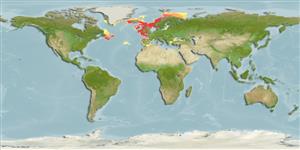
Native range | All suitable habitat | Point map | Year 2050
This map was computer-generated and has not yet been reviewed.
Molva molva   AquaMaps   Data sources: GBIF OBIS
Hochladen Photos und videos
Bilder | videos | Google Bild
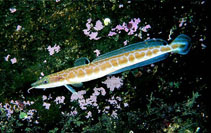
Image of Molva molva (Ling)
Molva molva
Photo von Svensen, E.


UK Great Britain & N. Ireland territory information

Common names: European ling
Occurrence: native
Salinity: marine
Abundance: | Ref:
Importance: commercial | Ref: FAO, 1994
Aquaculture: | Ref:
Regulations: | Ref:
Uses: no uses
Comments:
National Checklist:
Territory Information: https://www.cia.gov/library/publications/resources/the-world-factbook/geos/uk.html
National Fisheries Authority:
Occurrences: Occurrences Point map
Main Ref: Cohen, D.M., T. Inada, T. Iwamoto and N. Scialabba, 1990
National Database:

Common names from other countries

Klassifizierung / Names Namen | Synonyme | Catalog of Fishes(Gattung, Arten) | ITIS | CoL | WoRMS | Cloffa

> Gadiformes (Cods) > Lotidae (Hakes and burbots)
More on author: Linnaeus.

Umwelt: Milieu / Klimazone / Tiefenbereich / Verbreitungsgebiet Ökologie

seewasser demersal; ozeanodrom (Ref. 51243); tiefenbereich 100 - 1000 m (Ref. 35388), usually 100 - 400 m (Ref. 35388). Temperate; 75°N - 35°N, 55°W - 44°E (Ref. 54595)

Verbreitung Territorien | FAO Gebiete | Ökosysteme | Vorkommen | Punkt Karte | Einführungen | Faunafri

Northwest Atlantic: off southern Greenland and Canada. Northeast Atlantic: Barents Sea and Iceland to Morocco. Mediterranean Sea: northwestern Mediterranean only.

Länge bei der ersten Reifung / Größe / Gewicht / Alter

Geschlechtsreife: Lm 92.5, range 90 - 100 cm
Max length : 200 cm TL Männchen/unbestimmt; (Ref. 1371); common length : 106 cm TL Männchen/unbestimmt; (Ref. 1371); max. veröff. Gewicht: 45.0 kg (Ref. 35388); max. veröff. Alter: 25 Jahre (Ref. 35388)

Kurzbeschreibung Bestimmungsschlüssel | Morphologie | Morphometrie

Rückenflossenstacheln (insgesamt) : 0; Rückenflossenweichstrahlen (insgesamt) : 75 - 83; Afterflossenweichstrahlen: 58 - 64; Wirbelzahl: 63 - 65. Upper jaw projecting beyond lower one. Color is reddish brown dorsally, grading to white ventrally. The posterior areas of the vertical fins dark with pale margins. The sides distinctly marbled (Ref. 232). Barbel is present in the chin, longer than the diameter of the eye. Black spot in the rear end of the first dorsal fin. Caudal peduncle stout compared to blue ling (Ref. 35388).
Body shape (shape guide): elongated; Cross section: circular.

Biologie     Fachlexikon (Englisch) (z.B. epibenthic)

Occurs mainly on rocky bottoms in fairly deep water (Ref. 9988). Found more commonly from 100 to 400 m. Feeds on fish (cod, herring, flatfish), lobsters, cephalopods and starfishes. Principal spawning areas are Biscay, slopes west of the British Isles and off the Faeroes and southern Iceland (Ref. 35388). Marketed fresh, dried or salted and frozen; eaten steamed, fried, broiled and baked (Ref. 9988).

Lebenszyklus und Paarungsverhalten Geschlechtsreife | Fortpflanzung | Ablaichen | Eier | Fruchtbarkeit | Larven

Major spawning grounds are located at 200 m depth from the Bay of Biscay to the Gulf of Norway at 100 to 300 m off southern Iceland, and at 50 to 300 m in the Mediterranean Sea. Fecundity may reach 20 to 60 million eggs per female (Ref. 1371).

Hauptreferenz Laden Sie Ihre Referenzen hoch | Referenzen | Koordinator | Partner

Cohen, D.M., T. Inada, T. Iwamoto and N. Scialabba, 1990. FAO species catalogue. Vol. 10. Gadiform fishes of the world (Order Gadiformes). An annotated and illustrated catalogue of cods, hakes, grenadiers and other gadiform fishes known to date. FAO Fish. Synop. 125(10). Rome: FAO. 442 p. (Ref. 1371)

IUCN Rote Liste Status (Ref. 130435: Version 2025-2)


CITES

Not Evaluated

CMS (Ref. 116361)

Not Evaluated

Bedrohung für Menschen

  Harmless


Nutzung durch Menschen

Fischereien: hoch kommerziell; Sportfisch: ja
FAO - Fischereien: landungen, Artbeschreibung; Publication: search | FIRMS - Stock assessments | FishSource | Das Meer um uns herum

Mehr Information

Trophische Ökologie
Lebensmittel (Beutetiere)
Nahrungszusammensetzung
Nahrungsaufnahme
Lebensmittelrationen
Räuber
Ökologie
Ökologie
Home ranges
Lebenszyklus
Fortpflanzung
Geschlechtsreife
Reifung/Kiemen rel.
Fruchtbarkeit
Ablaichen
Laichaggregationen
Eier
Eientwicklung
Larven
Larven Pop.Dyn.
Verbreitung
Territorien
FAO Gebiete
Ökosysteme
Vorkommen
Einführungen
BRUVS - Videos
Anatomie
Kiemenoberfläche
Gehirn
Otolith
Physiologie
Körperliche Zusammensetzung
Nährstoffe
Sauerstoffverbrauch
Schwimmart
Schwimmgeschwindigkeit
Visuelle Pigmente
Fischgeräusche
Krankheiten und Parasiten
Toxizität (LC50s)
Genetik
Genom
Genetik
Heterozygotie
Vererbbarkeit
Menschenbezogen
Aquakultur-Systeme
Aquakultur Profile
Zuchtlinien
Ciguatera-Fälle
Briefmarken, Münzen, Verschiedenes.
Aufsuchen
Partner
Referenzen
Referenzen

Tools

Zusatzinformationen

Download XML

Internet Quellen

Schätzungen auf der Grundlage von Modellen

Bevorzugte Temperatur (Ref. 123201): 4.6 - 11.3, mean 7.7 °C (based on 438 cells).
Phylogenetischer Diversitätsindex (Ref. 82804):  PD50 = 0.6562   [Uniqueness, from 0.5 = low to 2.0 = high].
Bayesian length-weight: a=0.00389 (0.00241 - 0.00628), b=3.06 (2.92 - 3.20), in cm total length, based on LWR estimates for this species & (Sub)family-body (Ref. 93245).
Trophische Ebene (Ref. 69278):  4.4   ±0.2 se; based on diet studies.
Widerstandsfähigkeit (Ref. 120179):  mittel, Verdopplung der Population dauert 1,4 - 4,4 Jahre. (K=0.12; tm=5-6; tmax=25; Fec=60 million).
Prior r = 0.55, 95% CL = 0.36 - 0.82, Based on 9 full stock assessments.
Anfälligkeit der Fischerei (Ref. 59153):  Very high vulnerability (77 of 100). 🛈
Klimaanfälligkeit (Ref. 125649):  Moderate vulnerability (38 of 100). 🛈
Preiskategorie (Ref. 80766):   Low.
Nährstoffe (Ref. 124155):  Calcium = 15.2 [7.4, 33.3] mg/100g; Iron = 0.278 [0.140, 0.600] mg/100g; Protein = 17.7 [15.9, 19.4] %; Omega3 = 0.368 [0.197, 0.685] g/100g; Selenium = 32.5 [16.9, 66.3] μg/100g; VitaminA = 8.35 [2.10, 31.25] μg/100g; Zinc = 0.28 [0.18, 0.44] mg/100g (wet weight);