Common names from other countries
Teleostei (teleosts) >
Scombriformes (Mackerels) >
Gempylidae (Snake mackerels)
Etymology: Lepidocybium: Greek, lepis = scale + Greek, kybion, -ou = tunna (Ref. 45335).
Environment: milieu / climate zone / depth range / distribution range
Ecology
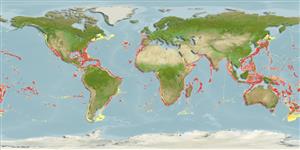
Marine; benthopelagic; oceanodromous (Ref. 51243); depth range 200 - 1100 m (Ref. 44037). Deep-water; 50°N - 56°S, 180°W - 180°E (Ref. 6181)
Tropical and temperate seas of the World, but probably not occurring in the northern Indian Ocean. Northwest Atlantic: Canada (Ref. 5951). Eastern Atlantic: known from 13°N off Guinea to Lobutu, Angola (Ref. 10816).
Size / Weight / Age
Maturity: Lm ? range ? - ? cm
Max length : 200 cm SL male/unsexed; (Ref. 6181); common length : 150 cm SL male/unsexed; (Ref. 6181); max. published weight: 45.0 kg (Ref. 3403)
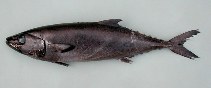
Dorsal spines (total): 8 - 9; Dorsal soft rays (total): 16 - 18; Anal spines: 1 - 2; Anal soft rays: 12 - 14; Vertebrae: 31. Body almost uniformly dark brown, becoming almost black with age. Pelvic fins well developed, with I spine and 5 soft rays (Ref. 9784). Prominent lateral keel on caudal peduncle, flanked by smaller accessory keels above and below (Ref. 26938).
Body shape (shape guide): fusiform / normal; Cross section: oval.
Occurs mainly over the continental slope, down to 200 m and more (Ref. 6181). Migrates upward at night (Ref. 6181). Feeds on squid, crustaceans and a wide variety of fishes (Ref. 6181). Flesh oily and may have purgative properties (Ref. 9784). Sometimes caught by tuna long-liners (Ref. 26938). Marketed frozen and as fish cakes in Japan (Ref. 9302).
Life cycle and mating behavior
Maturity | Reproduction | Spawning | Eggs | Fecundity | Larvae
Nakamura, I. and N.V. Parin, 1993. FAO Species Catalogue. Vol. 15. Snake mackerels and cutlassfishes of the world (families Gempylidae and Trichiuridae). An annotated and illustrated catalogue of the snake mackerels, snoeks, escolars, gemfishes, sackfishes, domine, oilfish, cutlassfishes,. scabbardfishes, hairtails, and frostfishes known to date. FAO Fish. Synop. 125(15):136 p. (Ref. 6181)
IUCN Red List Status (Ref. 130435: Version 2025-2 (Global))
Threat to humans
Harmless
Human uses
Fisheries: minor commercial; gamefish: yes
Tools
Special reports
Download XML
Internet sources
Estimates based on models
Preferred temperature (Ref.
123201): 7 - 14.4, mean 9.9 °C (based on 642 cells).
Phylogenetic diversity index (Ref.
82804): PD
50 = 1.0000 [Uniqueness, from 0.5 = low to 2.0 = high].
Bayesian length-weight: a=0.01175 (0.00592 - 0.02333), b=2.98 (2.80 - 3.16), in cm total length, based on LWR estimates for this species & (Sub)family-body (Ref.
93245).
Trophic level (Ref.
69278): 4.3 ±0.67 se; based on food items.
Resilience (Ref.
120179): Low, minimum population doubling time 4.5 - 14 years (Assuming tm=4-5).
Fishing Vulnerability (Ref.
59153): Very high vulnerability (90 of 100).
🛈
Climate Vulnerability (Ref.
125649): Moderate vulnerability (39 of 100).
🛈
Nutrients (Ref.
124155): Calcium = 7.33 [3.81, 15.92] mg/100g; Iron = 0.279 [0.128, 0.578] mg/100g; Protein = 17.1 [14.9, 19.0] %; Omega3 = 0.33 [0.19, 0.60] g/100g; Selenium = 29.2 [12.6, 64.6] μg/100g; VitaminA = 11.8 [2.8, 50.1] μg/100g; Zinc = 0.25 [0.17, 0.37] mg/100g (wet weight);