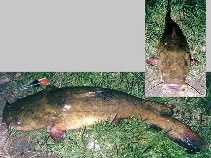
Pylodictis olivaris, Flathead catfish : fisheries, gamefish, aquarium

You can sponsor this page

Pylodictis olivaris (Rafinesque, 1818)

Flathead catfish
Ladda upp din foton och Videor
Bilder | Google image
Image of Pylodictis olivaris (Flathead catfish)
Pylodictis olivaris
Bild av Østergaard, T.


US America (contiguous states) territory information

Common names: Catfish, Flathead catfish
Occurrence: native
Salinity: freshwater
Abundance: fairly common (chances are about 50%) | Ref: Page, L.M. and B.M. Burr, 2011
Importance: commercial | Ref: Missouri Department of Conservation, 2008
Aquaculture: | Ref:
Regulations: | Ref:
Uses: gamefish: yes;
Comments: Known from the Lower Great Lakes and Mississippi River basins from western Pennsylvania to White-Little Missouri River system in North Dakota, and south to Louisiana; and Gulf Slope from Mobile Bay drainage in Georgia and Alabama (Ref. 86798). Occurs in Big Blue, Neosho rivers, Kansas (Ref. 3987) and occasionally in Chesapeake watershed (tidal portion of the James River) (Ref. 27549). A recreational fishery exists in the country (Ref. 52559). Also Ref. 5723, 10294.
National Checklist:
Territory Information: https://www.cia.gov/library/publications/resources/the-world-factbook/geos/us.html
National Fisheries Authority: http://www.nmfs.gov
Occurrences: Occurrences Point map
Main Ref: Page, L.M. and B.M. Burr, 2011
National Database:

Common names from other countries

Klassificering / Namn Populärnamn | synonymer | Catalog of Fishes(Släkte, Arter) | ITIS | CoL | WoRMS | Cloffa

> Siluriformes (Catfishes) > Ictaluridae (North American freshwater catfishes)
Etymology: Pylodictis: Greek, pylos = mud + Greek, ichthys = fish (Ref. 45335)olivaris: olivarus meaning olive colored (Ref. 10294).
More on author: Rafinesque.

Miljö: miljö / Klimatzon / djupintervall / distributionsområde Ekologi

; sötvatten bottenlevande; flodvandrande (Ref. 126106). Subtropical; ? - 33°C (Ref. 12741); 47°N - 26°N, 108°W - 80°W (Ref. 86798)

Utbredning Territorier | FAO områden | Ekosystem | Förekomster | Prickkarta | Utplanteringar | Faunafri

North America: Lower Great Lakes and Mississippi River basins from western Pennsylvania to White-Little Missouri River system in North Dakota, and south to Louisiana in USA; Gulf Slope from Mobile Bay drainage in Georgia and Alabama in USA to Mexico. Transplanted elsewhere in USA.

Längd vid första mognad / Storlek / Vikt / Ålder

Könsmognad: Lm 48.3, range 46 - 50.8 cm
Max length : 155 cm TL hane/ej könsbestämd; (Ref. 86798); publicerad maxvikt: 55.8 kg (Ref. 40637); rapporterad maxålder: 25 år (Ref. 120825)

Kort beskrivning Bestämningsnycklar | Morfologi | Morfometri


Body shape (shape guide): elongated.

Biologi     Ordlista (t.ex. epibenthic)

Adults inhabit pools with logs and other debris in low-gradient to moderate-gradient, small to large rivers. Also found in lakes and impoundments. Young occur in rocky and sandy runs and riffles (Ref. 5723, 86798). Juveniles feed on aquatic insect immature in riffle areas (Ref. 10294). Older individuals consume crayfish, clams and fishes (Ref. 93252).

Livscykel och parningsbeteende Könsmognad | Reproduktion | Lek | Ägg | Fekunditet | Larver

Huvudreferens Ladda upp dina referenser | referenser | Koordinator | Medarbetare

Page, L.M. and B.M. Burr, 2011. A field guide to freshwater fishes of North America north of Mexico. Boston : Houghton Mifflin Harcourt, 663p. (Ref. 86798)

Status på IUCN:s rödlista (Ref. 130435: Version 2025-2 (Global))

  Least Concern (LC) ; Date assessed: 01 March 2012

CITES

Not Evaluated

CMS (Ref. 116361)

Not Evaluated

Hot mot människor

  Harmless


Mänskliga användningsområden

Fiskeri: kommersiell; sportfisk: ja; Akvarium: Offentliga akvarier
FAO - fiskeri: landningar; Publication: search | FishSource |

Ytterligare information

Trofisk ekologi
Livsmedelsartiklar (preys)
Födosammansättning
Födointag
Matransoner
Predatorer
Ekologi
Ekologi
Home ranges
Populationsdynamik
Tillväxtparametrar
Max. åldrar / storlekar
Längd-vikt rel.
Längd-längd rel.
Längd-frekvenser
Massakonvertering
Rekrytering
Abundans
Livscykel
Reproduktion
Könsmognad
Mognad/Gills rel.
Fekunditet
Lek
Lekande aggregat
Ägg
Utveckling av ägg
Larver
Larvdynamik
Anatomi
Gälyta
Hjärna
Otolit
Fysiologi
Kroppssammansättning
Näringsämnen
Syreförbrukning
Typ av simning
Simhastighet
Visuella pigment
Ljud från fisk
Sjukdomar & Parasiter
Toxicitet (LC50)
Genetik
Genom
Genetik
Heterozygositet
Ärftlighet
Människorelaterad
Vattenbrukssystem
Vattenbruksprofiler
Avelslinjer
Ciguatera-fall
Frimärken, mynt, diverse.
Uppsökande verksamhet
Medarbetare
referenser
referenser

Verktyg

Särskilda rapporter

Ladda ner XML

Internet-källor

AFORO (otoliths) | Alien/Invasive Species database | Aquatic Commons | BHL | Cloffa | Websites from users | Check FishWatcher | CISTI | Catalog of Fishes: Släkte, Arter | DiscoverLife | ECOTOX | FAO - fiskeri: landningar; Publication: search | Faunafri | Fishipedia | Fishtrace | GloBI | GoMexSI (interaction data) | Google Books | Google Scholar | Google | IGFA World Record | OneZoom | Open Tree of Life | Otolith Atlas of Taiwan Fishes | PubMed | Reef Life Survey | Socotra Atlas | TreeBase | Tree of Life | Wikipedia: Go, sök | World Records Freshwater Fishing | Zoologiskt register

Uppskattningar baserade på modeller

Index för fylogenetisk mångfald (Ref. 82804):  PD50 = 1.0000   [Uniqueness, from 0.5 = low to 2.0 = high].
Bayesian length-weight: a=0.00589 (0.00446 - 0.00777), b=3.11 (3.03 - 3.19), in cm total length, based on LWR estimates for this species (Ref. 93245).
Trofisk nivå (Ref. 69278):  3.8   ±0.3 se; based on diet studies.
Generation time: 7.8 (6.9 - 9.5) years. Estimated as median ln(3)/K based on 24 growth studies.
Resiliens (Ref. 120179):  Låg, lägsta populationsfördubblingstid 4,5-14 år (K=0.06-0.38; tm=3-6; tmax=34; Fec=6,900).
Sårbarhet i fisket (Ref. 59153):  High vulnerability (62 of 100). 🛈
Priskategori (Ref. 80766):   Unknown.
Näringsämnen (Ref. 124155):  Calcium = 32.2 [18.3, 73.4] mg/100g; Iron = 1.17 [0.65, 2.08] mg/100g; Protein = 17.1 [15.0, 18.9] %; Omega3 = 0.467 [0.192, 1.143] g/100g; Selenium = 77.9 [32.5, 172.5] μg/100g; VitaminA = 14.8 [5.0, 45.4] μg/100g; Zinc = 0.595 [0.403, 0.893] mg/100g (wet weight);