Common names from other countries
การจำแนกประเภท / ชื่อ
ชื่อสามัญ | ชื่อพ้อง | Catalog of Fishes(สกุล, ชนิด) | ITIS | CoL | WoRMS | Cloffa
>
Gadiformes (Cods) >
Gadidae (Cods and haddocks)
Etymology: Gadus: Latin, gadus = a fish, cod? (Ref. 45335); chalcogrammus: Name from the Greek 'chalcos' meaning brass and 'gramma' meaning mark (Ref. 6885).
More on author: Pallas.
Taxonomic Remarks
This species is placed in the genus Gadus in Eschmeyer (CofF ver. Jan. 2012: Ref. 89336). More studies are needed for a complete revision of all genera of Gadidae.
In the past decade, a number of molecular works have shown that T. chalcogramma coud be deeply nested in a clade that contains the Gadus spp.
It has been suggested that the species should be now assigned to Gadus, although none of these works had a conclusive statement with a complete taxonomic re-assessment. However, the name Gadus chalcogrammus may be used in scientific publications. If the American Fisheries Society has endorsed that change in the latest edition of its list of fish names, FAO will not change it until a more stable consensus is reached. Since this species is highly commercial, with a number of regulations and statistical reports using that name, it is preferable to change it with the strongest scientific support. In addition, they are other taxonomic issue in that family, with the same issues about names. Therefore, for the use by the rest of the society, the fishery domain in particular, we recommend to continue using T. chalcogramma and wait that a complete revision of the family and thorough taxonomic and nomenclatural decisions are published.
สิ่งแวดล้อม : สิ่งแวดล้อม / เขตภูมิอากาศ / ระดับความลึก / ระยะการกระจายสินค้า
นิเวศวิทยา
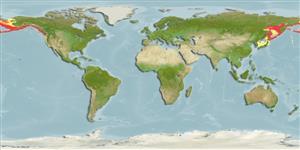
เกี่ยวกับทะเล,น้ำเค็ม; กร่อย กลุ่มสัตว์หน้าดิน,กลุ่มสัตว์พื้นท้องน้ำ; สัตว์น้ำที่อาศัยและอพยพภายในทะเลเท่านั้น (Ref. 87829); ระดับความลึก ? - 1280 m (Ref. 50550), usually 30 - 400 m (Ref. 54255). Polar; 68°N - 34°N, 129°E - 120°W (Ref. 54255)
North Pacific: from Kivalina, Alaska, to the southern Sea of Japan and to Carmel, California, USA. The occurrence off the northern part of Baja California (Mexico), as reported from Quast and Hall, (1972) (Ref. 6876) is apparently erroneous.
ความยาวเมื่อครบกำหนดครั้งแรก / ขนาด / น้ำหนัก / อายุ
วัยเจริญพันธุ์: Lm 36.9 range ? - ? cm
Max length : 91.0 cm TL เพศผู้/กระเทย; (Ref. 2850); น้ำหนักสูงสุดที่มีการรายงาน: 3.9 kg (Ref. 56335); อายุสูงสุดที่ได้รายงาน: 28 ปี (Ref. 55701)
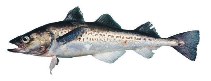
เงี่ยงครีบหลัง (รวม) : 0; ก้านครีบอ่อนที่หาง (รวม) : 38 - 48; เงี่ยงครีบก้น: 0; ก้านครีบอ่อนที่ก้น: 33 - 42. The dorsal fins are widely separated. The pelvic fins have a slightly elongated filament. The lateral line is continuous to about the back end of the first dorsal-fin base; it is interrupted at the read of the body. On the head are lateral line pores. Body color is olive green to brown on the back and becomes silvery on the sides and pale ventrally, often with mottled patterns or blotches.
Body shape (shape guide): fusiform / normal; Cross section: circular.
The adults usually live near to the sea floor, but sometimes they also appear near the surface (Ref. 1371). They perform diurnal vertical migrations (Ref. 1371) and are considered as one of the straddling stocks in the northwest and northeast Pacific (Ref. 87829). They mainly feed on krill (Ref. 39882) but they also eat fishes and crustaceans (Ref. 6885). The adults which are spawning are often solely captured for their roe (may have been the case in the first years of the fishery in the U.S., but hasn't been true for some time. In 1994, the North Pacific Fishery Management Council/NOAA enacted an amendment to the Bering Sea and Gulf of Alaska Fishery Management Plans effectively banning the practice of stripping roe and discarding the carcasses, R. Rogness, pers.comm. April 2022). The meat is used to produce surimi (this is an imitation of shellfish meat) (Ref. 28499). They are traded as fresh fish, boneless flesh, in frozen blocks or as surimi. The fish is cooked in the microwave, steamed or fried in butter (Ref. 9988).
Oviparous, sexes are separate (Ref. 205). Congregate in dense schools to spawn, usually at 50 to 250 m depth.
Cohen, D.M., T. Inada, T. Iwamoto and N. Scialabba, 1990. FAO species catalogue. Vol. 10. Gadiform fishes of the world (Order Gadiformes). An annotated and illustrated catalogue of cods, hakes, grenadiers and other gadiform fishes known to date. FAO Fish. Synop. 125(10). Rome: FAO. 442 p. (Ref. 1371)
สถานะบัญชีแดงของ IUCN (Ref. 130435: Version 2025-2 (Global))
ภัยคุกคามต่อมนุษย์
Harmless
การใช้ของมนุษย์
การประมง: เน้นการพาณิชย์; การตกปลาเป็นกีฬา: ใช่
เครื่องมือ
รายงานพิเศษ
ดาวน์โหลด XML
แหล่งที่มาจากอินเตอร์เน็ต
การประมาณค่าตามแบบจำลอง
อุณหภูมิที่ต้องการ (อ้างอิง
123201): 0.4 - 5.6, mean 1.6 °C (based on 444 cells).
ดัชนีความหลากหลายทางวิวัฒนาการ (อ้างอิง
82804): PD
50 = 0.5625 [Uniqueness, from 0.5 = low to 2.0 = high].
Bayesian length-weight: a=0.00631 (0.00549 - 0.00725), b=3.03 (2.99 - 3.07), in cm total length, based on LWR estimates for this species (Ref.
93245).
ระดับชั้นอาหาร (อ้างอิง
69278): 3.6 ±0.1 se; based on diet studies.
Generation time: 6.5 (3.6 - 7.8) years. Estimated as median ln(3)/K based on 25
growth studies.
ความสามารถในการกลับคืนสู่ปกติ (อ้างอิง
120179): ต่ำ, เวลาต่ำสุดที่จะทำให้ประชากรเพิ่มขึ้นเป็น 2 เท่าใช้เวลา 4.5 - 14 ปี (Musick et al. 2000 (Ref.
36717); tmax = 28).
Prior r = 0.29, 95% CL = 0.19 - 0.44, Based on 16 full stock assessments.
ความเสี่ยงต่อการตกปลา (Ref.
59153): High vulnerability (59 of 100).
🛈
ความเสี่ยงต่อสภาพภูมิอากาศ (Ref.
125649): High vulnerability (55 of 100).
🛈
สารอาหาร (Ref.
124155): Calcium = 12 [8, 19] mg/100g; Iron = 0.185 [0.122, 0.296] mg/100g; Protein = 16.5 [15.1, 17.9] %; Omega3 = 0.337 [0.159, 0.741] g/100g; Selenium = 14.5 [5.7, 33.5] μg/100g; VitaminA = 11.2 [2.0, 57.3] μg/100g; Zinc = 0.445 [0.340, 0.563] mg/100g (wet weight); based on
nutrient studies.