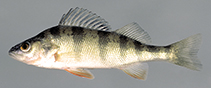
Common names from other countries
Klassifizierung / Names
Namen | Synonyme | Catalog of Fishes(Gattung, Arten) | ITIS | CoL | WoRMS | Cloffa
Umwelt: Milieu / Klimazone / Tiefenbereich / Verbreitungsgebiet
Ökologie
; süßwasser; brackwasser benthopelagisch; tiefenbereich 0 - 56 m (Ref. 11004), usually ? - 9 m (Ref. 1998). Subtropical; 0°C - 30°C (Ref. 35682); 66°N - 30°N, 124°W - 59°W (Ref. 86798)
North America: Atlantic, Arctic, Great Lakes, and Mississippi River basins from Nova Scotia to Mackenzie River drainage, Northwest Territories in Canada, and south to Ohio, Illinois and Nebraska in the USA; south in Atlantic drainages to Savannah River in Georgia, USA.
Länge bei der ersten Reifung / Größe / Gewicht / Alter
Geschlechtsreife: Lm 19.2 range ? - ? cm
Max length : 50.0 cm TL Männchen/unbestimmt; (Ref. 9988); common length : 19.1 cm TL Männchen/unbestimmt; (Ref. 12193); max. veröff. Gewicht: 1.9 kg (Ref. 40637); max. veröff. Alter: 11 Jahre (Ref. 12193)
Inhabits lakes, ponds, pools of creeks, and rivers. Also found in brackish water and in salt lakes. Most commonly found in clear water near vegetation; tends to shoal near the shore during spring (Ref. 9988, 10294). Feeds on immature insects, larger invertebrates, fishes and fish eggs during the day. Preyed upon by fishes and birds (Ref. 1998). Spawns between February and July in the northern hemisphere and between August and October in the southern hemisphere (Ref. 10999). Neither anterolateral glandular groove nor venom gland is present (Ref. 57406). Marketed fresh or frozen; eaten pan-fried, broiled or baked (Ref. 9988).
Nonobligatory plant spawner.
Page, L.M. and B.M. Burr, 2011. A field guide to freshwater fishes of North America north of Mexico. Boston : Houghton Mifflin Harcourt, 663p. (Ref. 86798)
IUCN Rote Liste Status (Ref. 130435: Version 2025-2 (Global))
Nutzung durch Menschen
Fischereien: kommerziell; Sportfisch: ja; Aquarium: Öffentliche Aquarien
Tools
Zusatzinformationen
Download XML
Internet Quellen
Schätzungen auf der Grundlage von Modellen
Phylogenetischer Diversitätsindex (Ref.
82804): PD
50 = 0.6250 [Uniqueness, from 0.5 = low to 2.0 = high].
Bayesian length-weight: a=0.01175 (0.00918 - 0.01503), b=3.05 (2.98 - 3.12), in cm total length, based on LWR estimates for this species (Ref.
93245).
Trophische Ebene (Ref.
69278): 3.7 ±0.2 se; based on diet studies.
Generation time: 3.7 (3.3 - 4.8) years. Estimated as median ln(3)/K based on 43
growth studies.
Widerstandsfähigkeit (Ref.
120179): mittel, Verdopplung der Population dauert 1,4 - 4,4 Jahre. (K=0.17-0.19; tmax=11).
Anfälligkeit der Fischerei (Ref.
59153): Moderate to high vulnerability (48 of 100).
🛈
Nährstoffe (Ref.
124155): Calcium = 30.3 [13.5, 69.8] mg/100g; Iron = 0.379 [0.205, 0.696] mg/100g; Protein = 17.5 [16.4, 18.6] %; Omega3 = 0.157 [0.070, 0.345] g/100g; Selenium = 18.5 [6.2, 51.4] μg/100g; VitaminA = 26.1 [11.2, 61.2] μg/100g; Zinc = 0.785 [0.530, 1.181] mg/100g (wet weight); based on
nutrient studies.