Common names from other countries
Klassifizierung / Names
Namen | Synonyme | Catalog of Fishes(Gattung, Arten) | ITIS | CoL | WoRMS | Cloffa
>
Mulliformes (Goatfishes) >
Mullidae (Goatfishes)
Etymology: Upeneus: Greek, ypene, -es = upper lip (Ref. 45335); elongatus: Named for the elongate, very shallow body and head of this species.
Umwelt: Milieu / Klimazone / Tiefenbereich / Verbreitungsgebiet
Ökologie
seewasser demersal; tiefenbereich ? - 25 m (Ref. 123711). Subtropical
Western Pacific: Japan and probably the Philippines.
Größe / Gewicht / Alter
Geschlechtsreife: Lm ? range ? - ? cm
Max length : 8.9 cm SL Männchen/unbestimmt; (Ref. 123711)
Kurzbeschreibung
Bestimmungsschlüssel | Morphologie | Morphometrie
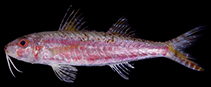
Rückenflossenstacheln (insgesamt) : 7; Rückenflossenweichstrahlen (insgesamt) : 9. This species is distinguished by the following characters: D VII + 9; pectoral fins 13; gill rakers 8 + 19-20 = 27-28; elongated body laterally compressed. Measurements as % SL: depth at first dorsal-fin origin 21; body depth at anal-fin origin 18; caudal peduncle depth 8.3, its width 3.3; maximum head depth 18 and through eye 14; head length 27; snout length 10; orbit length 6.7; upper-jaw length 11; barbel length 17; caudal-fin length 29; anal-fin height 16; pelvic-fin length 23; pectoral-fin length 21; first dorsal-fin height 20 with dorsal-fin spines proportionally decreasing in height; second dorsal-fin height 15. Body markings: total oblique bars on caudal fin 12, upper caudal-fin lobe with 5 red bars; lower caudal-fin lobe with 7 red-brown blotch-like bars which are most distinct along middle of lobe and dorsally with a faint yellowish-beige stripe of less than orbit diameter in width that connects to caudal-fin base; bars are mostly retained after preservation; first dorsal fin with a large yellowish-beige triangular patch close to fin base covering central part of ventral half of fin; a similarly coloured, but much smaller patch at middle of second dorsal-fin base; when fresh barbels are white; in freshly deceased fish, body and head colour pale greyish dorsally and mostly red below eye level except for pale-grey snout region; ventral margin of the head and body silvery white; with a vermillion mid-lateral body stripe from snout tip through eye to middle of caudal-fin base; when preserved, body and head pale brown, mid-body darkened (Ref. 123711).
Body shape (shape guide): fusiform / normal; Cross section: compressed.
Occurs on shallow sandy bottoms (Ref. 123711).
Lebenszyklus und Paarungsverhalten
Geschlechtsreife | Fortpflanzung | Ablaichen | Eier | Fruchtbarkeit | Larven
Uiblein, F. and H. Motomura, 2021. Three new goatfishes of the genus Upeneus from the Eastern Indian Ocean and Western Pacific, with an updated taxonomic account for U. itoui (Mullidae: Japonicus-species group). Zootaxa 4938(3):298-324. (Ref. 123711)
IUCN Rote Liste Status (Ref. 130435: Version 2025-2 (Global))
Bedrohung für Menschen
Harmless
Nutzung durch Menschen
Tools
Zusatzinformationen
Download XML
Internet Quellen
Schätzungen auf der Grundlage von Modellen
Phylogenetischer Diversitätsindex (Ref.
82804): PD
50 = 0.5000 [Uniqueness, from 0.5 = low to 2.0 = high].
Bayesian length-weight: a=0.00933 (0.00439 - 0.01983), b=3.09 (2.92 - 3.26), in cm total length, based on LWR estimates for this Genus-body shape (Ref.
93245).
Trophische Ebene (Ref.
69278): 3.4 ±0.4 se; based on size and trophs of closest relatives
Widerstandsfähigkeit (Ref.
120179): hoch, Verdopplung der Population dauert weniger als 15 Monate. (Preliminary K or Fecundity.).
Anfälligkeit der Fischerei (Ref.
59153): Low vulnerability (10 of 100).
🛈