This website uses cookies to enhance your browsing experience and ensure the functionality of our site. For more detailed information about the types of cookies we use and how we protect your privacy, please visit our Privacy Information page.
×
Cookie Settings
This website uses different types of cookies to enhance your experience. Please select your preferences below:
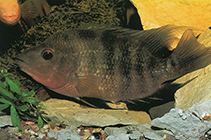
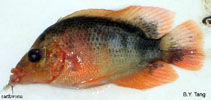
Amphilophus labiatus, Red devil : fisheries, aquarium
Teleostei (teleosts) > Cichliformes (Cichlids, convict blennies) > Cichlidae (Cichlids) > Cichlasomatinae
Etymology: Amphilophus:Greek, amphi = on both sides + Greek, lophos = crest (Ref. 45335). More on author: Günther.
Issue Systematics and biology covered by Barlow & Munsey (1976). Kullander & Hartel (1997:199) examined Agassiz' description of Amphilophus froebelii and searched in vain for type material. Villa (1976:381) added Cichlasoma dorsatum to the synonymy of A. labiatus. The name froebelii has never been used as a senior synonym of A. labiatus subsequent to its description.
Environment: milieu / climate zone / depth range / distribution range Ecology
Central America: Atlantic slope of Nicaragua, in Lakes Nicaragua and Managua.
Size / Weight / Age
Maturity: Lm? range ? - ? cm Max length : 28.3 cm TL male/unsexed; (Ref. 126024); max. published weight: 444.00 g (Ref. 126024)
Inhabits lakes and rarely enters rivers (Ref. 7335). Feeds on small fish, snails, insect larvae, worms and other bottom-dwelling organisms (Ref. 44091). Females tend clutch of eggs (Ref. 2060).
Life cycle and mating behavior Maturity | Reproduction | Spawning | Eggs | Fecundity | Larvae
600-700 eggs, female tends the clutch (Ref. 2060).
Kullander, S.O. and K.E. Hartel, 1997. The systematic status of cichlid genera described by Louis Agassiz in 1859: Amphilophus, Baiodon, Hypsophrys and Parachromis (Teleostei: Cichlidae). Ichthyol. Explor. Freshwat. 7(3-4):193-202. (Ref. 13677)
IUCN Red List Status (Ref. 130435: Version 2025-2)