-

- About this page
- Languages
- User feedbacks
- Citation
- Uploads
- Related species
-



Add your observation in Fish Watcher
| Native range | All suitable habitat | Point map | Year 2050 |

|
| This map was computer-generated and has not yet been reviewed. |
| Pterois antennata AquaMaps Data sources: GBIF OBIS |
Upload your photos and videos
Pictures | Videos | Stamps, coins, misc. | Google image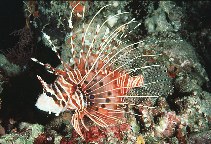 Pterois antennata
Picture by Randall, J.E.
Pictures | Videos | Stamps, coins, misc. | Google image
Picture by Randall, J.E.
Classification / Names Common names | Synonyms | Catalog of Fishes(genus, species) | ITIS | CoL | WoRMS | Cloffa
Teleostei (teleosts) > Perciformes/Scorpaenoidei (Scorpionfishes) > Scorpaenidae (Scorpionfishes or rockfishes) > Pteroinae
Etymology: Pterois: Greek, pteron = wing, fin (Ref. 45335).
More on author: Bloch.
Etymology: Pterois: Greek, pteron = wing, fin (Ref. 45335).
More on author: Bloch.
Environment: milieu / climate zone / depth range / distribution range Ecology
Marine; reef-associated; depth range 2 - 86 m (Ref. 95664). Tropical; 42°N - 40°S, 30°E - 137°W
Distribution Territories | FAO areas | Ecosystems | Occurrences | Point map | Introductions | Faunafri
Indo-Pacific: East Africa to Marquesan and Mangaréva islands, north to southern Japan, south to Queensland, Australia and Kermadec (Ref. 8879) and Austral islands.
Size / Weight / Age
Short description Identification keys | Morphology | Morphometrics
Dorsal spines (total): 13; Dorsal soft rays (total): 11 - 12; Anal spines: 3; Anal soft rays: 6. Reddish to tan with many dark bars on body; median fins with scattered dark spots; tentacle above eye long and with dark bands (Ref. 4313). Adults with bluish black blotches near the base of the pectoral fins (Ref. 48635)
Body shape (shape guide): fusiform / normal.
Body shape (shape guide): fusiform / normal.
Occurs in lagoon and seaward reefs. Hides in crevices under rocks and coral formations during the day and hunts at night. Typically with head towards the safety of their hide-out or narrow passage (Ref. 48635). Feeds on shrimps and crabs. Venomous and capable of inflicting a painful sting. Minimum depth reported taken from Ref. 30874. Solitary or in groups, under ledges and holes (Ref. 37816).
Life cycle and mating behavior Maturity | Reproduction | Spawning | Eggs | Fecundity | Larvae
Main reference
Upload your references | References | Coordinator | Collaborators
Eschmeyer, W.N., 1986. Scorpaenidae. p. 463-478. In M.M. Smith and P.C. Heemstra (eds.) Smiths' sea fishes. Springer-Verlag, Berlin. (Ref. 4313)
IUCN Red List Status (Ref. 130435: Version 2025-2)
Least Concern (LC) ; Date assessed: 03 March 2015
CITES
Not Evaluated
Threat to humans
Venomous (Ref. 4690)
Human uses
Fisheries: subsistence fisheries; aquarium: commercial
FAO - Publication: search | FishSource |
More information
Population dynamics
Growth parameters
Max. ages / sizes
Length-weight rel.
Length-length rel.
Length-frequencies
Mass conversion
Recruitment
Abundance
Growth parameters
Max. ages / sizes
Length-weight rel.
Length-length rel.
Length-frequencies
Mass conversion
Recruitment
Abundance
Life cycle
Reproduction
Maturity
Maturity/Gills rel.
Fecundity
Spawning
Spawning aggregations
Eggs
Egg development
Larvae
Larval dynamics
Reproduction
Maturity
Maturity/Gills rel.
Fecundity
Spawning
Spawning aggregations
Eggs
Egg development
Larvae
Larval dynamics
Physiology
Body composition
Nutrients
Oxygen consumption
Swimming type
Swimming speed
Visual pigments
Fish sound
Diseases & Parasites
Toxicity (LC50s)
Body composition
Nutrients
Oxygen consumption
Swimming type
Swimming speed
Visual pigments
Fish sound
Diseases & Parasites
Toxicity (LC50s)
Genetics
Genome
Genetics
Heterozygosity
Heritability
Genetic Diversity
Genome
Genetics
Heterozygosity
Heritability
Genetic Diversity
Tools
Bio-Quiz | E-book | Field guide | Identification keys | Length-frequency wizard | Life-history tool | Point map |
Catch-MSY |
Special reports
Download XML
Internet sources
AFORO (otoliths) | Aquatic Commons | BHL | Cloffa | Websites from users | Check FishWatcher | CISTI | Catalog of Fishes: genus, species | DiscoverLife | DORIS | ECOTOX | FAO - Publication: search | Faunafri | Fishipedia | Fishtrace | GloBI | Google Books | Google Scholar | Google | IGFA World Record | National databases | OneZoom | Open Tree of Life | Otolith Atlas of Taiwan Fishes | Public aquariums | PubMed | Reef Life Survey | Socotra Atlas | TreeBase | Tree of Life | Wikipedia: Go, Search |