-

- About this page
- Languages
- User feedbacks
- Citation
- Uploads
-
Related species
- Species in
Microchirus - Species in
Soleidae - - Classification -
- Soleidae
- Pleuronectiformes
- Teleostei
- Chordata
- Animalia
- Species in
-



Microchirus azevia (de Brito Capello, 1867)
Add your observation in Fish Watcher
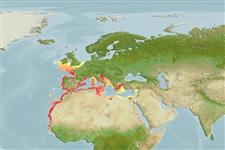
| Native range | All suitable habitat | Point map | Year 2050 |
|
| This map was computer-generated and has not yet been reviewed. |
| Microchirus azevia AquaMaps Data sources: GBIF OBIS |
Upload your photos and videos
Pictures | Google image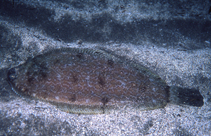 Microchirus azevia
Picture by Wirtz, P.
Pictures | Google image
Picture by Wirtz, P.
Classification / Names Common names | Synonyms | Catalog of Fishes(genus, species) | ITIS | CoL | WoRMS | Cloffa
Teleostei (teleosts) > Pleuronectiformes (Flatfishes) > Soleidae (Soles)
Etymology: Microchirus: Greek, mikros = small + Greek, cheir = hand (Ref. 45335).
Etymology: Microchirus: Greek, mikros = small + Greek, cheir = hand (Ref. 45335).
Environment: milieu / climate zone / depth range / distribution range Ecology
Marine; demersal; depth range 20 - 250 m (Ref. 4710). Temperate; 53°N - 12°N, 18°W - 36°E
Distribution Territories | FAO areas | Ecosystems | Occurrences | Point map | Introductions | Faunafri
Eastern Atlantic: Portugal southward to Senegal; a single record from southwest of the British Isles; Mediterranean: Spain, Algeria and Turkey.
Size / Weight / Age
Short description Identification keys | Morphology | Morphometrics
Dorsal soft rays (total): 71 - 86; Anal soft rays: 58 - 68; Vertebrae: 40 - 43. Body oval; upper eye less than its own diameter from dorsal profile of head; anterior nostril on blind side not enlarged; anterior nostril on eyed side with a backward-pointing tube hardly reaching to front border of lower eye; dorsal fin beginning near vertical through front border of upper eye; pectoral fin on eyed side with 6-8 fin rays, on blind side shorter; caudal fin separate from last dorsal and anal fin rays; lateral line supra-temporal branch forming an angular S-shape, the ascending part running upward and backward (Ref. 4710).
Body shape (shape guide): short and / or deep.
Body shape (shape guide): short and / or deep.
Found on mud and sand of the continental shelf, from the shore down to 250 m (Ref. 4710). Feeds on small benthic invertebrates, mainly amphipods and polychaetes (Ref. 4710). Minimum depth range from Ref. 121791.
Life cycle and mating behavior Maturity | Reproduction | Spawning | Eggs | Fecundity | Larvae
Main reference
Upload your references | References | Coordinator | Collaborators
Desoutter, M., 1994. Révision des genres Microchirus, Dicologlossa et Vanstraelenia (Pleuronectiformes, Soleidae). Cybium 18(3):215-249. (Ref. 35940)
IUCN Red List Status (Ref. 130435: Version 2025-2)
Data deficient (DD) ; Date assessed: 15 July 2014
CITES
Not Evaluated
Threat to humans
Harmless
Human uses
FAO - Publication: search | FishSource |
More information
Population dynamics
Growth parameters
Max. ages / sizes
Length-weight rel.
Length-length rel.
Length-frequencies
Mass conversion
Recruitment
Abundance
Growth parameters
Max. ages / sizes
Length-weight rel.
Length-length rel.
Length-frequencies
Mass conversion
Recruitment
Abundance
Life cycle
Reproduction
Maturity
Maturity/Gills rel.
Fecundity
Spawning
Spawning aggregations
Eggs
Egg development
Larvae
Larval dynamics
Reproduction
Maturity
Maturity/Gills rel.
Fecundity
Spawning
Spawning aggregations
Eggs
Egg development
Larvae
Larval dynamics
Anatomy
Gill area
Brain
Otolith
Gill area
Brain
Otolith
Physiology
Body composition
Nutrients
Oxygen consumption
Swimming type
Swimming speed
Visual pigments
Fish sound
Diseases & Parasites
Toxicity (LC50s)
Body composition
Nutrients
Oxygen consumption
Swimming type
Swimming speed
Visual pigments
Fish sound
Diseases & Parasites
Toxicity (LC50s)
Genetics
Genome
Genetics
Heterozygosity
Heritability
Genetic Diversity
Genome
Genetics
Heterozygosity
Heritability
Genetic Diversity
Human related
Aquaculture systems
Aquaculture profiles
Strains
Ciguatera cases
Stamps, coins, misc.
Aquaculture systems
Aquaculture profiles
Strains
Ciguatera cases
Stamps, coins, misc.
Tools
Special reports
Download XML
Internet sources
AFORO (otoliths) | Aquatic Commons | BHL | Cloffa | Websites from users | Check FishWatcher | CISTI | Catalog of Fishes: genus, species | DiscoverLife | ECOTOX | FAO - Publication: search | Faunafri | Fishipedia | Fishtrace | GloBI | Google Books | Google Scholar | Google | IGFA World Record | National databases | OneZoom | Open Tree of Life | Otolith Atlas of Taiwan Fishes | PubMed | Reef Life Survey | Socotra Atlas | TreeBase | Tree of Life | Wikipedia: Go, Search |