-

- About this page
- Languages
- User feedbacks
- Citation
- Uploads
- Related species
-



Upload your photos and videos
Pictures | Google image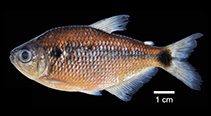 Astyanax embera
Picture by Ruiz-C., R.I. et al., 2018
Pictures | Google image
Picture by Ruiz-C., R.I. et al., 2018
Classification / Names Common names | Synonyms | Catalog of Fishes(genus, species) | ITIS | CoL | WoRMS | Cloffa
Teleostei (teleosts) > Characiformes (Characins) > Acestrorhamphidae (American tetras) > Acestrorhamphinae
Etymology: Astyanax: The name of Astyanax, Hector´s son in the Greek mythology (Ref. 45335); embera: Named for the native Americans known as the Embera, who occupy the type locality of this new species; noun in apposition.
Eponymy: Astyanax was the son of Hector in Greek mythology. See Homer’s Iliad for details. The reasoning for its use for a genus of characins is not explained. (Ref. 128868), visit book page.
Etymology: Astyanax: The name of Astyanax, Hector´s son in the Greek mythology (Ref. 45335); embera: Named for the native Americans known as the Embera, who occupy the type locality of this new species; noun in apposition.
Eponymy: Astyanax was the son of Hector in Greek mythology. See Homer’s Iliad for details. The reasoning for its use for a genus of characins is not explained. (Ref. 128868), visit book page.
Environment: milieu / climate zone / depth range / distribution range Ecology
Freshwater; benthopelagic. Tropical
Distribution Territories | FAO areas | Ecosystems | Occurrences | Point map | Introductions | Faunafri
South America, Colombia.
Size / Weight / Age
Maturity: Lm ? range ? - ? cm
Max length : 8.3 cm SL male/unsexed; (Ref. 119406); 9.0 cm SL (female)
Max length : 8.3 cm SL male/unsexed; (Ref. 119406); 9.0 cm SL (female)
Short description Identification keys | Morphology | Morphometrics
This species, a member of the orthodus species-group of Astyanax, differs from other members of the group by the following characters: differs from villwocki, superbus, gandhiae, bopiensi, boliviensis, yariguies by the absence of a dark stripe on the sides of the body (vs. dark lateral stripe present or anterior prolongation of the caudal peduncle spot extending anteriorly over the silvery lateral stripe); differs from A. orthodus in having the caudal peduncle spot extending onto the ventral and dorsal margins of the caudal peduncle, covering 4-6 horizontal scale rows (vs. covering 2-4 horizontal scale rows on the caudal peduncle) and in having an unpigmented band across the anal-fin rays in both sexes (vs.pigmentation uniform on analfin rays); differs from A. moorii in body depth > 39% SL (vs. < 39% SL), the dorsal-pectoral fin distance > 40.5% SL (vs. < 40.5% SL), maxilla length < 33.5% HL (vs. > 33.5% SH), upper jaw length < 32% HL (vs. > 47% SH) and by the number of lateral-line scales 36-41 (vs. 44-50) (Ref. 119406).
Cross section: compressed.
Cross section: compressed.
Life cycle and mating behavior Maturity | Reproduction | Spawning | Eggs | Fecundity | Larvae
Main reference
Upload your references | References | Coordinator | Collaborators
Ruiz-C., R.I., C. Román-Valencia, D.C. Taphorn, P.A. Buckup and H. Ortega, 2018. Revision of the Astyanax orthodus species-group (Teleostei: Characidae) with descriptions of three new species. European Journal of Taxonomy 402:1-45. (Ref. 119406)
CITES
Not Evaluated
Threat to humans
Harmless
Human uses
FAO - Publication: search | FishSource |
More information
Trophic ecology
Food items (preys)
Diet composition
Food consumption
Food rations
Predators
Food items (preys)
Diet composition
Food consumption
Food rations
Predators
Ecology
Ecology
Ecology
Population dynamics
Growth parameters
Max. ages / sizes
Length-weight rel.
Length-length rel.
Length-frequencies
Mass conversion
Recruitment
Abundance
Growth parameters
Max. ages / sizes
Length-weight rel.
Length-length rel.
Length-frequencies
Mass conversion
Recruitment
Abundance
Life cycle
Reproduction
Maturity
Maturity/Gills rel.
Fecundity
Spawning
Spawning aggregations
Eggs
Egg development
Larvae
Larval dynamics
Reproduction
Maturity
Maturity/Gills rel.
Fecundity
Spawning
Spawning aggregations
Eggs
Egg development
Larvae
Larval dynamics
Anatomy
Gill area
Brain
Otolith
Gill area
Brain
Otolith
Physiology
Body composition
Nutrients
Oxygen consumption
Swimming type
Swimming speed
Visual pigments
Fish sound
Diseases & Parasites
Toxicity (LC50s)
Body composition
Nutrients
Oxygen consumption
Swimming type
Swimming speed
Visual pigments
Fish sound
Diseases & Parasites
Toxicity (LC50s)
Genetics
Genome
Genetics
Heterozygosity
Heritability
Genetic Diversity
Genome
Genetics
Heterozygosity
Heritability
Genetic Diversity
Human related
Aquaculture systems
Aquaculture profiles
Strains
Ciguatera cases
Stamps, coins, misc.
Aquaculture systems
Aquaculture profiles
Strains
Ciguatera cases
Stamps, coins, misc.
Tools
Special reports
Download XML
Internet sources
AFORO (otoliths) | Aquatic Commons | BHL | Cloffa | Websites from users | Check FishWatcher | CISTI | Catalog of Fishes: genus, species | DiscoverLife | ECOTOX | FAO - Publication: search | Faunafri | Fishipedia | Fishtrace | GloBI | Google Books | Google Scholar | Google | IGFA World Record | OneZoom | Open Tree of Life | Otolith Atlas of Taiwan Fishes | PubMed | Reef Life Survey | Socotra Atlas | TreeBase | Tree of Life | Wikipedia: Go, Search |