-

- About this page
- Languages
- User feedbacks
- Citation
- Uploads
-
Related species
- Species in
Horaglanis - Species in
Clariidae - - Classification -
- Clariidae
- Siluriformes
- Teleostei
- Chordata
- Animalia
- Species in
-



Horaglanis populi Raghavan, Sundar, Arjun, Britz & Dahanukar, 2023
Upload your photos and videos
Google image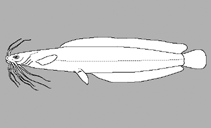 No image available for this species;
drawing shows typical species in Clariidae.
Google image
drawing shows typical species in Clariidae.
Classification / Names Common names | Synonyms | Catalog of Fishes(genus, species) | ITIS | CoL | WoRMS | Cloffa
Teleostei (teleosts) > Siluriformes (Catfishes) > Clariidae (Airbreathing catfishes)
Etymology: Horaglanis: Taken from mister S.L.Hora, director of Zoological Survey of India + Latin, glanis = a cat fish (Ref. 45335); populi: Name 'populi' from the Latin words 'populus', meaning 'people', in honor of the invaluable contributions made by interested members of the public in the southern Indian state of Kerala in documenting the biodiversity of subterranean and groundwater systems, including this novel species.
Eponymy: Dr Sunder Lal Hora (1896–1955) was a distinguished Indian ichthyologist and biologist who held a doctorate in science from both the Punjab University (1922) and Edinburgh University (1928), having studied for his master’s at the Government College, [...] (Ref. 128868), visit book page.
Etymology: Horaglanis: Taken from mister S.L.Hora, director of Zoological Survey of India + Latin, glanis = a cat fish (Ref. 45335); populi: Name 'populi' from the Latin words 'populus', meaning 'people', in honor of the invaluable contributions made by interested members of the public in the southern Indian state of Kerala in documenting the biodiversity of subterranean and groundwater systems, including this novel species.
Eponymy: Dr Sunder Lal Hora (1896–1955) was a distinguished Indian ichthyologist and biologist who held a doctorate in science from both the Punjab University (1922) and Edinburgh University (1928), having studied for his master’s at the Government College, [...] (Ref. 128868), visit book page.
Environment: milieu / climate zone / depth range / distribution range Ecology
Freshwater; demersal. Tropical
Distribution Territories | FAO areas | Ecosystems | Occurrences | Point map | Introductions | Faunafri
Asia: India.
Size / Weight / Age
Short description Identification keys | Morphology | Morphometrics
This species is distinguished from its congeners by the following set of characters: body elongated, round in cross section anteriorly, laterally compressed posteriorly, dorsal profile slightly convex to start of dorsal fin, straight more posteriorly; ventral profile convex in head region, then straight posteriorly; head large, 15.7-20.4% standard length, with dorsally and laterally bulging adductor muscles; snout truncated; mouth wide, terminal; absence of eye; 4 pairs of barbels; 2 mandibular, 1 maxillary and 1 nasal barbel pair; nasal and inner mandibular barbels shorter than maxillary and outer mandibular barbels; maxillary and outer mandibular barbels reaching posterior border of pectoral fins when folded back; large gill opening, extending to slightly above pectoral-fin base; gill membranes united with isthmus; absence of scales; caudal peduncle laterally compressed, 9.3-16.9% of standard length; dorsal fin long, with 22-23 soft rays (xiii-xiv unbranched/8-9 branched), originating in advance of pelvic fin origin; anal fin long, with xiii-xvii unbranched rays, starting opposite dorsal fin ray number 9, ending opposite base of last dorsal fin ray; pectoral fin vestigial, consisting only of modified pectoral fin spine covered by thickened skin; pelvic fin short, wide, with rounded margin, with ii-iv unbranched and 2-4 branched rays; caudal fin with rounded posterior margin, with 8-9 branched and 2-4 dorsal unbranched and 2-4 ventral unbranched rays; head skeleton well ossified; neurocranium with a single large cranial fontanelle, no epiphyseal bridge connecting frontals in dorsal midline; lateral neurocranium wall with large trigeminofacial foramen; supraoccipital with long, narrow and pointed crest; opercle small and subtriangular; and jaws massive, dentary and premaxilla studded with numerous rows of closely set, recurved villiform teeth (Ref. 137782).
Body shape (shape guide): elongated; Cross section: circular.
Body shape (shape guide): elongated; Cross section: circular.
Life cycle and mating behavior Maturity | Reproduction | Spawning | Eggs | Fecundity | Larvae
Main reference
Upload your references | References | Coordinator | Collaborators
Raghavan, R., R.L. Sundar, C.P. Arjun, R. Britz and N. Dahanukar, 2023. Evolution in the dark: Unexpected genetic diversity and morphological stasis in the blind, aquifer-dwelling catfish Horaglanis. Vertebrate Zoology 73:57-74. (Ref. 137782)
CITES
Not Evaluated
Threat to humans
Harmless
Human uses
Fisheries: of no interest
FAO - Publication: search | FishSource |
More information
Trophic ecology
Food items (preys)
Diet composition
Food consumption
Food rations
Predators
Food items (preys)
Diet composition
Food consumption
Food rations
Predators
Ecology
Ecology
Ecology
Population dynamics
Growth parameters
Max. ages / sizes
Length-weight rel.
Length-length rel.
Length-frequencies
Mass conversion
Recruitment
Abundance
Growth parameters
Max. ages / sizes
Length-weight rel.
Length-length rel.
Length-frequencies
Mass conversion
Recruitment
Abundance
Life cycle
Reproduction
Maturity
Maturity/Gills rel.
Fecundity
Spawning
Spawning aggregations
Eggs
Egg development
Larvae
Larval dynamics
Reproduction
Maturity
Maturity/Gills rel.
Fecundity
Spawning
Spawning aggregations
Eggs
Egg development
Larvae
Larval dynamics
Anatomy
Gill area
Brain
Otolith
Gill area
Brain
Otolith
Physiology
Body composition
Nutrients
Oxygen consumption
Swimming type
Swimming speed
Visual pigments
Fish sound
Diseases & Parasites
Toxicity (LC50s)
Body composition
Nutrients
Oxygen consumption
Swimming type
Swimming speed
Visual pigments
Fish sound
Diseases & Parasites
Toxicity (LC50s)
Genetics
Genome
Genetics
Heterozygosity
Heritability
Genetic Diversity
Genome
Genetics
Heterozygosity
Heritability
Genetic Diversity
Human related
Aquaculture systems
Aquaculture profiles
Strains
Ciguatera cases
Stamps, coins, misc.
Aquaculture systems
Aquaculture profiles
Strains
Ciguatera cases
Stamps, coins, misc.
Tools
Special reports
Download XML
Internet sources
AFORO (otoliths) | Aquatic Commons | BHL | Cloffa | Websites from users | Check FishWatcher | CISTI | Catalog of Fishes: genus, species | DiscoverLife | ECOTOX | FAO - Publication: search | Faunafri | Fishipedia | Fishtrace | GloBI | Google Books | Google Scholar | Google | IGFA World Record | OneZoom | Open Tree of Life | Otolith Atlas of Taiwan Fishes | PubMed | Reef Life Survey | Socotra Atlas | TreeBase | Tree of Life | Wikipedia: Go, Search | World Records Freshwater Fishing | Zoobank | Zoological Record
Estimates based on models
Phylogenetic diversity index (Ref. 82804): PD50 = 0.5625 [Uniqueness, from 0.5 = low to 2.0 = high].