-

- About this page
- Languages
- User feedbacks
- Citation
- Uploads
-
Related species
- Species in
Notarius - Species in
Ariidae - - Classification -
- Ariinae
- Ariidae
- Siluriformes
- Teleostei
- Chordata
- Animalia
- Species in
-



Notarius quadriscutis (Valenciennes, 1840)
Bressou sea catfish
Upload your photos and videos
Pictures | Google image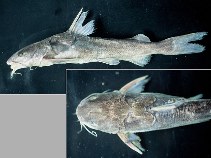 Notarius quadriscutis
Picture by Carvalho Filho, A.
Pictures | Google image
Picture by Carvalho Filho, A.
Classification / Names Common names | Synonyms | Catalog of Fishes(genus, species) | ITIS | CoL | WoRMS | Cloffa
Teleostei (teleosts) > Siluriformes (Catfishes) > Ariidae (Sea catfishes) > Ariinae
More on author: Valenciennes.
More on author: Valenciennes.
Environment: milieu / climate zone / depth range / distribution range Ecology
Marine; freshwater; brackish; benthopelagic. Tropical; 9°N - 13°S, 59°W - 34°W
Distribution Territories | FAO areas | Ecosystems | Occurrences | Point map | Introductions | Faunafri
South America: Atlantic coastal rivers from Guyana to northeastern Brazil.
Size / Weight / Age
Maturity: Lm ? range ? - ? cm
Max length : 50.0 cm TL male/unsexed; (Ref. 3265); common length : 30.0 cm TL male/unsexed; (Ref. 3265); max. published weight: 33.30 g (Ref. 118626)
Max length : 50.0 cm TL male/unsexed; (Ref. 3265); common length : 30.0 cm TL male/unsexed; (Ref. 3265); max. published weight: 33.30 g (Ref. 118626)
Short description Identification keys | Morphology | Morphometrics
Dorsal spines (total): 1. Three pair of barbels on rostral region, two pairs on lower jaw, one pair on posterior end of maxilla; end of maxilla barbel reaching pectoral fin insertion; large saddle-shaped bony plate with rugosa surface in front of dorsal fin, anterior margin of this plate waved but no deep medial incision; body yellow or gray-yellow dorsally, white ventrally (Ref. 13608).
Body shape (shape guide): elongated.
Body shape (shape guide): elongated.
Found in turbid waters over muddy bottoms in shallow coastal areas, also around estuaries (Ref. 3265), and coastal rivers (Ref. 39852). Food items include bottom-living invertebrates. Marketed fresh. Exported frozen (Ref. 5217). Reproduction period is probably between September and November. Egg diameter is 9-11 mm. Males practice mouth brooding of the eggs. (Ref. 35381).
Life cycle and mating behavior Maturity | Reproduction | Spawning | Eggs | Fecundity | Larvae
Main reference
Upload your references | References | Coordinator : Ferraris, Jr., Carl J. | Collaborators
Taylor, W.R. and N.A. Menezes, 1978. Ariidae. In W. Fischer (ed.) FAO species identification sheets for fishery purposes. West Atlantic (Fishing Area 31). volume 1. [pag. var.]. FAO, Rome. (Ref. 3265)
IUCN Red List Status (Ref. 130435: Version 2025-2)
Least Concern (LC) ; Date assessed: 17 August 2011
CITES
Not Evaluated
Threat to humans
Traumatogenic (Ref. 58010)
Human uses
Fisheries: minor commercial
FAO - Publication: search | FishSource | Sea Around Us
More information
Population dynamics
Growth parameters
Max. ages / sizes
Length-weight rel.
Length-length rel.
Length-frequencies
Mass conversion
Recruitment
Abundance
Growth parameters
Max. ages / sizes
Length-weight rel.
Length-length rel.
Length-frequencies
Mass conversion
Recruitment
Abundance
Life cycle
Reproduction
Maturity
Maturity/Gills rel.
Fecundity
Spawning
Spawning aggregations
Eggs
Egg development
Larvae
Larval dynamics
Reproduction
Maturity
Maturity/Gills rel.
Fecundity
Spawning
Spawning aggregations
Eggs
Egg development
Larvae
Larval dynamics
Anatomy
Gill area
Brain
Otolith
Gill area
Brain
Otolith
Physiology
Body composition
Nutrients
Oxygen consumption
Swimming type
Swimming speed
Visual pigments
Fish sound
Diseases & Parasites
Toxicity (LC50s)
Body composition
Nutrients
Oxygen consumption
Swimming type
Swimming speed
Visual pigments
Fish sound
Diseases & Parasites
Toxicity (LC50s)
Genetics
Genome
Genetics
Heterozygosity
Heritability
Genetic Diversity
Genome
Genetics
Heterozygosity
Heritability
Genetic Diversity
Human related
Aquaculture systems
Aquaculture profiles
Strains
Ciguatera cases
Stamps, coins, misc.
Aquaculture systems
Aquaculture profiles
Strains
Ciguatera cases
Stamps, coins, misc.
Tools
E-book | Field guide | Identification keys | Length-frequency wizard | Life-history tool | Point map |
Catch-MSY |
Special reports
Download XML
Internet sources
AFORO (otoliths) | Aquatic Commons | BHL | Cloffa | Websites from users | Check FishWatcher | CISTI | Catalog of Fishes: genus, species | DiscoverLife | ECOTOX | FAO - Publication: search | Faunafri | Fishipedia | Fishtrace | GloBI | Google Books | Google Scholar | Google | IGFA World Record | OneZoom | Open Tree of Life | Otolith Atlas of Taiwan Fishes | PubMed | Reef Life Survey | Socotra Atlas | TreeBase | Tree of Life | Wikipedia: Go, Search | World Records Freshwater Fishing | Zoological Record
Estimates based on models
Preferred temperature (Ref. 123201): 26.9 - 28.2, mean 27.5 °C (based on 66 cells).
Phylogenetic diversity index (Ref. 82804): PD50 = 0.5000 [Uniqueness, from 0.5 = low to 2.0 = high].
Bayesian length-weight: a=0.00589 (0.00388 - 0.00894), b=3.12 (3.00 - 3.24), in cm total length, based on LWR estimates for this species & (Sub)family-body (Ref. 93245).
Trophic level (Ref. 69278): 3.5 ±0.37 se; based on food items.
Resilience (Ref. 120179): Medium, minimum population doubling time 1.4 - 4.4 years (Preliminary K or Fecundity.).
Prior r = 0.58, 95% CL = 0.38 - 0.87, Based on 1 data-limited stock assessment.
Nutrients (Ref. 124155): Calcium = 85.4 [43.1, 173.7] mg/100g; Iron = 0.769 [0.461, 1.295] mg/100g; Protein = 16.2 [14.6, 18.1] %; Omega3 = 0.166 [0.089, 0.317] g/100g; Selenium = 67.3 [33.7, 136.1] μg/100g; VitaminA = 29.3 [12.1, 71.0] μg/100g; Zinc = 1.44 [0.97, 2.25] mg/100g (wet weight);