This website uses cookies to enhance your browsing experience and ensure the functionality of our site. For more detailed information about the types of cookies we use and how we protect your privacy, please visit our Privacy Information page.
×
Cookie Settings
This website uses different types of cookies to enhance your experience. Please select your preferences below:
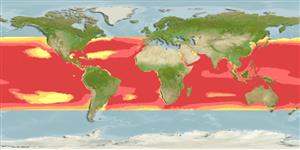
Widespread in tropical zones of all oceans. Western Atlantic: Massachusetts, USA to southern South America (Ref. 7251). Eastern Atlantic: equator eastward to 8°W, Cape Verde. Northwest Atlantic: Canada (Ref. 5951). Indian Ocean: widely distributed but absent from the Red Sea, northern Arabian Sea, and the Persian Gulf (Ref. 3395). Western Pacific: absent in inland waters of southeast Asia (Ref. 9839). Eastern Central Pacific.
Taille / Poids / Âge
Maturité: Lm? range ? - ? cm Max length : 35.0 cm TL mâle / non sexé; (Ref. 5217); common length : 25.0 cm TL mâle / non sexé; (Ref. 5217)
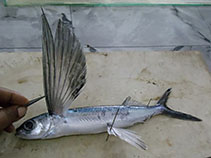
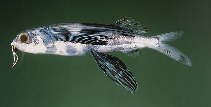
Épines dorsales (Total) : 0; Rayons mous dorsaux (Total) : 12 - 14; Épines anales: 0; Rayons mous anaux: 9 - 11. Body dark iridescent blue above, silvery white below; pectorals dark grey, with a broad pale margin crossed by a pale stripe becoming narrower toward anterior fin margin; pelvic fins pale (Ref. 2797). Juveniles up to 10-19 cm SL with dark bars on body and variegated paired fins (Ref. 2797). Body shape (shape guide): elongated.
Occurs in surface waters of the open ocean (Ref. 30573). Capable of leaping out of the water and gliding for considerable distances above the surface (Ref. 30573). Feeds on zooplankton and small fish (Ref. 9839).
Cycle de vie et comportement reproducteur Maturité | Reproduction | Frai | Œufs | Fécondité | Larves
Parin, N.V., 1996. On the species composition of flying fishes (Exocoetidae) in the West-Central part of tropical Pacific. J. Ichthyol. 36(5):357-364. (Ref. 27313)
Statut dans la liste rouge de l'IUCN (Ref. 130435: Version 2025-2)
Dynamique des populations Paramètres de croissance Âges / tailles maximales Longueur-poids rel. Rel. longueur-longueur. Fréquences de longueurs Conversion de masse Recrutement Abondance
Cycle de vie Reproduction Maturité Maturité/épines rel. Fécondité Frai Agrégats de frai Œufs Développement de l'œuf Larves Dynamique des populations larvaires
Physiologie Composition corporelle Nutriments Consommation d'oxygène Type de natation Vitesse de nage Pigments visuels Son de poisson Maladies et parasites Toxicité (CL50)
Température préférée (Réf. 123201): 20.1 - 28.5, mean 26.2 °C (based on 48395 cells).
Indice de diversité phylogénétique (Réf. 82804): PD50 = 0.5000 [Uniqueness, from 0.5 = low to 2.0 = high].
Bayesian length-weight: a=0.00631 (0.00288 - 0.01384), b=3.05 (2.85 - 3.25), in cm total length, based on LWR estimates for this (Sub)family-body shape (Ref. 93245).
Niveau trophique (Réf. 69278): 4.0 ±0.65 se; based on food items.
Résilience (Réf. 120179): Haut, temps minimum de doublement de population inférieur à 15 mois (Preliminary K or Fecundity.).
Vulnérabilité de la pêche (Ref. 59153): Low vulnerability (25 of 100). 🛈