



Hochladen Photos und videos
Bilder | Briefmarken, Münzen, Verschiedenes. | Google Bild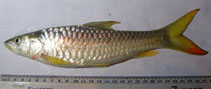 Tor putitora
Photo von Bakalial, B.
Bilder | Briefmarken, Münzen, Verschiedenes. | Google Bild
Photo von Bakalial, B.
Klassifizierung / Names Namen | Synonyme | Catalog of Fishes(Gattung, Arten) | ITIS | CoL | WoRMS | Cloffa
Taxonomic Remarks
Junior synonym Tor mosal is considered valid by Pinder et al., 2019 (Ref. 123468:428).
Umwelt: Milieu / Klimazone / Tiefenbereich / Verbreitungsgebiet Ökologie
; süßwasser benthopelagisch; pH range: 7.4 - 8.0; potamodrom (Ref. 51243); tiefenbereich 0 - ? m (Ref. 56197), usually 0 - 1 m (Ref. 56197). Subtropical; 13°C - 30°C (Ref. 40948); 34°N - 20°N
Verbreitung Territorien | FAO Gebiete | Ökosysteme | Vorkommen | Punkt Karte | Einführungen | Faunafri
Asia: Afghanistan, Pakistan, India, Nepal, Bangladesh (Ref. 4832), Bhutan (Ref. 9418) and Mynmar (Ref. 57739).
Länge bei der ersten Reifung / Größe / Gewicht / Alter
Geschlechtsreife: Lm ?, range 33 - ? cm
Max length : 275 cm TL Männchen/unbestimmt; (Ref. 6695); common length : 183 cm TL Männchen/unbestimmt; (Ref. 6694); max. veröff. Gewicht: 54.0 kg (Ref. 1479)
Max length : 275 cm TL Männchen/unbestimmt; (Ref. 6695); common length : 183 cm TL Männchen/unbestimmt; (Ref. 6694); max. veröff. Gewicht: 54.0 kg (Ref. 1479)
Kurzbeschreibung Bestimmungsschlüssel | Morphologie | Morphometrie
Rückenflossenstacheln (insgesamt) : 4; Rückenflossenweichstrahlen (insgesamt) : 8; Afterflossenstacheln: 2; Afterflossenweichstrahlen: 5.
Body shape (shape guide): fusiform / normal; Cross section: compressed.
Body shape (shape guide): fusiform / normal; Cross section: compressed.
Inhabit streams, riverine pools and lakes. Found in rapid streams with rocky bottom (Ref. 41236). Omnivorous, feeding on fish, zooplankton, dipteran larvae and plant matter (Ref. 40948). Juveniles subsist on plankton while fingerlings feed mainly on algae (Ref. 40948). Ascend streams to breed over gravel and stones and returns to perennial ponds after breeding. The most common Himalayan mahseer and a very attractive sport fish, with excellent food value. Specimens over 30 cm and 5 kg in weight are rarely caught in recent times (Ref. 41236). Threatened due to over harvesting and habitat loss (Ref. 58490).
Lebenszyklus und Paarungsverhalten Geschlechtsreife | Fortpflanzung | Ablaichen | Eier | Fruchtbarkeit | Larven
Migrate from the lower to the middle reaches of streams or rivers to spawn (Ref. 40949). Spawning takes place during low phase of flood (Ref. 56197). Fry are found among stones in marginal areas of the stream (Ref. 56197).
Hauptreferenz
Laden Sie Ihre Referenzen hoch | Referenzen | Koordinator | Partner
Talwar, P.K. and A.G. Jhingran, 1991. Inland fishes of India and adjacent countries. vol 1. A.A. Balkema, Rotterdam. i-liv + 1-541, 1 map (Ref. 4832)
IUCN Rote Liste Status (Ref. 130435: Version 2025-2 (Global))
stark gefährdet (EN) (A2abcd); Date assessed: 05 August 2018
CITES
Not Evaluated
Bedrohung für Menschen
Harmless
Nutzung durch Menschen
Fischereien: kommerziell; Aquakultur: kommerziell; Sportfisch: ja; Aquarium: Öffentliche Aquarien
FAO - Publication: search | FishSource |
Mehr Information
Trophische Ökologie
Lebensmittel (Beutetiere)
Nahrungszusammensetzung
Nahrungsaufnahme
Lebensmittelrationen
Räuber
Lebensmittel (Beutetiere)
Nahrungszusammensetzung
Nahrungsaufnahme
Lebensmittelrationen
Räuber
Populationsdynamik
Wachstumsparameter
Max. Alter/Größen
Länge-Gewicht-Rel.
Länge-Länge-Verhältnis.
Längenhäufigkeiten
Massenkonvertierung
Rekrutierung
Dichte
Wachstumsparameter
Max. Alter/Größen
Länge-Gewicht-Rel.
Länge-Länge-Verhältnis.
Längenhäufigkeiten
Massenkonvertierung
Rekrutierung
Dichte
Lebenszyklus
Fortpflanzung
Geschlechtsreife
Reifung/Kiemen rel.
Fruchtbarkeit
Ablaichen
Laichaggregationen
Eier
Eientwicklung
Larven
Larven Pop.Dyn.
Fortpflanzung
Geschlechtsreife
Reifung/Kiemen rel.
Fruchtbarkeit
Ablaichen
Laichaggregationen
Eier
Eientwicklung
Larven
Larven Pop.Dyn.
Anatomie
Kiemenoberfläche
Gehirn
Otolith
Kiemenoberfläche
Gehirn
Otolith
Physiologie
Körperliche Zusammensetzung
Nährstoffe
Sauerstoffverbrauch
Schwimmart
Schwimmgeschwindigkeit
Visuelle Pigmente
Fischgeräusche
Krankheiten und Parasiten
Toxizität (LC50s)
Körperliche Zusammensetzung
Nährstoffe
Sauerstoffverbrauch
Schwimmart
Schwimmgeschwindigkeit
Visuelle Pigmente
Fischgeräusche
Krankheiten und Parasiten
Toxizität (LC50s)
Menschenbezogen
Aquakultur-Systeme
Aquakultur Profile
Zuchtlinien
Ciguatera-Fälle
Briefmarken, Münzen, Verschiedenes.
Aquakultur-Systeme
Aquakultur Profile
Zuchtlinien
Ciguatera-Fälle
Briefmarken, Münzen, Verschiedenes.
Tools
E-Book | Feldführer | Bestimmungsschlüssel | Längenhäufigkeits Tool | Lebensdaten Tool | Punkt Karte |
Catch-MSY |
Zusatzinformationen
Download XML
Zusammenfassung | Punktdaten | Namen | Photos
Internet Quellen
AFORO (otoliths) | Alien/Invasive Species database | Aquatic Commons | BHL | Cloffa | Websites from users | FishWatcher Einträge suchen | CISTI | Catalog of Fishes: Gattung, Arten | DiscoverLife | ECOTOX | FAO - Publication: search | Faunafri | Fishipedia | Fishtrace | GloBI | Google Books | Google Scholar | Google | IGFA World Record | OneZoom | Open Tree of Life | Otolith Atlas of Taiwan Fishes | Öffentliche Aquarien | PubMed | Reef Life Survey | Socotra Atlas | TreeBase | Tree of Life | Wikipedia: Gehe zu, Suchen | World Records Freshwater Fishing | Zoologischer Rekord
Schätzungen auf der Grundlage von Modellen
Phylogenetischer Diversitätsindex (Ref. 82804): PD50 = 0.5000 [Uniqueness, from 0.5 = low to 2.0 = high].
Bayesian length-weight: a=0.00933 (0.00767 - 0.01136), b=3.00 (2.94 - 3.06), in cm total length, based on LWR estimates for this species (Ref. 93245).
Trophische Ebene (Ref. 69278): 2.9 ±0.38 se; based on food items.
Generation time: 15.7 ( na - na) years. Estimated as median ln(3)/K based on 1 growth studies.
Widerstandsfähigkeit (Ref. 120179): niedrig, Verdopplung der Population dauert 4,5 - 14 Jahre. (tm=1.5; K=0.07; Fec=26,998).
Nährstoffe (Ref. 124155): Calcium = 69.7 [16.3, 159.7] mg/100g; Iron = 1 [0, 3] mg/100g; Protein = 17.8 [15.9, 19.9] %; Omega3 = 0.514 [0.223, 1.171] g/100g; Selenium = 55.5 [22.8, 134.3] μg/100g; VitaminA = 14.4 [5.2, 40.4] μg/100g; Zinc = 1.17 [0.53, 1.99] mg/100g (wet weight); based on nutrient studies.