-

- About this page
- Languages
- User feedbacks
- Citation
- Uploads
- Related species
-



Carangichthys dinema (Bleeker, 1851)
Shadow trevally
Upload your photos and videos
Pictures | Google image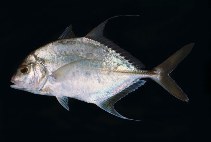 Carangichthys dinema
Picture by Randall, J.E.
Pictures | Google image
Picture by Randall, J.E.
Classification / Names Common names | Synonyms | Catalog of Fishes(genus, species) | ITIS | CoL | WoRMS | Cloffa
Teleostei (teleosts) > Carangiformes (Jacks) > Carangidae (Jacks and pompanos) > Caranginae
More on author: Bleeker.
More on author: Bleeker.
Issue
In the Japenese literature, often placed in the monospecific genus Carangichthys of which the validity remains to be demonstrated (following Gulshiken, 1988 who listed one autapomorphy).
Environment: milieu / climate zone / depth range / distribution range Ecology
Marine; brackish; reef-associated; depth range 1 - 80 m (Ref. 86942). Tropical; 32°N - 22°S
Distribution Territories | FAO areas | Ecosystems | Occurrences | Point map | Introductions | Faunafri
Indo-West Pacific: East Africa to Samoa, north to southern Japan, south to Tonga.
Size / Weight / Age
Maturity: Lm ? range ? - ? cm
Max length : 85.0 cm TL male/unsexed; (Ref. 48635); common length : 35.0 cm TL male/unsexed; (Ref. 9137); max. published weight: 2.6 kg (Ref. 3287)
Max length : 85.0 cm TL male/unsexed; (Ref. 48635); common length : 35.0 cm TL male/unsexed; (Ref. 9137); max. published weight: 2.6 kg (Ref. 3287)
Short description Identification keys | Morphology | Morphometrics
Dorsal spines (total): 9; Dorsal soft rays (total): 17 - 19; Anal spines: 3; Anal soft rays: 15 - 17.
Body shape (shape guide): fusiform / normal; Cross section: compressed.
Body shape (shape guide): fusiform / normal; Cross section: compressed.
Adults inhabit coastal waters. They occur singly or in small to large schools (Ref. 90102) at a depth of 15 m or less along steep drop-offs. Piscivore (Ref. 97629). Maximum depth reported taken from Ref. 128797.
Life cycle and mating behavior Maturity | Reproduction | Spawning | Eggs | Fecundity | Larvae
Main reference
Upload your references | References | Coordinator : Smith-Vaniz, William F. | Collaborators
Smith-Vaniz, W.F., 1984. Carangidae. In W. Fischer and G. Bianchi (eds.) FAO species identification sheets for fishery purposes. Western Indian Ocean fishing area 51. Vol. 1. [pag. var.]. FAO, Rome. (Ref. 3287)
IUCN Red List Status (Ref. 130435: Version 2025-2)
Least Concern (LC) ; Date assessed: 06 March 2015
CITES
Not Evaluated
Threat to humans
Harmless
Human uses
Fisheries: minor commercial; gamefish: yes
FAO - Publication: search | FishSource |
More information
Population dynamics
Growth parameters
Max. ages / sizes
Length-weight rel.
Length-length rel.
Length-frequencies
Mass conversion
Recruitment
Abundance
Growth parameters
Max. ages / sizes
Length-weight rel.
Length-length rel.
Length-frequencies
Mass conversion
Recruitment
Abundance
Life cycle
Reproduction
Maturity
Maturity/Gills rel.
Fecundity
Spawning
Spawning aggregations
Eggs
Egg development
Larvae
Larval dynamics
Reproduction
Maturity
Maturity/Gills rel.
Fecundity
Spawning
Spawning aggregations
Eggs
Egg development
Larvae
Larval dynamics
Anatomy
Gill area
Brain
Otolith
Gill area
Brain
Otolith
Physiology
Body composition
Nutrients
Oxygen consumption
Swimming type
Swimming speed
Visual pigments
Fish sound
Diseases & Parasites
Toxicity (LC50s)
Body composition
Nutrients
Oxygen consumption
Swimming type
Swimming speed
Visual pigments
Fish sound
Diseases & Parasites
Toxicity (LC50s)
Genetics
Genome
Genetics
Heterozygosity
Heritability
Genetic Diversity
Genome
Genetics
Heterozygosity
Heritability
Genetic Diversity
Human related
Aquaculture systems
Aquaculture profiles
Strains
Ciguatera cases
Stamps, coins, misc.
Aquaculture systems
Aquaculture profiles
Strains
Ciguatera cases
Stamps, coins, misc.
Tools
E-book | Field guide | Identification keys | Length-frequency wizard | Life-history tool | Point map |
Catch-MSY |
Special reports
Download XML
Internet sources
AFORO (otoliths) | Aquatic Commons | BHL | Cloffa | Websites from users | Check FishWatcher | CISTI | Catalog of Fishes: genus, species | DiscoverLife | ECOTOX | FAO - Publication: search | Faunafri | Fishipedia | Fishtrace | GloBI | Google Books | Google Scholar | Google | IGFA World Record | National databases | OneZoom | Open Tree of Life | Otolith Atlas of Taiwan Fishes | PubMed | Reef Life Survey | Socotra Atlas | TreeBase | Tree of Life | Wikipedia: Go, Search |