Xiphias gladius, Swordfish : fisheries, gamefish

You can sponsor this page

Xiphias gladius Linnaeus, 1758

Swordfish
अपना अवलोकन जोड़ें Fish Watcher
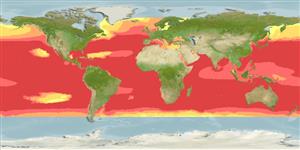
Native range | All suitable habitat | Point map | Year 2050
This map was computer-generated and has not yet been reviewed.
Xiphias gladius   AquaMaps   Data sources: GBIF OBIS
अपना अपलोड करें तस्वीरें और वीडियो
तस्वीरे | वीडियो | टिकट, सिक्के, विविध. | Google image
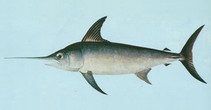
Image of Xiphias gladius (Swordfish)
Xiphias gladius
चित्र स्रोत: AP CAFS


Italy territory information

Common names: Pei spa, Pesce spada, Pesce spate
Occurrence: native
Salinity: marine
Abundance: | Ref:
Importance: commercial | Ref:
Aquaculture: | Ref:
Regulations: | Ref:
Uses: no uses
Comments: Also Ref. 9987.
National Checklist:
Territory Information: https://www.cia.gov/library/publications/resources/the-world-factbook/geos/it.html
National Fisheries Authority:
Occurrences: Occurrences Point map
Main Ref: Nakamura, I., 1985
National Database: ICTIMED

Common names from other countries

वर्गीकरण / नाम आम नाम | उपशब्द | Catalog of Fishes(वर्ग, प्रजाति) | ITIS | CoL | WoRMS | Cloffa

> Carangiformes (Jacks) > Xiphiidae (Swordfish)
Etymology: Xiphias: Greek, xiphos = sword (Ref. 45335).
More on author: Linnaeus.

पर्यावरण: पर्यावरण / जलवायु क्षेत्र / गहराई सीमा / वितरण सीमा पारिस्थितिकी

समुद्री pelagic-oceanic; औशिनोड़िरोमस (Ref. 71039); गहराई सीमा 0 - 2878 m (Ref. 116993), usually 0 - 550 m (Ref. 54934). Temperate; 5°C - 27°C (Ref. 43); 69°N - 50°S, 180°W - 180°E (Ref. 54934)

वितरण प्रदेशों | ऐफ ऐ ओ क्षेत्र | पारिस्थितिकी प्रणालियों | संयोग | बिन्दु नक्शा | भूमिका | Faunafri

Atlantic, Indian and Pacific: tropical and temperate and sometimes cold waters, including the Mediterranean Sea, the Sea of Marmara, the Black Sea, and the Sea of Azov. Highly migratory species. Mt DNA restriction analysis reveal that genetic differentiation occurs between populations inhabiting the Mediterranean Sea and the tropical Atlantic ocean, indicating little genetic exchange occurring between the two (Ref. 12784).

प्रथम परिपक्वता पर लंबाई / आकार / वज़न / आयु

परिपक्व अवधि: Lm 212.0, range 156 - 250 cm
Max length : 455 cm FL पुल्लिंग / अलिंग; (Ref. 40637); common length : 300 cm TL पुल्लिंग / अलिंग; (Ref. 9354); अधिकतम प्रकाशित वज़न: 650.0 kg (Ref. 4689)

संक्षिप्त वर्णन पहचान कुंजी | आकृति विज्ञान | मौरफोमैटरिक्स

पृष्ठीय रीढ़ (सम्पूर्ण) : 0; पृष्ठीय सौफट रेज़ (सम्पूर्ण) : 38 - 56; गुदा कांटा: 0; ऐनल सौफट रेज़: 16 - 18. Blackish-brown fading to light-brown below; 1st dorsal fin with blackish-brown membrane, other fins brown or blackish-brown (Ref. 43). A long, flat, sword-like bill and no pelvic fins (Ref. 26938).
Body shape (shape guide): elongated.

जीवविज्ञान     शब्द संग्रह (उदाहरणार्थ epibenthic)

Oceanic but sometimes found in coastal waters (Ref. 9354). Generally above the thermocline (Ref. 9354), preferring temperatures of 18°C to 22°C (Ref. 9987). Larvae are frequently encountered at temperatures above 24 °C (Ref. 9702). Migrate toward temperate or cold waters in the summer and back to warm waters in the fall. Adults are opportunistic feeders, known to forage for their food from the surface to the bottom over a wide depth range (Ref. 9702). Feed mainly on fishes (Atlantic mackerel, barracudinas, silver hake, redfish, herring and lanternfishes (Ref. 5951); also on crustaceans and squids (Ref. 9354). They use their sword to kill their prey (Ref. 9354). Large individuals may accumulate large percentages of mercury in its flesh (Ref. 9354). Are batch spawners (Ref. 51846). Spawning takes place in Atlantic during spring in southern Sargasso Sea. Migrate to cooler waters to feed (Ref. 4689). Females grow fastest. Determination of age is difficult since the otoliths are very small and scales are missing in adults. Year rings have been successfully counted on cross sections of the fin rays (Ref. 35388). Pelagic eggs measure 1.6-1.8mm and the newly hatched larvae is 4 mm long. Sword is well developed at a length of 10mm and young live pelagically in the upper water layers where they quickly develop into very voracious predators (Ref. 35388). Mt DNA restriction analysis reveal that genetic differentiation occurs between populations inhabiting the Mediterranean Sea and the tropical Atlantic ocean, indicating little genetic exchange occurring between the two (Ref. 12784). Good food fish, marketed fresh or frozen, and can be made into sashimi, teriyaki or fillets (Ref. 9354).

जीवन चक्र और संभोग व्यवहार परिपक्व अवधि | पुनरुत्पत्ति | मछलीऔ का अंडे देना | अंडे | उपजाऊपन | लार्वा

In the Atlantic Ocean, spawning occurs in the upper water layer at depths between 0 and 75 m, at temperatures around 23°C, and salinity of 33.8 to 37.4 ppt. The distribution of larval broadbill swordfish in the Pacific Ocean indicates that spawning occurs mainly in waters with a temperature of 24°C or more. Spawning appears to occur in all seasons in equatorial waters, but is restricted to spring and summer at higher latitudes (Ref. 30448). Fertilisation in broadbill swordfish is external and pairing of solitary males and females is thought to occur when spawning (Ref. 9742). Broadbill swordfish are reported to spawn in the upper layers of the water column, from the surface to a depth of 75 m (Ref. 43). Estimates of egg numbers vary considerably, from 1 million to 16 million in 168,000 g female (Ref. 9742) and 29 million in a 272,000 g female (Ref. 30372).

मुख्य संदर्भ अपने संदर्भ अपलोड करें | संदर्भ | संयोजक | सहयोगीयो

Nakamura, I., 1985. FAO species catalogue. Vol. 5. Billfishes of the world. An annotated and illustrated catalogue of marlins, sailfishes, spearfishes and swordfishes known to date. FAO Fish. Synop. 125(5):65p. Rome: FAO. (Ref. 43)

आईयूसीएन रेड लिस्ट स्थिति (Ref. 130435: Version 2025-2 (Global))

  Near Threatened (NT) (A2bd); Date assessed: 01 May 2021

CITES

Not Evaluated

CMS (Ref. 116361)

Not Evaluated

मनुष्यों के लिए ख़तरा


मानव उपयोग

मात्स्यिकी: व्यापारिक; आखेट मत्स्य: हां

अधिक जानकारी

शरीर रचना
गिल क्षेत्र
दिमाग
ओटोलिथ
फिजियोलॉजी
शारीरिक संरचना
पोषक तत्व
प्राणवायु की खपत
तैराकी का प्रकार
तैराकी की गति
दृश्य वर्णक
मछली की आवाज
रोग एवं परजीवी
विषाक्तता (LC50s)
आनुवंशिकी
जीनोम
आनुवंशिकी
विषमयुग्मजी
हैरेटिबिलटी
मानव संबंधी
जलकृषि प्रणालियाँ
जलीयकृषि रूपरेखाऐ
खींच
सिगुएटेरा के मामले
टिकट, सिक्के, विविध.
आउटरीच
सहयोगीयो
संदर्भ
संदर्भ

साधन

विशेष रिपोर्ट

XML डाउनलोड करें

इंटरनेट स्रोत

मॉडल पर आधारित अनुमान

पसंदीदा तापमान (संदर्भ 123201): 10.9 - 27.6, mean 22.7 °C (based on 5276 cells).
जातिवृति विविधता सूचकांक (संदर्भ 82804):  PD50 = 1.5000   [Uniqueness, from 0.5 = low to 2.0 = high].
Bayesian length-weight: a=0.00380 (0.00161 - 0.00900), b=3.15 (2.93 - 3.37), in cm total length, based on LWR estimates for this (Sub)family-body shape (Ref. 93245).
ट्रॉफिक स्तर (संदर्भ 69278):  4.5   ±0.2 se; based on diet studies.
Generation time: 8.9 (6.1 - 13.7) years. Estimated as median ln(3)/K based on 11 growth studies.
लौटाव (संदर्भ 120179):  माध्यम, न्यूनतम जनसंख्या दुगनी होने का समय 1.4 - 4.4 वर्ष। (rm=0.076; K=0.23; tm=5-6; tmax=9).
Prior r = 0.46, 95% CL = 0.30 - 0.69, Based on 17 full stock assessments.
मछली पकड़ने की भेद्यता (Ref. 59153):  High to very high vulnerability (72 of 100). 🛈
जलवायु भेद्यता (Ref. 125649):  Moderate vulnerability (43 of 100). 🛈
मूल्य श्रेणी (Ref. 80766):   Very high.
पोषक तत्व (Ref. 124155):  Calcium = 9 [4, 16] mg/100g; Iron = 0.278 [0.142, 0.491] mg/100g; Protein = 19.3 [17.0, 22.1] %; Omega3 = 0.333 [0.155, 0.694] g/100g; Selenium = 44.1 [17.4, 121.6] μg/100g; VitaminA = 5.71 [1.63, 20.67] μg/100g; Zinc = 0.443 [0.157, 0.783] mg/100g (wet weight); based on nutrient studies.