This website uses cookies to enhance your browsing experience and ensure the functionality of our site. For more detailed information about the types of cookies we use and how we protect your privacy, please visit our Privacy Information page.
×
Cookie Settings
This website uses different types of cookies to enhance your experience. Please select your preferences below:
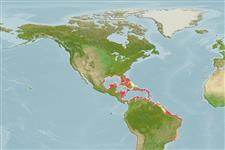
Western Atlantic: Bermuda (introduced) and Florida, USA to Brazil, including the Gulf of Mexico and the Caribbean Sea (Ref. 9626).
Größe / Gewicht / Alter
Geschlechtsreife: Lm? range ? - ? cm Max length : 40.6 cm TL Männchen/unbestimmt; (Ref. 40637); common length : 25.0 cm TL Männchen/unbestimmt; (Ref. 3798); max. veröff. Gewicht: 930.00 g (Ref. 40637)
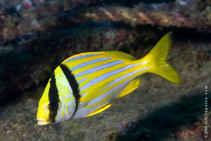
Rückenflossenstacheln (insgesamt) : 12; Rückenflossenweichstrahlen (insgesamt) : 16 - 18; Afterflossenstacheln: 3; Afterflossenweichstrahlen: 9. Body striped yellow and silvery blue; fins yellow, 2 black bars: one from nape through eye to mouth, another from origin of dorsal fin to base of pectoral fin. Only grunt fish in the Caribbean with two vertical black bars and yellow stripes. (Ref. 26938). Body shape (shape guide): short and / or deep.
Maximum depth from Ref. 126840. Inhabits reefs and rocky bottoms. Feeds at night on mollusks, echinoderms, annelids, and crustaceans (Ref. 3798). Young pick parasites from the bodies of larger fishes (Ref. 5521). Young are popular aquarium fish (Ref. 7251). Marketed fresh (Ref. 3798). Has been reared in captivity (Ref. 35420).
Bevorzugte Temperatur (Ref. 123201): 24.9 - 28.2, mean 27.4 °C (based on 791 cells).
Phylogenetischer Diversitätsindex (Ref. 82804): PD50 = 0.5020 [Uniqueness, from 0.5 = low to 2.0 = high].
Bayesian length-weight: a=0.01514 (0.00897 - 0.02555), b=3.05 (2.90 - 3.20), in cm total length, based on LWR estimates for this species & (Sub)family-body (Ref. 93245).
Trophische Ebene (Ref. 69278): 3.6 ±0.5 se; based on diet studies.
Widerstandsfähigkeit (Ref. 120179): mittel, Verdopplung der Population dauert 1,4 - 4,4 Jahre. (Preliminary K or Fecundity.).
Anfälligkeit der Fischerei (Ref. 59153): Low to moderate vulnerability (31 of 100). 🛈