



Chaenophryne draco Beebe, 1932
Smooth dreamer
Beobachtung melden im Fish Watcher
| Native range | All suitable habitat | Point map | Year 2050 |

|
| This map was computer-generated and has not yet been reviewed. |
| Chaenophryne draco AquaMaps Data sources: GBIF OBIS |
Hochladen Photos und videos
Google Bild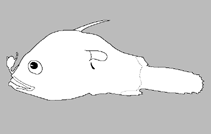 No image available for this species;
drawing shows typical species in Oneirodidae.
Google Bild
drawing shows typical species in Oneirodidae.
Klassifizierung / Names Namen | Synonyme | Catalog of Fishes(Gattung, Arten) | ITIS | CoL | WoRMS | Cloffa
> Lophiiformes (Anglerfishes) > Oneirodidae (Dreamers)
Etymology: Chaenophryne: Greek, 'chaeno' or 'chaino' = to gape + Greek, 'phryne' = toad (alluring to a "gaping toad") (Ref. 86949).
More on author: Beebe.
Etymology: Chaenophryne: Greek, 'chaeno' or 'chaino' = to gape + Greek, 'phryne' = toad (alluring to a "gaping toad") (Ref. 86949).
More on author: Beebe.
Umwelt: Milieu / Klimazone / Tiefenbereich / Verbreitungsgebiet Ökologie
seewasser bathypelagisch; tiefenbereich 350 - 1750 m (Ref. 58302). Deep-water; 44°N - 42°S, 180°W - 180°E
Verbreitung Territorien | FAO Gebiete | Ökosysteme | Vorkommen | Punkt Karte | Einführungen | Faunafri
Tropical and subtropical parts of all oceans. Eastern Atlantic: A single female was recorded north of Madeira. Eastern Pacific: Oregon, USA and British Columbia, Canada (Ref. 6885). Western Pacific: Japan (Ref. 559) and Australia (Ref. 7300).
Größe / Gewicht / Alter
Geschlechtsreife: Lm ? range ? - ? cm
Max length : 12.3 cm SL Männchen/unbestimmt; (Ref. 75756); common length : 8.3 cm SL Männchen/unbestimmt; (Ref. 6885)
Max length : 12.3 cm SL Männchen/unbestimmt; (Ref. 75756); common length : 8.3 cm SL Männchen/unbestimmt; (Ref. 6885)
Kurzbeschreibung Bestimmungsschlüssel | Morphologie | Morphometrie
Rückenflossenstacheln (insgesamt) : 0; Rückenflossenweichstrahlen (insgesamt) : 6 - 8; Afterflossenstacheln: 0; Afterflossenweichstrahlen: 5 - 6. Caudal large; pectorals small, pediculate, directed upward (Ref. 6885). Black except for pale on esca at end of illicium (Ref. 6885). Distinguishing characteristics: esca with single conical to elongate, internally pigmented anterior appendage, less than one-seventh to nearly one-third length of escal bulb; absence of medial escal appendages; posterior escal appendages with swollen basal portion and compressed distal crest, posterior filament or filaments and pair of anterior lobes each with numerous filaments; anterolateral escal appendages and basal series of filaments absent; have the highest ratio between the number of upper and lower jaw teeth of any species, 1.08-1.45; total number of teeth in upper jaw 35-47, lower jaw with 31-38 teeth; vomerine teeth 4-8; slightly shorter illicium compared to C.ramifera and slightly longer than that of C.melanorhabdus, length 24-36.4% SL (Ref. 86949).
Body shape (shape guide): short and / or deep.
Body shape (shape guide): short and / or deep.
Meso- (Ref. 10524) and bathypelagic (Ref. 58302). Males dwarfed, non-parasitic (Ref. 10524). Specimen examined was 9.7 cm SL from Auckland Institute and Museum (AIM 6609) (Ref. 58502).
Lebenszyklus und Paarungsverhalten Geschlechtsreife | Fortpflanzung | Ablaichen | Eier | Fruchtbarkeit | Larven
Hauptreferenz
Laden Sie Ihre Referenzen hoch | Referenzen | Koordinator | Partner
Bertelsen, E., 1990. Oneirodidae. p. 498-507. In J.C. Quero, J.C. Hureau, C. Karrer, A. Post, and L. Saldanha (eds.) Check-list of the fishes of the eastern tropical Atlantic (CLOFETA). JNICT, Lisbon; SEI, Paris; and UNESCO, Paris. Vol. 1. (Ref. 10524)
IUCN Rote Liste Status (Ref. 130435: Version 2025-2 (Global))
nicht bedroht (LC) ; Date assessed: 14 July 2014
CITES
Not Evaluated
Bedrohung für Menschen
Harmless
Nutzung durch Menschen
FAO - Publication: search | FishSource |
Mehr Information
Trophische Ökologie
Lebensmittel (Beutetiere)
Nahrungszusammensetzung
Nahrungsaufnahme
Lebensmittelrationen
Räuber
Lebensmittel (Beutetiere)
Nahrungszusammensetzung
Nahrungsaufnahme
Lebensmittelrationen
Räuber
Populationsdynamik
Wachstumsparameter
Max. Alter/Größen
Länge-Gewicht-Rel.
Länge-Länge-Verhältnis.
Längenhäufigkeiten
Massenkonvertierung
Rekrutierung
Dichte
Wachstumsparameter
Max. Alter/Größen
Länge-Gewicht-Rel.
Länge-Länge-Verhältnis.
Längenhäufigkeiten
Massenkonvertierung
Rekrutierung
Dichte
Lebenszyklus
Fortpflanzung
Geschlechtsreife
Reifung/Kiemen rel.
Fruchtbarkeit
Ablaichen
Laichaggregationen
Eier
Eientwicklung
Larven
Larven Pop.Dyn.
Fortpflanzung
Geschlechtsreife
Reifung/Kiemen rel.
Fruchtbarkeit
Ablaichen
Laichaggregationen
Eier
Eientwicklung
Larven
Larven Pop.Dyn.
Anatomie
Kiemenoberfläche
Gehirn
Otolith
Kiemenoberfläche
Gehirn
Otolith
Physiologie
Körperliche Zusammensetzung
Nährstoffe
Sauerstoffverbrauch
Schwimmart
Schwimmgeschwindigkeit
Visuelle Pigmente
Fischgeräusche
Krankheiten und Parasiten
Toxizität (LC50s)
Körperliche Zusammensetzung
Nährstoffe
Sauerstoffverbrauch
Schwimmart
Schwimmgeschwindigkeit
Visuelle Pigmente
Fischgeräusche
Krankheiten und Parasiten
Toxizität (LC50s)
Genetik
Genom
Genetik
Heterozygotie
Vererbbarkeit
Genetische Vielfalt
Genom
Genetik
Heterozygotie
Vererbbarkeit
Genetische Vielfalt
Menschenbezogen
Aquakultur-Systeme
Aquakultur Profile
Zuchtlinien
Ciguatera-Fälle
Briefmarken, Münzen, Verschiedenes.
Aquakultur-Systeme
Aquakultur Profile
Zuchtlinien
Ciguatera-Fälle
Briefmarken, Münzen, Verschiedenes.
Tools
Zusatzinformationen
Download XML
Zusammenfassung | Punktdaten | Namen | Photos
Internet Quellen
AFORO (otoliths) | Aquatic Commons | BHL | Cloffa | Websites from users | FishWatcher Einträge suchen | CISTI | Catalog of Fishes: Gattung, Arten | DiscoverLife | ECOTOX | FAO - Publication: search | Faunafri | Fishipedia | Fishtrace | GloBI | Google Books | Google Scholar | Google | IGFA World Record | OneZoom | Open Tree of Life | Otolith Atlas of Taiwan Fishes | PubMed | Reef Life Survey | Socotra Atlas | TreeBase | Tree of Life | Wikipedia: Gehe zu, Suchen | World Records Freshwater Fishing | Zoobank | Zoologischer Rekord
Schätzungen auf der Grundlage von Modellen
Bevorzugte Temperatur (Ref. 123201): 4.1 - 7.9, mean 6.1 °C (based on 492 cells).
Phylogenetischer Diversitätsindex (Ref. 82804): PD50 = 0.5312 [Uniqueness, from 0.5 = low to 2.0 = high].
Bayesian length-weight: a=0.01995 (0.00906 - 0.04395), b=3.01 (2.83 - 3.19), in cm total length, based on all LWR estimates for this body shape (Ref. 93245).
Trophische Ebene (Ref. 69278): 4.0 ±0.6 se; based on size and trophs of closest relatives
Widerstandsfähigkeit (Ref. 120179): mittel, Verdopplung der Population dauert 1,4 - 4,4 Jahre. (Preliminary K or Fecundity.).
Nährstoffe (Ref. 124155): Calcium = 53.2 [17.1, 134.8] mg/100g; Iron = 0.442 [0.179, 1.356] mg/100g; Protein = 18.3 [15.5, 21.5] %; Omega3 = 0.207 [0.058, 0.720] g/100g; Selenium = 12.4 [3.5, 38.1] μg/100g; VitaminA = 57.2 [6.2, 532.1] μg/100g; Zinc = 0.531 [0.255, 1.102] mg/100g (wet weight);