This website uses cookies to enhance your browsing experience and ensure the functionality of our site. For more detailed information about the types of cookies we use and how we protect your privacy, please visit our Privacy Information page.
×
Cookie Settings
This website uses different types of cookies to enhance your experience. Please select your preferences below:
> Carangiformes (Jacks) > Carangidae (Jacks and pompanos) > Trachinotinae
Etymology: Trachinotus:Greek, trachys, -eia, -ys = rough + Greek,noton = back (Ref. 45335). Eponymy: Marcus Élieser Bloch (1723–1799) was a German physician and naturalist specialising in ichthyology. [...] (Ref. 128868), visit book page. More on author: Lacepède.
Umwelt: Milieu / Klimazone / Tiefenbereich / Verbreitungsgebiet Ökologie
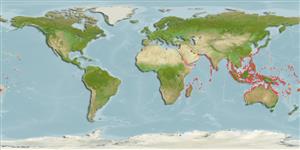
Indo-Pacific: Red Sea and East Africa (Ref. 3287) to the Marshall Islands and Samoa, north to southern Japan, south to Australia.
Länge bei der ersten Reifung / Größe / Gewicht / Alter
Geschlechtsreife: Lm?, range 58 - ? cm Max length : 110 cm FL Männchen/unbestimmt; (Ref. 1602); common length : 40.0 cm TL Männchen/unbestimmt; (Ref. 3280); max. veröff. Gewicht: 3.4 kg (Ref. 40637)
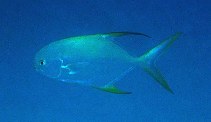
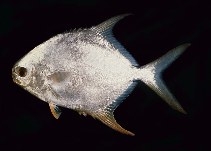
Rückenflossenstacheln (insgesamt) : 7; Rückenflossenweichstrahlen (insgesamt) : 18 - 20; Afterflossenstacheln: 3; Afterflossenweichstrahlen: 16 - 18. Body shape (shape guide): short and / or deep; Cross section: compressed.
Juveniles inhabit sandy shorelines and shallow sandy or muddy bays near river mouths while adults move out in schools to clear seaward coral and rock reefs (Ref. 5213). Juveniles are in small schools, while adults are usually solitary (Ref. 48635). Adults feed primarily on sand mollusks and other hard-shelled invertebrates (Ref. 9710).
Paxton, J.R., D.F. Hoese, G.R. Allen and J.E. Hanley, 1989. Pisces. Petromyzontidae to Carangidae. Zoological Catalogue of Australia, Vol. 7. Australian Government Publishing Service, Canberra, 665 p. (Ref. 7300)
IUCN Rote Liste Status (Ref. 130435: Version 2025-2 (Global))
Bevorzugte Temperatur (Ref. 123201): 24.8 - 29.3, mean 28.4 °C (based on 3759 cells).
Phylogenetischer Diversitätsindex (Ref. 82804): PD50 = 0.5000 [Uniqueness, from 0.5 = low to 2.0 = high].
Bayesian length-weight: a=0.02630 (0.01476 - 0.04687), b=2.83 (2.68 - 2.98), in cm total length, based on LWR estimates for this species & Genus-body shape (Ref. 93245).
Trophische Ebene (Ref. 69278): 3.8 ±0.41 se; based on food items.
Widerstandsfähigkeit (Ref. 120179): mittel, Verdopplung der Population dauert 1,4 - 4,4 Jahre. (Assuming tm=2-4).
Anfälligkeit der Fischerei (Ref. 59153): High to very high vulnerability (73 of 100). 🛈
Klimaanfälligkeit (Ref. 125649): Very high vulnerability (93 of 100). 🛈