



Acheilognathus tabira Jordan & Thompson, 1914
Hochladen Photos und videos
Bilder | Google Bild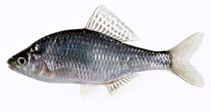 Acheilognathus tabira
Photo von Senou, H.
Bilder | Google Bild
Photo von Senou, H.
Klassifizierung / Names Namen | Synonyme | Catalog of Fishes(Gattung, Arten) | ITIS | CoL | WoRMS | Cloffa
> Cypriniformes (Carps) > Acheilognathidae (Bitterlings)
Etymology: Acheilognathus: Greek, a = without + Greek, cheilos = lip + Greek, gnathos = jaw (Ref. 45335).
More on authors: Jordan & Thompson.
Etymology: Acheilognathus: Greek, a = without + Greek, cheilos = lip + Greek, gnathos = jaw (Ref. 45335).
More on authors: Jordan & Thompson.
Umwelt: Milieu / Klimazone / Tiefenbereich / Verbreitungsgebiet Ökologie
; süßwasser; brackwasser benthopelagisch; tiefenbereich ? - 40 m (Ref. 78070). Temperate; 10°C - 25°C (Ref. 13614)
Verbreitung Territorien | FAO Gebiete | Ökosysteme | Vorkommen | Punkt Karte | Einführungen | Faunafri
Asia: Japan. Five subspecies were recognized: Acheilognathus tabira erythropterus Pacific Ocean side of eastern Honshu (Miyagi, Tochigi, Ibaraki, Chiba Prefectures and Tokyo Metropolis); Acheilognathus tabira jordani in Japan Sea side of western Honshu (Toyama, Ishikawa, Fukui, Tottori and Shimane Prefectures); Acheilognathus tabira nakamurae in Kyushu area; Acheilognathus tabira tabira in Western Honshu; and Acheilognathus tabira tohokuensis in Japan Sea side of eastern Honshu (Akita, Yamagata, Fukushima in western area and Niigata Prefectures).
Größe / Gewicht / Alter
Kurzbeschreibung Bestimmungsschlüssel | Morphologie | Morphometrie
Rückenflossenweichstrahlen (insgesamt) : 11 - 14; Afterflossenweichstrahlen: 11 - 13; Wirbelzahl: 35 - 38. Can be diagnosed by having the following characters: dorsal fin with iii, 9-11 rays; anal fin with iii, 9-10 rays; dorsal fin in males grayish; anal fin in nuptial males white; absence of black blotch on dorsal fin in juveniles; eggs short ellipsoid, ratio of major axis to minor axis, 1.4-1.7 (Ref. 78070).
Body shape (shape guide): fusiform / normal.
Body shape (shape guide): fusiform / normal.
Inhabits rivers, creeks, lakes and ponds in plains. Also occurs in mouths of rivers draining into lagoons, in rocky shores of rivers and irrigation creeks, and in floodplain pools. Deposits its eggs into host mussels (Ref. 78070).
Lebenszyklus und Paarungsverhalten Geschlechtsreife | Fortpflanzung | Ablaichen | Eier | Fruchtbarkeit | Larven
Female has an ovipositor which is used to deposit eggs inside bivalves. Young remain in the bivalve until they can swim (Ref. 43281).
Hauptreferenz
Laden Sie Ihre Referenzen hoch | Referenzen | Koordinator | Partner
Doi, A., R. Arai and H.-Z. Liu, 1999. Acheilognathus macromandibularis, a new bitterling (Cyprinidae) from the lower Changjiang basin, China. Ichthyol. Explor. Freshwat. 10(4):303-308. (Ref. 39330)
IUCN Rote Liste Status (Ref. 130435: Version 2025-2 (Global))
Gefährdung zunehmend (NT) (B2ab(i,ii,iii,iv,v)); Date assessed: 08 December 2017
CITES
Not Evaluated
Bedrohung für Menschen
Harmless
Nutzung durch Menschen
FAO - Publication: search | FishSource |
Mehr Information
Trophische Ökologie
Lebensmittel (Beutetiere)
Nahrungszusammensetzung
Nahrungsaufnahme
Lebensmittelrationen
Räuber
Lebensmittel (Beutetiere)
Nahrungszusammensetzung
Nahrungsaufnahme
Lebensmittelrationen
Räuber
Populationsdynamik
Wachstumsparameter
Max. Alter/Größen
Länge-Gewicht-Rel.
Länge-Länge-Verhältnis.
Längenhäufigkeiten
Massenkonvertierung
Rekrutierung
Dichte
Wachstumsparameter
Max. Alter/Größen
Länge-Gewicht-Rel.
Länge-Länge-Verhältnis.
Längenhäufigkeiten
Massenkonvertierung
Rekrutierung
Dichte
Lebenszyklus
Fortpflanzung
Geschlechtsreife
Reifung/Kiemen rel.
Fruchtbarkeit
Ablaichen
Laichaggregationen
Eier
Eientwicklung
Larven
Larven Pop.Dyn.
Fortpflanzung
Geschlechtsreife
Reifung/Kiemen rel.
Fruchtbarkeit
Ablaichen
Laichaggregationen
Eier
Eientwicklung
Larven
Larven Pop.Dyn.
Anatomie
Kiemenoberfläche
Gehirn
Otolith
Kiemenoberfläche
Gehirn
Otolith
Physiologie
Körperliche Zusammensetzung
Nährstoffe
Sauerstoffverbrauch
Schwimmart
Schwimmgeschwindigkeit
Visuelle Pigmente
Fischgeräusche
Krankheiten und Parasiten
Toxizität (LC50s)
Körperliche Zusammensetzung
Nährstoffe
Sauerstoffverbrauch
Schwimmart
Schwimmgeschwindigkeit
Visuelle Pigmente
Fischgeräusche
Krankheiten und Parasiten
Toxizität (LC50s)
Menschenbezogen
Aquakultur-Systeme
Aquakultur Profile
Zuchtlinien
Ciguatera-Fälle
Briefmarken, Münzen, Verschiedenes.
Aquakultur-Systeme
Aquakultur Profile
Zuchtlinien
Ciguatera-Fälle
Briefmarken, Münzen, Verschiedenes.
Tools
E-Book | Feldführer | Bestimmungsschlüssel | Längenhäufigkeits Tool | Lebensdaten Tool | Punkt Karte |
Catch-MSY |
Zusatzinformationen
Download XML
Zusammenfassung | Punktdaten | Namen | Photos
Internet Quellen
AFORO (otoliths) | Aquatic Commons | BHL | Cloffa | Websites from users | FishWatcher Einträge suchen | CISTI | Catalog of Fishes: Gattung, Arten | DiscoverLife | ECOTOX | FAO - Publication: search | Faunafri | Fishipedia | Fishtrace | GloBI | Google Books | Google Scholar | Google | IGFA World Record | OneZoom | Open Tree of Life | Otolith Atlas of Taiwan Fishes | PubMed | Reef Life Survey | Socotra Atlas | TreeBase | Tree of Life | Wikipedia: Gehe zu, Suchen | World Records Freshwater Fishing | Zoobank | Zoologischer Rekord
Schätzungen auf der Grundlage von Modellen
Phylogenetischer Diversitätsindex (Ref. 82804): PD50 = 0.5000 [Uniqueness, from 0.5 = low to 2.0 = high].
Bayesian length-weight: a=0.01096 (0.00507 - 0.02372), b=3.10 (2.93 - 3.27), in cm total length, based on LWR estimates for this Genus-body shape (Ref. 93245).
Trophische Ebene (Ref. 69278): 2.2 ±0.1 se; based on size and trophs of closest relatives
Widerstandsfähigkeit (Ref. 120179): mittel, Verdopplung der Population dauert 1,4 - 4,4 Jahre. (Assuming Fec < 10,000).