



Beobachtung melden im Fish Watcher
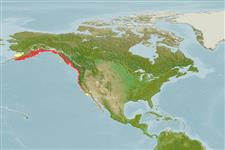
| Native range | All suitable habitat | Point map | Year 2050 |
|
| This map was computer-generated and has not yet been reviewed. |
| Hypomesus pretiosus AquaMaps Data sources: GBIF OBIS |
Hochladen Photos und videos
Bilder | videos | Google Bild Hypomesus pretiosus
Photo von Bull. U.S. Bur. Fish.
Bilder | videos | Google Bild
Photo von Bull. U.S. Bur. Fish.
Klassifizierung / Names Namen | Synonyme | Catalog of Fishes(Gattung, Arten) | ITIS | CoL | WoRMS | Cloffa
> Osmeriformes (Freshwater smelts) > Osmeridae (Smelts)
Etymology: Hypomesus: Greek, hypo = under + Greek,mesos = a half (Ref. 45335).
More on author: Girard.
Etymology: Hypomesus: Greek, hypo = under + Greek,mesos = a half (Ref. 45335).
More on author: Girard.
Umwelt: Milieu / Klimazone / Tiefenbereich / Verbreitungsgebiet Ökologie
seewasser; brackwasser benthopelagisch; diadromous (Ref. 138280). Temperate; 61°N - 33°N, 163°W - 117°W
Verbreitung Territorien | FAO Gebiete | Ökosysteme | Vorkommen | Punkt Karte | Einführungen | Faunafri
Eastern Pacific: Prince William Sound, Gulf of Alaska to Long Beach, southern California, USA. Reports from the western Pacific are misidentifications of Hypomesus japonicus.
Länge bei der ersten Reifung / Größe / Gewicht / Alter
Geschlechtsreife: Lm ?, range 9 - ? cm
Max length : 30.5 cm TL Männchen/unbestimmt; (Ref. 6885); common length : 15.0 cm TL Männchen/unbestimmt; (Ref. 12193); max. veröff. Alter: 5 Jahre (Ref. 72502)
Max length : 30.5 cm TL Männchen/unbestimmt; (Ref. 6885); common length : 15.0 cm TL Männchen/unbestimmt; (Ref. 12193); max. veröff. Alter: 5 Jahre (Ref. 72502)
Kurzbeschreibung Bestimmungsschlüssel | Morphologie | Morphometrie
Rückenflossenstacheln (insgesamt) : 0; Rückenflossenweichstrahlen (insgesamt) : 9 - 11; Afterflossenstacheln: 0; Afterflossenweichstrahlen: 12 - 17; Wirbelzahl: 64 - 67. Vomer small, without posterior process; periphery of glossohyal bone with single row of blunt teeth, a few teeth located irregularly at center of distal region; base of adipose fin less than 20% of head length; eye small; adipose eyelid well developed (Ref. 33312). Distinguished by its midlateral scale count of 66 to 73 and the presence of 4 to 7 pyloric caeca (Ref. 27547). Lateral line short and incomplete, reaching about to tip of pectorals (Ref. 27547). Adipose sickle-shaped; pectorals small; pelvic fins originating behind or below dorsal origin (Ref. 6885). Light olive green to brownish on back, sides and belly silvery and iridescent with a bright reflecting band along the side in living specimens; males show more golden hues than females during spawning season (Ref. 6885). Branchiostegal rays: 7-8 (Ref. 35792).
Body shape (shape guide): elongated.
Body shape (shape guide): elongated.
Individuals 3.5 cm may ascend rivers, presumably returning to the sea shortly after (Ref. 27547). Presumably young move offshore and reappear inshore as mature adults (Ref. 27547). At sea, they feed on small crustaceans, worms and jellyfish, as well as larval fishes (Ref. 6885, 10276). Females reach age 3, males age 2 (Ref. 27547). Oviparous, with demersal eggs and planktonic larvae (Ref. 35792). Eggs are laid on beaches with heavy surf action (Ref. 33312).
Lebenszyklus und Paarungsverhalten Geschlechtsreife | Fortpflanzung | Ablaichen | Eier | Fruchtbarkeit | Larven
Schools approach the beach to spawn, usually with the females appearing a few days before the males. At spawning, large numbers of males mill about near the edge of the surf. When a female is seen, numbers of males pursue her and try to get into spawning position. If she swims to deeper water, the males desert her. 1 to 5 males swim parallel to and slightly behind a ripe female. The males press against the female and as they reach water 2.5 to 5 cm deep, the fish bend and vibrate, releasing eggs and sperm, then retreat to deeper water. The spawning act may be repeated on several successive waves. Wave action buries the eggs, usually to a depth of 2.5 to10 cm but sometimes to as deep as 30 cm (Ref. 27547).
Hauptreferenz
Laden Sie Ihre Referenzen hoch | Referenzen | Koordinator | Partner
Saruwatari, T., J.A. López and T.W. Pietsch, 1997. A revision of the ormerid genus Hypomesus Gill (Teleostei: Salmoniformes), with a description of a new species from the southern Kuril Islands. Species Diversity 2:59-82. (Ref. 33312)
CITES
Not Evaluated
Bedrohung für Menschen
Harmless
Nutzung durch Menschen
Fischereien: kommerziell; Sportfisch: ja
FAO - Fischereien: landungen; Publication: search | FishSource | Das Meer um uns herum
Mehr Information
Trophische Ökologie
Lebensmittel (Beutetiere)
Nahrungszusammensetzung
Nahrungsaufnahme
Lebensmittelrationen
Räuber
Lebensmittel (Beutetiere)
Nahrungszusammensetzung
Nahrungsaufnahme
Lebensmittelrationen
Räuber
Populationsdynamik
Wachstumsparameter
Max. Alter/Größen
Länge-Gewicht-Rel.
Länge-Länge-Verhältnis.
Längenhäufigkeiten
Massenkonvertierung
Rekrutierung
Dichte
Wachstumsparameter
Max. Alter/Größen
Länge-Gewicht-Rel.
Länge-Länge-Verhältnis.
Längenhäufigkeiten
Massenkonvertierung
Rekrutierung
Dichte
Lebenszyklus
Fortpflanzung
Geschlechtsreife
Reifung/Kiemen rel.
Fruchtbarkeit
Ablaichen
Laichaggregationen
Eier
Eientwicklung
Larven
Larven Pop.Dyn.
Fortpflanzung
Geschlechtsreife
Reifung/Kiemen rel.
Fruchtbarkeit
Ablaichen
Laichaggregationen
Eier
Eientwicklung
Larven
Larven Pop.Dyn.
Anatomie
Kiemenoberfläche
Gehirn
Otolith
Kiemenoberfläche
Gehirn
Otolith
Physiologie
Körperliche Zusammensetzung
Nährstoffe
Sauerstoffverbrauch
Schwimmart
Schwimmgeschwindigkeit
Visuelle Pigmente
Fischgeräusche
Krankheiten und Parasiten
Toxizität (LC50s)
Körperliche Zusammensetzung
Nährstoffe
Sauerstoffverbrauch
Schwimmart
Schwimmgeschwindigkeit
Visuelle Pigmente
Fischgeräusche
Krankheiten und Parasiten
Toxizität (LC50s)
Menschenbezogen
Aquakultur-Systeme
Aquakultur Profile
Zuchtlinien
Ciguatera-Fälle
Briefmarken, Münzen, Verschiedenes.
Aquakultur-Systeme
Aquakultur Profile
Zuchtlinien
Ciguatera-Fälle
Briefmarken, Münzen, Verschiedenes.
Tools
Zusatzinformationen
Download XML
Zusammenfassung | Punktdaten | Namen | Photos
Internet Quellen
AFORO (otoliths) | Aquatic Commons | BHL | Cloffa | Websites from users | FishWatcher Einträge suchen | CISTI | Catalog of Fishes: Gattung, Arten | DiscoverLife | ECOTOX | FAO - Fischereien: landungen; Publication: search | Faunafri | Fishipedia | Fishtrace | GloBI | Google Books | Google Scholar | Google | IGFA World Record | OneZoom | Open Tree of Life | Otolith Atlas of Taiwan Fishes | PubMed | Reef Life Survey | Socotra Atlas | TreeBase | Tree of Life | Wikipedia: Gehe zu, Suchen | World Records Freshwater Fishing | Zoologischer Rekord
Schätzungen auf der Grundlage von Modellen
Bevorzugte Temperatur (Ref. 123201): 7.5 - 11.8, mean 8.6 °C (based on 58 cells).
Phylogenetischer Diversitätsindex (Ref. 82804): PD50 = 0.5313 [Uniqueness, from 0.5 = low to 2.0 = high].
Bayesian length-weight: a=0.00363 (0.00177 - 0.00744), b=3.17 (2.99 - 3.35), in cm total length, based on LWR estimates for this (Sub)family-body shape (Ref. 93245).
Trophische Ebene (Ref. 69278): 3.4 ±0.41 se; based on food items.
Widerstandsfähigkeit (Ref. 120179): mittel, Verdopplung der Population dauert 1,4 - 4,4 Jahre. (tm=1-2; tmax=5; Fec=1,320).
Nährstoffe (Ref. 124155): Calcium = 54.4 [24.8, 135.3] mg/100g; Iron = 0.415 [0.193, 1.044] mg/100g; Protein = 16.9 [13.6, 19.8] %; Omega3 = 0.633 [0.287, 1.428] g/100g; Selenium = 12.8 [5.8, 26.6] μg/100g; VitaminA = 29.8 [11.0, 84.9] μg/100g; Zinc = 0.771 [0.517, 1.176] mg/100g (wet weight); based on nutrient studies.