



Benthophilus magistri Iljin, 1927
Azov tadpole goby
Envoyez vos Photos et vidéos
Images Google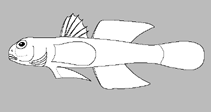 No image available for this species;
drawing shows typical species in Gobiidae.
Images Google
drawing shows typical species in Gobiidae.
Classification / Noms Noms communs | Synonymes | Catalog of Fishes(Genre, Espèce) | ITIS | CoL | WoRMS | Cloffa
> Gobiiformes (Gobies) > Gobiidae (Gobies) > Gobiinae
Etymology: Benthophilus: Greek, benthos = depth of the sea + Greek, phyle, that loves (Ref. 45335).
Eponymy: The binomial means ‘teacher’; the allusion is not explained by Iljin but may well refer to Nikolai Mikhailovich Knipovich (1862–1938), a Caspian Sea biologist and Iljin’s teacher whom Iljin had honoured with the new genus Knipowitschia in the same [...] (Ref. 128868), visit book page.
Etymology: Benthophilus: Greek, benthos = depth of the sea + Greek, phyle, that loves (Ref. 45335).
Eponymy: The binomial means ‘teacher’; the allusion is not explained by Iljin but may well refer to Nikolai Mikhailovich Knipovich (1862–1938), a Caspian Sea biologist and Iljin’s teacher whom Iljin had honoured with the new genus Knipowitschia in the same [...] (Ref. 128868), visit book page.
Environnement : milieu / zone climatique / profondeur / gamme de distribution Écologie
; eau douce; saumâtre démersal. Temperate; 47°N - 36°N, 36°E - 54°E
Distribution Territoires | Zones FAO | Écosystèmes | Occurrences | Carte par point | Introductions | Faunafri
Europe: Sea of Azov.
Taille / Poids / Âge
Description synthétique Clés d'identification | Morphologie | Morphométrie
This species is distinguished from its congeners by the following characters: head tubercles and granules of almost equal size; tubercle on dorsal midline of head behind eye absent; numerous, densely set granules, covering whole body except abdominal are; tubercles in dorsal row 28-30, ventral row 23-25, upper and lower lateral rows more than 20, size small, especially in caudal area, while for the dorsal row, increasing from head to base of dorsal; branched rays in D2 9-11.5, A 8-10.5; body without dark blotches (Ref. 59043).
Body shape (shape guide): elongated.
Body shape (shape guide): elongated.
Stays in the biocoenosis of the estuarine silts (Ref. 2058). Occurs in fresh and slightly brackish waters with salinity below 11 ppt , usually over mud bottom. It lives about a year. Females probably lay eggs in 2-3 portions within or under a molluscs shell and the adults die soon after spawning. Feeds mainly on molluscs, crustaceans and chironomid larvae. (Ref.59043).
Cycle de vie et comportement reproducteur Maturité | Reproduction | Frai | Œufs | Fécondité | Larves
Référence principale
Téléchargez vos références | Références | Coordinateur | Collaborateurs
Coad, B.W., 1998. Systematic biodiversity in the freshwater fishes of Iran. Ital. J. Zool. 65:101-108. (Ref. 31728)
Statut dans la liste rouge de l'IUCN (Ref. 130435: Version 2025-2 (Global))
Préoccupation mineure (LC) ; Date assessed: 17 January 2023
CITES
Not Evaluated
Menace pour l'homme
Harmless
Utilisations par l'homme
FAO - Publication: search | FishSource |
Plus d'informations
Écologie trophique
Aliments (proies)
Composition du régime alimentaire
Consommation alimentaire
Rations alimentaires
Prédateurs
Aliments (proies)
Composition du régime alimentaire
Consommation alimentaire
Rations alimentaires
Prédateurs
Écologie
Écologie
Écologie
Dynamique des populations
Paramètres de croissance
Âges / tailles maximales
Longueur-poids rel.
Rel. longueur-longueur.
Fréquences de longueurs
Conversion de masse
Recrutement
Abondance
Paramètres de croissance
Âges / tailles maximales
Longueur-poids rel.
Rel. longueur-longueur.
Fréquences de longueurs
Conversion de masse
Recrutement
Abondance
Cycle de vie
Reproduction
Maturité
Maturité/épines rel.
Fécondité
Frai
Agrégats de frai
Œufs
Développement de l'œuf
Larves
Dynamique des populations larvaires
Reproduction
Maturité
Maturité/épines rel.
Fécondité
Frai
Agrégats de frai
Œufs
Développement de l'œuf
Larves
Dynamique des populations larvaires
Anatomie
Surface branchiale
Cerveau
Otolithe
Surface branchiale
Cerveau
Otolithe
Physiologie
Composition corporelle
Nutriments
Consommation d'oxygène
Type de natation
Vitesse de nage
Pigments visuels
Son de poisson
Maladies et parasites
Toxicité (CL50)
Composition corporelle
Nutriments
Consommation d'oxygène
Type de natation
Vitesse de nage
Pigments visuels
Son de poisson
Maladies et parasites
Toxicité (CL50)
Génétique
génôme
Génétique
Hétérozygotie
Héritabilité
Diversité génétique
génôme
Génétique
Hétérozygotie
Héritabilité
Diversité génétique
Liées à l'homme
Systèmes d'aquaculture
Profils d'aquaculture
Souches
Cas de ciguatera
Timbres, pièces de monnaie, divers
Systèmes d'aquaculture
Profils d'aquaculture
Souches
Cas de ciguatera
Timbres, pièces de monnaie, divers
Outils
E-book | Guide de terrain | Générateur de fréquences de longueur | Outil de dynamique de population | Carte par point |
Capture-MSY |
Articles particuliers
Télécharger en XML
Sources Internet
AFORO (otoliths) | Aquatic Commons | BHL | Cloffa | Websites from users | FishWatcher | CISTI | Catalog of Fishes: Genre, Espèce | DiscoverLife | ECOTOX | FAO - Publication: search | Faunafri | Fishipedia | Fishtrace | GloBI | Google Books | Google Scholar | Google | IGFA World Record | OneZoom | Open Tree of Life | Otolith Atlas of Taiwan Fishes | PubMed | Reef Life Survey | Socotra Atlas | TreeBase | Arbre de Vie | Wikipedia: aller à, chercher | World Records Freshwater Fishing | Zoobank | Zoological Record
Estimations basées sur des modèles
Indice de diversité phylogénétique (Réf. 82804): PD50 = 0.5000 [Uniqueness, from 0.5 = low to 2.0 = high].
Bayesian length-weight: a=0.00741 (0.00347 - 0.01582), b=3.09 (2.91 - 3.27), in cm total length, based on LWR estimates for this (Sub)family-body shape (Ref. 93245).
Niveau trophique (Réf. 69278): 3.3 ±0.3 se; based on size and trophs of closest relatives
Résilience (Réf. 120179): Haut, temps minimum de doublement de population inférieur à 15 mois (Preliminary K or Fecundity.).